At the beginning of the year, the few open galleries around Dunedin are generally showing stock shows, and an opportunity exists to examine art elsewhere on general public display.
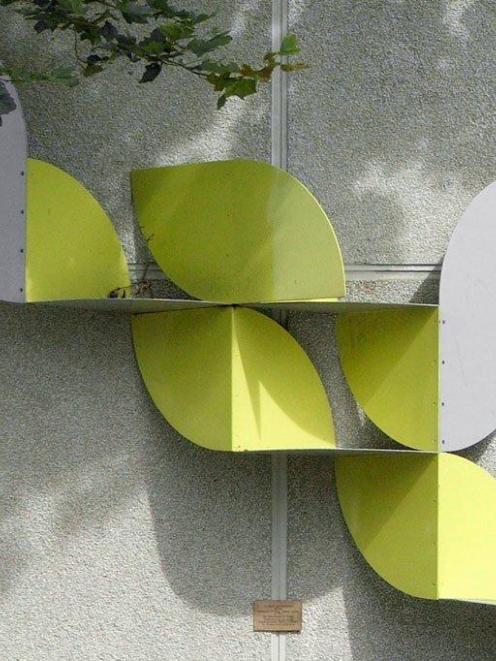
One area of considerable interest is around Dunedin Public Hospital and Medical School. The latter has several sculptural works as part of its buildings or nearby, among them Marte Szirmay's prosaically titled Sculpture, its abstract form created from folded sheets of anodised aluminium.
The work is brutally modernist, an ironic name for a style which now seems dated to many. Yet even a seemingly simple piece like this is capable of surprising. For many years, from its construction in 1975, this piece was at street level, lying on its side. A change to the urban landscape in 2006 saw it hoisted above street level on to a wall of the Medical School.
Whether this location was the artist's original intention or not, it has caused a major transformation in the perception of the piece. The work has more life, as the whole object can now be readily seen at a glance. Its folds now have a dynamic interplay with the corrugated walls of the nearby medical library building, allowing the sculpture to add a pleasing and harmonious aspect to the streetscape.

Located deep within the hospital's main building is its chapel. This haven emanates an air of calm and is highly attractive even to the non-religious.
The sparse elegance of the room is a fine example of the grandly austere modern design which has been widely used in chapels and churches from the end of World War 2 onwards, perhaps best exemplified (on a far grander scale) by the chapels of the new Coventry Cathedral in England.
The chapel is airy and naturally lit, and makes fine use of bare timber both as a soft linear feature and as blinds to baffle and diffuse the light. Focus is thereby drawn away from plainer windows to the pictorial stained glass, especially to a large attractive work by Elizabeth Stevens. The opposing wall of the chapel, both literally and metaphorically, reflects the window's colours with a series of simple yet powerful embroidered works by Gay Eaton and the Otago Embroiderers Guild.
More works of note can be found in and around the chapel, most notably a large cross by Peter Nicholls constructed from Southland beech, brass and steel. Austere, in keeping with its surroundings, this work nevertheless captures the spirit and grace of Christ's crucifixion far more effectively than many more prosaic representations.

It is often forgotten that Dunedin Public Hospital has one of the country's finest institutional art collections. This is in part because the art is scattered throughout many floors and wards rather than being a single concerted display.
One place where a considerable number of works is found, however, is the main corridor connecting the hospital's Great King St and Cumberland St entrances. Here lies a substantial display leading directly to and from the well-known sculptural installations around the main atrium.
The collection was started under the auspices of Prof Alan Clarke in the 1970s, a now seemingly mythical time when hospitals could allow for some discretionary spending. The art advisory committee chose wisely, and the collection has also grown by donations from both artists and grateful patients and their families.
Many fine works are on display (though unfortunately not all well labelled), including several from the cream of New Zealand modern art. Among these, impressive images by Jeffrey Harris and Pat Hanly are notable, as is the massive McCahon-influenced multi-panelled work of Robin White, Seven Hills, which crowns the collection.
It should be kept in mind that the works are within a working environment where art is of secondary importance; as such, the casual viewer should demur to any more urgent uses of the viewing area.
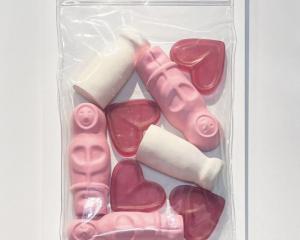
![Untitled (c. mid 1990s, [pink 3]), by Martin Thompson, 415mm×590mm. Photo: courtesy of Brett...](https://www.odt.co.nz/sites/default/files/styles/odt_landscape_small_related_stories/public/story/2024/02/untitled_pink_3.jpg?itok=Q0aQrc9o)