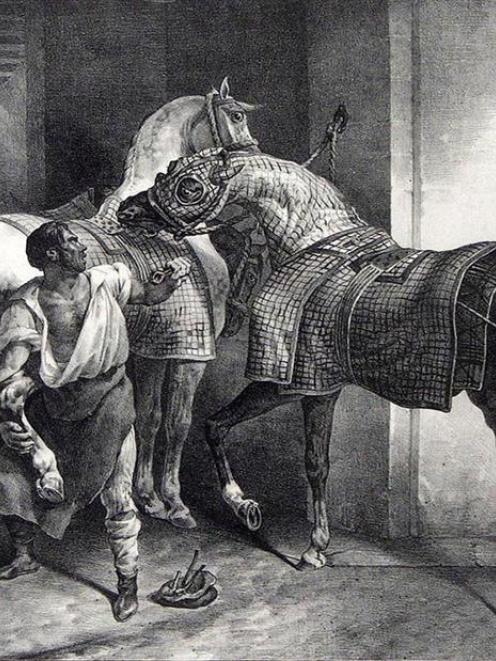
A touring collection illustrating 19th-century French printmaking is a must-see at the Dunedin Public Art Gallery.
The display concentrates on a period during which the print was reclaimed as a major art form, rather than simply a means to create mass-produced commercial work. From the end of the Napoleonic era, lithography, and later etching, were taken up by painters as a means to extend their skills and explore the themes in their work. The influence of overseas printmaking, particularly that of the Orient, also had a profound effect on French printmaking during the period.
The exhibition focuses not only on French artists, but also on artists of other nationalities who came to France to extend their knowledge and reputation. Works presented range from the realist schools to later Impressionist and Post-impressionist pieces.
A list of the artists in this exhibition reads like a roll call of European art history: Renoir, Manet, Pissarro, Lautrec ... but it is the less well-remembered names that provide many of the delights. The wild, sketch-like lines of Jean-Louis Forain's courtroom scene and a delicate riverscape by Felix Bracquemond in particular caught my eye, though to limit mention of individual works to two is to unfairly neglect the many other works that make this exhibition well worth a visit.

It's often a little off-putting to consider an exhibition primarily on the basis of its whimsicality, but whimsy is nicely evoked by many of The Artist's Room's artists. As such, the gallery has presented exhibitions of whimsical work on a regular basis, and the latest collection hits the right mark on the tightrope between the serious and the silly.
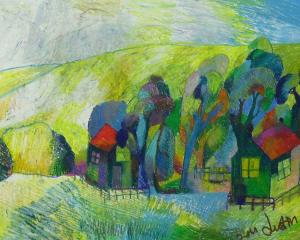
There is also a good balance between the styles of the different artists involved in the exhibition. The almost religious icon-like smoothness of Emma Butler's large, calming works is counterpointed by Sharon Singer's free brushstrokes, her violently green New Zealand scenes threatening to dominate the gallery. Similarly, Crispin Korschen's wispy ethereal introspections are met by the solid, cartoon-like humour of Tony Cribb's Tin man.
Dotted around the gallery, bringing light-hearted relief with their own eccentric nature, are ceramic works by Cheryl Oliver and Helen Back. Both sets of figures become characters in an outlandish circus, puncturing whatever remaining sobriety there may be in the gallery space. Back's large grotesques seem poised as slightly sinister yet delightful ringmasters, ready to guide the viewer from one strange sight to the next. Oliver's charmingly oddball figures are the clowns, travelling along in their absurd yet somehow perfectly appropriate vehicles.

Dedication, desperation, desolation. These words capture the essence of a relationship through its phases from happiness through break-up to loss. This narrative is detailed by Jeffrey Harris in his ''Melbourne drawings'', displayed in the Dunedin Public Art Gallery.
The works date from the mid-1980s, when Harris had taken up residency at the Victorian College of Arts. There, his art practice expanded from its roots, both in terms of his sources of inspiration and in terms of his artistic surroundings. Some of the new influences which inspired Harris are evident in these drawings, but the emotional heart of them is very much the artist's own, to the point where we view the destruction of the relationship depicted with a voyeuristic unease.
The narrative flow of these works is strong. The images become moments, 32 stations of the star-crossed, flowing from the busy, socially active early days to the broader strokes of two figures at odds, before moving to the existential angst of the lone figure against a bleak skyline, and the finality of empty desolation. The lines become darker, thicker, bold even by Harris' usual dramatic standard, as the protagonist moves though his own wasteland. Here we see the artist in total control of his medium as a means of exorcising the soul.
![Untitled (c. mid 1990s, [pink 3]), by Martin Thompson, 415mm×590mm. Photo: courtesy of Brett...](https://www.odt.co.nz/sites/default/files/styles/odt_landscape_small_related_stories/public/story/2024/02/untitled_pink_3.jpg?itok=Q0aQrc9o)