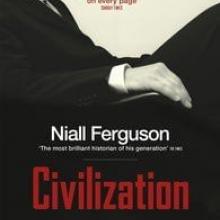
In this book, Ferguson takes on the question: why did a comparatively small number of nations at the western end of the Eurasian landmass (for example, Germany, France, Britain and the United States) come to dominate modern civilisation as we know it?
His answer lies in the West's comparatively better use of what he calls "the six killer apps" of modernity: competition, science, property rights, medicine, the consumer society, and the work ethic.
He asks these questions within the context of the recent rise of China. The most interesting part of this book outlines how China has been an ascendant power once before, during the period 1400-1800.
Ferguson's basic argument is that China did not become a leading power until fairly recently, despite having invented such nascent technology as printing presses and gunpowder, because its rulers chose to isolate themselves from the West until the post-Mao era.
He compares China to its ancient neighbour and rival Japan, which while being similarly slow in opening up to the West, tended to embrace Western technology and economic principles much faster than the Chinese did after the mid-1800s. This book clearly illustrates how the Japanese adapted many Western ideas, including imperialism, with such successful (and even devastating) effect.
Indeed, Ferguson's thesis centres on the idea that wherever Western ideas and ideals have been applied, considerable economic, social, political and cultural progress has followed.
This Western-centric thesis underpins the book and brings its many strands together. This is how Ferguson takes the reader from discussing how poor weapons technology failed the Ottoman Turks in their siege of Vienna in one part of the book to how medicine improved the health of colonial Africans in another.
In Ferguson's view, these and other political and historical events have all contributed to Western dominance.
At a personal level, I disagree with Ferguson's neo-liberal tendencies.
Also, Ferguson minimises the role that other civilisations have played in contributing to Western progress - after all, the Chinese, Indians and Arabs played significant roles in developing modern numeracy and mathematics.
What Ferguson does well, however, is the melding of a massive amount of research gathered from the four corners of the world into one book. In the preface, he mentions that this book supports another television documentary series from him.
I hope we do get to see the Civilization series on our screens. To make sense of it all, I would strongly suggest reading this book first.
And regardless of whether you agree with Ferguson's synopsis or not, this book makes a good read for those prepared to be chronologically transported back and forth by his tour de force style.
• Chris Ford is a writer, political commentator and blogger from Dunedin.