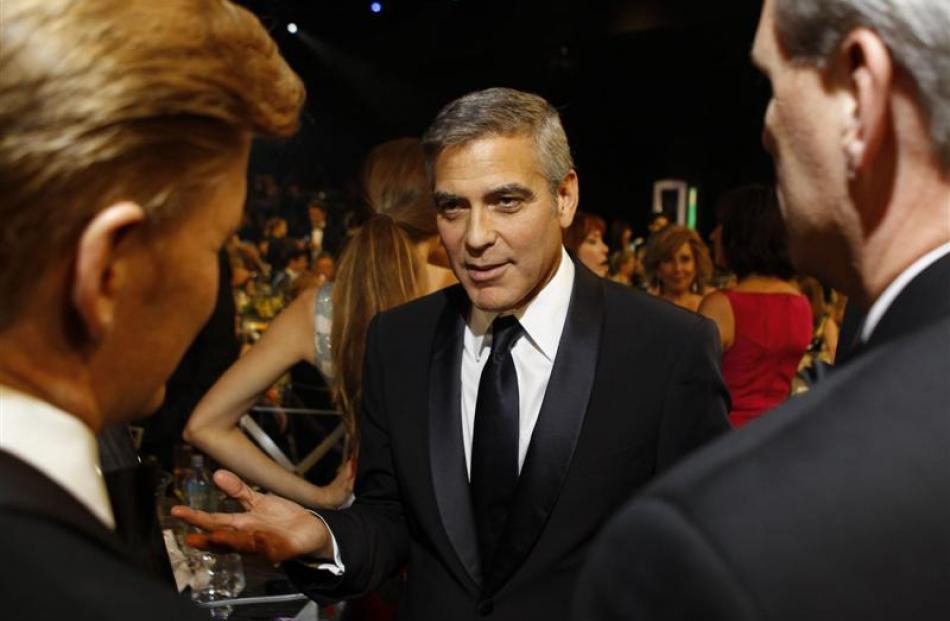
The Ides of March offers George Clooney an opportunity to meld his professional interests and his political ideals, writes John Horn, of the Los Angeles Times.
The Dow Jones industrial average was plummeting and President Obama was on the air, seeking to calm the nation and the markets.
Inside the Studio City offices of his production company Smoke House, George Clooney searched the TV screen, looking for the charismatic senator the actor had supported in the 2008 election.
But Obama this particular morning looked defensive and a bit gassed; life in the White House, it seemed, was grinding him down.
"I think he's getting beat around," Clooney said, the way a Little League dad might cheer on a son struggling on the pitching mound. "He should go after the S&P for the credit downgrade."
For better and often for worse, actors have dabbled in politics and causes, but few have shown the kind of sustained and informed interest and commitment - on- and off-screen - that Clooney has.
In his new film, The Ides of March, Clooney plays a liberal presidential candidate. As a director, he previously celebrated the power of a journalist crusading against McCarthyism in Good Night, and Good Luck, and as an executive producer he explored the corrosive influence of lobbyists and spinmeisters in the HBO series K Street. He also had a front-row seat for his father's 2004 US House campaign in Kentucky, which ended in disappointment.
The 50-year-old actor has travelled internationally to promote his Sudanese human rights effort, the Satellite Sentinel Project. He's addressed the United Nations about Darfur and co-founded an aid organisation, Not on Our Watch.
He's been asked numerous times about running for office himself. But even with his intricate understanding of political tactics and rhetoric (or perhaps precisely because of that knowledge), Clooney said he would rather play a candidate than be one.
"I don't wake up in the morning and say, 'I wish I had President Obama's job'," Clooney said. "Every two years, somebody tries to bring my name up and talk about politics in the real world - 'You should run for governor!'," he added.
"I'm not getting in politics. I have no interest in politics - because of the compromises you have to make. I don't have to make those kind of compromises when I get to go to the Sudan or Darfur. I get to come back and sit down in front of the Security Council at the United Nations and say, 'This is right, and this is wrong. Now how you deal with it, I don't know, but this is right and this is wrong'."
Still, Ides of March, loosely adapted from Beau Willimon's off-Broadway play Farragut North, offers a particularly ripe opportunity for Clooney to meld his professional interests and his political ideals.
On one hand, the political thriller is a vehicle for Clooney (who directed and co-wrote the movie) and longtime writing and producing partner Grant Heslov to fulfil their wishful thinking about how a stand-up Democrat could walk and talk. But it also takes a hard look at the personal price of politics and its inevitable betrayals and compromises. The film's ultimately pessimistic take may surprise some, given that it comes from a hopeful liberal such as Clooney.
Clooney's Governor Mike Morris is poised to take the Democratic nomination with a platform so uncompromisingly left-leaning it might make Fox News commentators burst into flames. He opposes the death penalty, foreign military intervention and even internal combustion engines and supports gay marriage, mandatory national volunteer service and higher taxes for the richest Americans.
Amid the critical Ohio primary, the governor's campaign team, led by Paul Zara (Philip Seymour Hoffman) and underling Stephen Myers (Ryan Gosling), must fend off the cut-throat tactics of Tom Duffy (Paul Giamatti), who's calling the shots for the governor's hard-charging opponent, Senator Pullman.
Drawn into a relationship with the sexually assertive and well-connected campaign intern Molly Stearns (Evan Rachel Wood) and confronted by a secret that the governor has harboured, Stephen is forced to make a momentous decision about his loyalties, his ambition and, most important, his principles.
Clooney and Heslov had planned to put the film into production around the time of Obama's election but postponed the project, because it was "too cynical" and clashed with the nation's ebullient mood.
By the time the healthcare debate had fractured any sense of bipartisanship less than a year after the election, Ides of March didn't seem so ill-timed after all.
The Ides of March narrative is laced with references that will please political junkies, many drawn from recent presidential contests. At one point in Ides of March, right-wing pundits encourage Republicans to support the governor's Democratic primary rival, Pullman, because he would be easier to defeat in the general election. (Rush Limbaugh advocated a similar course of action during the 2008 primary, encouraging his listeners to back Senator Hillary Rodham Clinton in an effort he dubbed "Operation Chaos".)
Clooney and Heslov believe the first half of Ides of March will be appreciated by Democrats - finally, a candidate we can believe in - and the second half will be loved by Republicans - well, he's just as much a fraud as every other lefty.
If real-life Democrats end up taking inspiration from the Mike Morris character and his stump speeches, Clooney will hardly be upset. On climate change and oil, for instance, the governor proposes that the United States do away with the internal combustion engine.
"If we're cut off from oil, we will find a way to power our cars. So say it and make it happen," Clooney said.
"It's not ridiculous. It is possible. And these are the kind of leadership things I would love to see and could be argued about. People will say, 'It's just actors.' But I truly believe it."
Asked about his character's views about taxation, Clooney grows more animated.
"This is the one I think should be used by the Democrats," he said, leaning forward in his chair.
"Every time you say the richest people in America don't pay their fair share, that is just simply the truth. And yet when you ask them to, everyone said it's 'socialism' or 'the redistribution of wealth.' And you'll hear it over and over again. 'Are you for the redistribution of wealth?' And every Democrat goes, 'No, no, no, no, no' - because they know it's code for socialism.
"To me, that's why the Democrats are so bad at this game. They're always back on their heels. They're always playing defence. I would start with an offence, and I would run on this as a candidate. 'My campaign, my administration, is vehemently against the distribution of wealth by the Government to the richest Americans. I'm not going to play your game of, 'Are you for the redistribution of wealth?'
"I want to go to these guys and say, 'Are you for distributing wealth by the government to the richest Americans?' Straight aggression - not this wimpy stuff. Democrats have always been really bad at that kind of version of politics. I say, 'Get up, stand up.'
"Those are the kind of arguments we have in this film," Clooney said. "And we balance it by saying, 'It doesn't mean this guy isn't going to screw up'."
If Ides of March upsets some moviegoers, Heslov and Clooney say they would be pleased.
"We didn't want to make this a civics lesson," Clooney said. "We wanted to make a movie that scares people. Not scares them politically but scares them this way - 'Oh, my God. What's going to happen to him? What's going to happen to her?'."