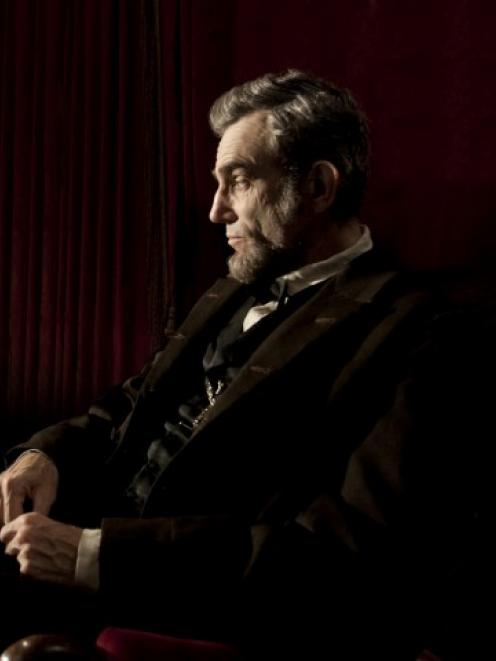
By the time production began on Steven Spielberg's movie "Lincoln", the British-Irish actor was so immersed in the character he was even texting co-stars as America's Civil War president.
"I knew nothing about him," Day-Lewis, 55, told reporters ahead of the November 9 release of "Lincoln".
"I had everything to learn and apart from a few images, a statue ... a few lines from the first inaugural, a few from the Gettysburg address, that would be my entire knowledge of that man's life," he added.
The double Oscar winner admitted he was hesitant in taking on the role of Lincoln, saying he did not want to "be responsible for irrevocably staining the reputation of the greatest president this country's ever known."
Despite his doubts, Day-Lewis is already being hailed as a certain Oscar nominee for his work on the movie, which could add to his best actor Oscar haul for his greedy turn-of-the-century oil baron in "There Will be Blood" (2007) and his role as a quadriplegic writer in the 1989 film "My Left Foot".
Entertainment website Cinema Blend called his performance "faultless and surprisingly restrained," while Indiewire writes that "the motivating force of 'Lincoln' belongs to its leading man, whose screen presence is a wonder to behold even when he says nothing".
British born Day-Lewis is known for exhaustive preparation and for throwing himself completely in his roles, even when the cameras are not rolling.
"Lincoln" was no exception.
Sally Field, who plays Mary Todd Lincoln, recalled how the man who would play her on-screen husband had texted her "totally in character" over a seven-month period prior to shooting the movie.
"(It) was difficult because you had to figure out how to say what you wanted to say within the vernacular of the time," Field told reporters.
The film centres around the last few months of Lincoln's life. The Civil War is still raging and the president is fighting factions within his own cabinet, as well as political factions in Congress, to pass the Thirteenth Amendment to the US Constitution that abolished slavery.
While efforts to pass the Thirteenth Amendment in late 1864 and early 1865 take centre stage in the film, it also delves into Lincoln's life at home with his wife and sons Robert (Joseph Gordon-Levitt) and Tad (Gulliver McGrath).
Spielberg said the film was never intended to be a biography of Lincoln.
"We needed to focus it in on a working president and a father and a husband," Spielberg explained.
"You couldn't do that if it was the greatest hits of Abraham Lincoln. We would have been dilettantes as filmmakers and as actors. We would have been hitting all the high points and just giving you the headlines and not giving you any sense of the depth of this character, this man," he added.
Gordon-Levitt said he didn't get to know Day-Lewis until after production wrapped, despite the numerous scenes they shared.
"I never met Daniel in person," he said. "I only ever met the president, only ever heard the president's voice. I called him sir, he called me Robert."
After the last day of shooting, the cast went out in the evening to celebrate "and that was the first time I personally met Daniel," said Gordon-Levitt.
"He showed up in jeans and a T-shirt and had a completely different voice and posture," said the actor. "He was like one of my friends -- you know this kind of cool, artist guy, having a Guinness and just laughing and having a great time."