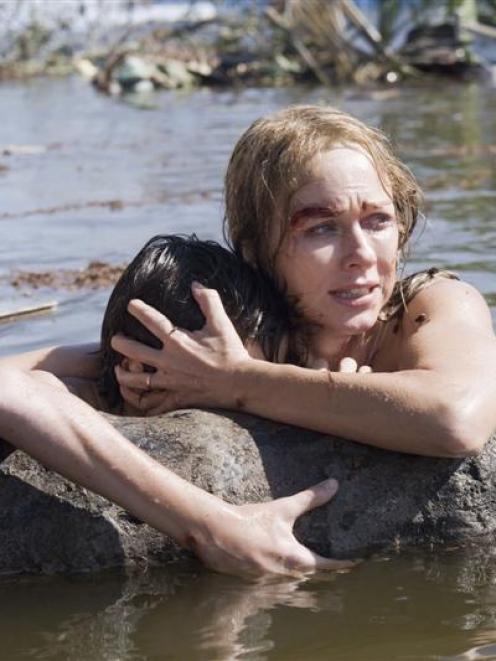
The tsunami sequence in the new film The Impossible is so terrifying in its intensity that you might believe you are watching actual documentary footage of the natural disaster that struck Southeast Asia on December 26, 2004, killing hundreds of thousands.
The verisimilitude is the result of more than a year's work of exacting planning - and experimentation - by director Juan Antonio Bayona and his visual- and special-effects supervisors, who used a giant water tank in Spain (the largest in Europe), a sprawling miniature of a beach resort, on-location shots in Thailand and some computer wizardry to create the 10 minutes of terror.
The Impossible, a drama of faith and bravery based on the real-life experience of a Spanish family, stars Naomi Watts and Ewan McGregor. They play a husband and wife, Maria and Henry, who are on vacation with their three sons in Phuket, Thailand, when the tsunami hits their hotel.
''The whole film was about a true story,'' Bayona said, ''so it had to feel very real.''
Bayona began storyboarding the sequence two years before filming began. He enlisted visual-effects supervisor Felix Berges and special-effects supervisor Pau Costa, who were involved in the project for more than a year.
To prepare, Berges travelled several times to Thailand, but because almost everything had been rebuilt since the disaster - including the resort where the Spanish family stayed - he found images and footage of the actual tsunami to be more helpful in his design of the effects.
He spent hours upon hours watching footage of the disaster.
''Everybody has an idea of the tsunami of being a big wave,'' he said.
''It is not a big wave. It is a huge amount of water that comes to land.''
Though the team studied other films and found what Berges called ''some very good examples of CGI water,'' they decided to use the real thing for The Impossible.
''I was almost 14 months on the project, because we never had done anything like this [in Spain], so we really had a lot of tests,'' said Costa.
The production team worked with a specially built channel in an outdoor tank - measuring roughly 120m by 80m - at the Ciudad de la Luz studios in Alicante, Spain. There, they spent a month shooting scenes of the wave, the flood and Maria and her son Lucas being carried by the wave and lashed by felled trees and other debris. The scenes of Watts being submerged were shot in a small tank, with the actress sitting in a moving chair to which a camera had been fixed.
The production tapped Edinburgh Designs Limited, which specialises in wave generators and equipment for marine and coastal engineering labs, to help the film-makers figure out how to make the wave in the channel, Costa said. Then he and his team worked on modifying the design to allow the doors of the channel to open quickly for retakes.
''We started off with a test with like six submergible pumps to try to get the current,'' Costa said.
''We ended up with 33 submergible pumps, and each pump weighed like 600kg.''
Each pumped about 300 litres per second. Four large generators supplied power to the pumps, which had to be adapted for the tank because they could not be visible on camera.
The actors would sit in carts that moved on two rails inside the channel, and they were pulled by steel cables at the same speed as the current, Costa said.
''They were very protected. They were sitting in the baskets with their arms and legs sticking out, and we would pull the camera next to them and behind them.''
Bayona said millions of gallons of sea water were used for the sequence. The water was treated with food colouring to darken it.
To film the tsunami obliterating the resort, the German company Magicon GMBH constructed a large miniature on a scale of one to three of the resort's recreation area. The production had only one chance to get the shot because only one miniature had been built. Director of photography Oscar Faura used an apparatus with 10 cameras to make sure he could capture it all.
The miniature was of only the centre of the hotel; everything surrounding it, such as the bungalows, larger palm trees and other debris, was generated using computers, Berges said. Some water was also added digitally.
The production shot many scenes at the actual locations in Thailand where the Spanish family experienced the disaster, including the Orchid Resort. The resort had been rebuilt and was about to reopen when the filming began. But the resort did not exactly look the same as in 2004; for example, laws enacted since the tsunami forbid the construction of bungalows on the beach. So production designer Eugenio Caballero built facades of six bungalows, redesigned the garden area of the resort and expanded the pool.
Bayona described digitally combining the on-location footage with the footage filmed in the tank as ''kind of a puzzle. ... We were working for months on every shot. Every shot could have tons of layers.''
Capturing the right sound for the 10-minute tsunami sequence was critical. Bayona wanted supervising sound editor Oriol Tarrago to create a sound design that would not have any music. After many experiments, Tarrago came up with the concept of having a different sound for each shot of the tsunami sequence.
''Every shot has a different point of view, so I tried the idea of making a contrast between every shot, like high and low frequencies and volumes,'' he said.
''We collected different sounds from waterfalls and underwater recordings.''
Conversations with Maria Belon, the Spanish woman played by Watts, helped inform Tarrago's choices.
''Maria was telling us she didn't know what was going on [as the tsunami approached],'' said Tarrago.
''She thought that a plane was flying really low. So we recorded a lot of planes here in Barcelona.''
Tarrago also used ''sounds like a far-off plane flying when the water is coming to the resort. We also used the vibration sounds of glass and animals running and birds flying because they could feel what was going on.''
Belon, Bayona says, was ''very impressed'' with the sequence when the water comes in.
''But she was really shocked with the sequence where you see her underwater, because for her that was the perfect metaphor of what was life, how you cannot control your destiny,'' he said.
''You are only dragged by the current.''