Carlos Riegelhaupt and Lisa Nyman-Ambrose show how to make two Argentinian Christmas favourites: vitel tone (beef in tuna sauce) and borrachitos (sweet pastry puffs).

Carlos says vitel toné (beef in tuna sauce) is a typical dish served at Christmas in Argentina. It was originally an Italian dish, vitello tonnato, and was brought to Argentina with an influx of Italian immigrants at the end of the 19th century.
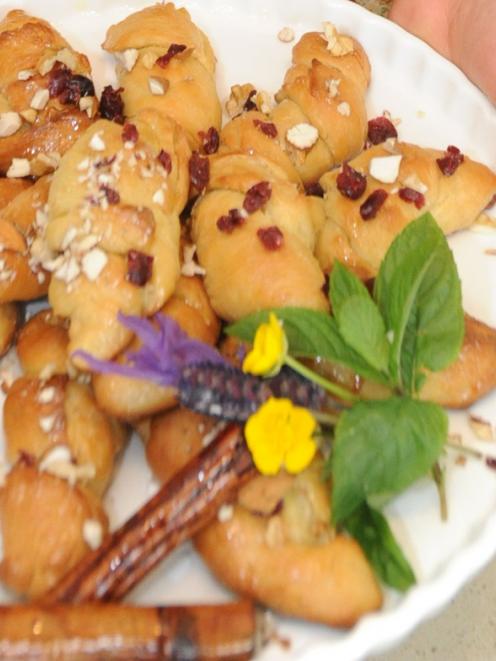
Lisa first came across borrachitos at a bus station in Argentina and whenever she was short of cash during her travels, she'd bake a large batch and sell them in the streets.
''Borrachitos'' means ''little drunk''.
Vitel toné

One round steak or half a sirloin, trimmed of fat
thyme, rosemary, salt and freshly ground black pepper
2 onions, roughly chopped
4-5 cloves garlic, crushed but not necessarily peeled
2 carrots, roughly chopped
½ bunch celery, roughly chopped (or any other vegetables that you have, such as potatoes, other root vegetables or leeks)
For the sauce
3 cloves garlic, peeled and finely chopped
juice of one lemon
2 free-range egg yolks
about 150ml rice bran oil or a mix of ¼ extra virgin and ¾ rice bran oils
¼ cup capers, drained
1 can (210g) sustainably caught tuna, drained
1 tsp vinegar (or to taste)
Method
Trim any fat or connective tissue from the meat and season it well with salt and freshly ground black pepper.
Heat a little oil in a frying pan, and wipe sprigs of thyme and rosemary around in it to infuse their flavours. Don't allow the herbs to burn. Remove when the fragrance has risen.
Place the meat in the hot pan and allow to brown on each side for about 1 to 3 minutes. Don't keep turning it. You want to seal the outside to trap the juices.
Meanwhile, chop the vegetables roughly and put in a deep roasting pan. When the meat is browned on all sides, place it on top of the vegetables. Rinse the frying pan with boiling water to collect the flavoursome brown bits and tip over the vegetables. Add more water until nearly to the top of the vegetables. Cover the pan with tinfoil or a tight-fitting lid and put in an oven at 180degC to braise for about 30 minutes.
While it is cooking, make the sauce.
First, make an aioli. Use either a stick blender in a tall container, or a processor or blender. You can also use a bowl and a whisk but this takes a long time.
Peel and slice the garlic, and add with the egg yolks and lemon juice to the blender bowl. Blend, dribbling in the oil slowly until the sauce thickens and becomes pale yellow. If it goes in too fast, it will split. This is aioli. You don't want it too thick, as you'll be adding stock from the cooked meat.
To check the meat is cooked, poke it to see if it's still slightly pink inside. Carlos and Lisa like it pink, but you can cook it to your liking. When the meat is ready, remove it to a plate to rest and cool.
To finish the sauce, add the drained capers and tuna, along with a couple of ladles full of the stock from under the meat. Blend until the consistency of thick cream.
To serve, slice the meat thinly and lay the slices on a plate. Spread the sauce over the meat. Garnish with more capers.
Carlos likes to use flowers as decoration but warns that anything that goes on a plate should be edible, so choose edible flowers.
Tips
• You can use wine instead of hot water to deglaze the browning pan if you wish.
• Braising meat, searing it then cooking it in a covered dish in a little liquid keeps it moist and tender.
• To get the juice out of a lemon efficiently, press and roll it on the bench before cutting it. This breaks the inner membranes and allows the juice to flow easily.
• The sauce base is aioli (without the garlic, this is mayonnaise).
It's quick and easy to make.
You could use a bought version, but he says it won't be so good.
• If you are making your own mayonnaise or aioli, you need to use free-range egg yolks, or even a whole egg. Caged eggs won't be any good, Carlos warns.
• You can serve the vegetables with the meat if you wish.
• Use the rest of the stock to make soup, as it has lots of flavour.
Borrachitos with a Kiwi twist
2 sachets (7g) dried yeast dissolved in 1-2 Tbsp tepid water
170g butter, softened
300g plain flour
1 tsp salt
50g sugar
4 eggs
For the syrup
1 cup water
250g sugar
cinnamon sticks, lemon peel and juice, lavender flowers or other flavouring
For Christmas decoration
chopped nuts and cranberries or crystallised ginger
Method
Sprinkle the yeast on the warm water and stir to mi.. Leave for 10 minutes or so until it begins to bubble, indicating that the yeast is working.
Cut the butter into pieces and put in a metal bowl over boiling water until just melted. You don't want it to get hot.
Mix the flour, salt and sugar in a bowl. Mix the eggs into the melted butter and add with the yeast mixture to the dry ingredients. Stir to mix, then bring the dough together with your hands and knead gently.
It should be a soft dough so add more warm water or more flour as needed.
Dampen a cloth with hot water, wring out and cover the bowl with the dough in it. Leave to rise, preferably for half a day or in the fridge overnight, but if you are in a hurry, an hour in a warm place will do.
When the dough has risen, sprinkle a little flour on a board. Turn out the dough and knead, folding the edges towards the middle, pressing down and turning.
Roll walnut or egg-sized pieces of dough into long sausage shapes, then wrap them round your fingers into a huhu grub shape - or any other shape you like. Place them on an oven sheet lined with baking paper or an oiled and floured baking sheet. Leave to rest and rise for half to one hour.
If you put a small bowl or pan of water in the bottom of the oven before you bake any bread, the moist atmosphere and steam will keep it soft. You want a soft crust for these.
Bake at 180degC for 15-20 minutes, or until lightly browned.
To make the syrup, put the water, sugar and flavouring in a saucepan and bring to a simmer. Cook slowly while the borrachitos bake. When the brioches are cooked, put them in the simmering syrup a couple at a time and allow to soak for a minute or two, then remove and allow to drain.
It's not traditional, but Lisa likes to make her borrachitos Christmassy by sprinkling them with chopped nuts and cranberries.
Tips
• In Argentina, borrachitos are usually shaped like croissants, but Lisa likes to shape hers like huhu grubs for a New Zealand twist.
• The borrachitos will rise, so make them small to start with.
• Lisa moistens the oven sheet to help hold the baking paper in place.
• This dough, without the syrup, makes lovely brioche buns.
• You can actually use bought croissants to make borrachitos. Just put them in the syrup, but home-made ones taste best.
• Borrachitos will cook well at a hotter temperature, about 220degC, but for a shorter time, Lisa says.
• Sometimes she puts chocolate (a dry ganache) in the centre of her borrachitos and soaks them in coffee syrup.
• Thanks to Afife Harris and Centre City New World.