

Diana Noonan visits the Istrian Coast, a small but perfectly formed little-known piece of paradise.
There is little more depressing for a traveller than an Italian bus station on a wet Sunday morning.
Unless, of course, it happens to be Easter Sunday morning - no staff, buses, heating, timetables, or helpful information of any sort. And there is the discouraging certainty that any one of these small comforts is unlikely to appear within the next few days.
So I am sure you will understand when I say it was an angel who plucked me, dripping wet, from the on-ramp to a virtually traffic-less motorway where I had been reduced to hitchhiking, and carried me out of Italy and across the border to the gloriously live and sunny Istrian Coast of Slovenia.
Being only vaguely aware of the existence of Slovenia, and having never heard of the Istrian Coast until finding a last-minute home-exchange there, it was a complete surprise to be set down in what is, quite simply, a paradise.
Sandwiched between Croatia and Italy, and forming Slovenia's only section of coastline, this 12km-long stretch of Adriatic sits prettily in a country influenced strongly by Italian culture but which also describes itself, quite accurately, as being a cross between the best of Switzerland and Austria.
Lacking the, sometimes, overly zealous orderliness of Austria (you will never find a Slovenian vigorously sweeping the road beyond their verge) and considerably less costly than Switzerland, the Istrian Coast is nevertheless highly developed with kilometres of sealed promenades, ritzy seafront cafes and restaurants, spas and health centres, casinos (discreetly positioned a short distance back from the ocean), elegant old Austrian-style hotels, and manicured beaches. It is only the equidistant positioning of its rows of rental sun loungers and uniformly matching umbrellas that arouse any thoughts of Slovenia's communist past.
Ritzy though the Istrian Coast may be, its parks and gardens, cycleways, fishing spots, and coastal walking trails meandering through olive groves and hillside vineyards mean that it is also family-friendly, and its affordable hostels and small hotels make it entirely accessible to the less-well-heeled traveller.
With a delightfully Mediterranean feel, except perhaps on the odd day when a chilly wind is blowing off the sea, it is no wonder that this efficient, welcoming, trilingual country (along with Italian, English is spoken everywhere), which was once the founding member of the Federated Republic of Yugoslavia, in 2007 became the first ex-communist nation to enter the euro zone.
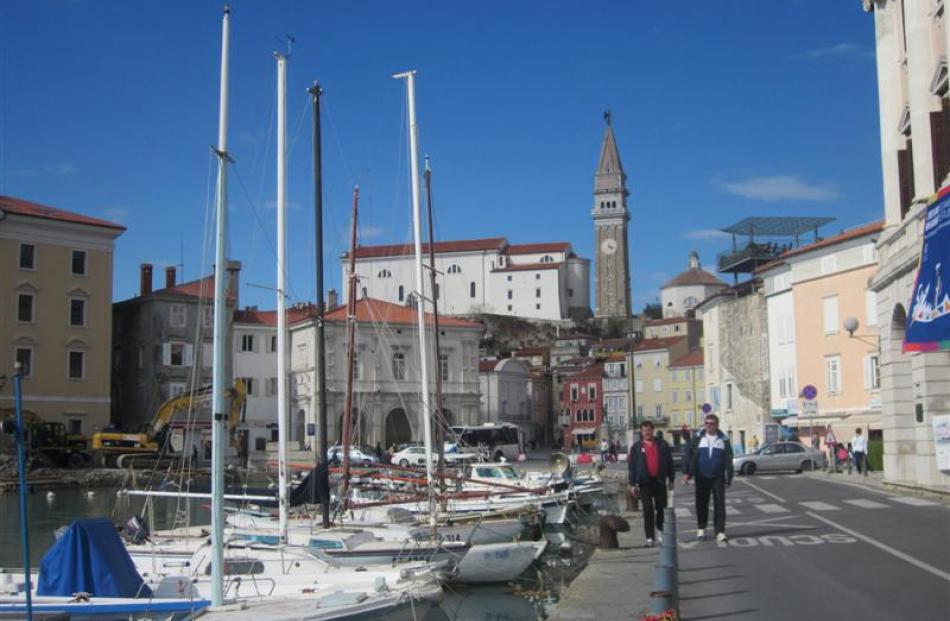
The Istrian Coast is also steeped in history, and Piran is the jewel in its crown.
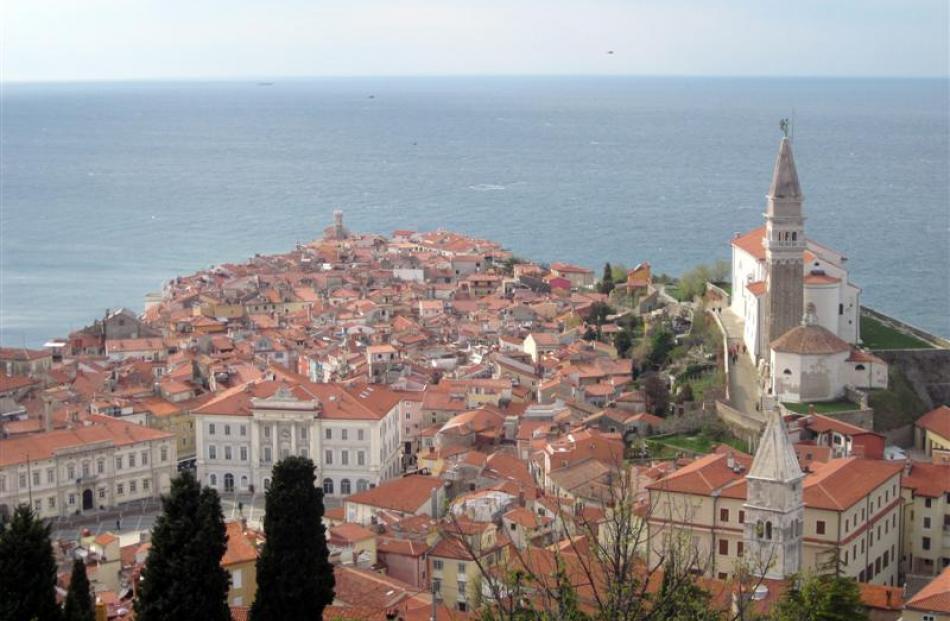
A walled "city" of compact houses and mediaeval architecture, this town of 4000 inhabitants juts into the Adriatic like the prow of a ship, with the Punta Madonna lighthouse as its figurehead.
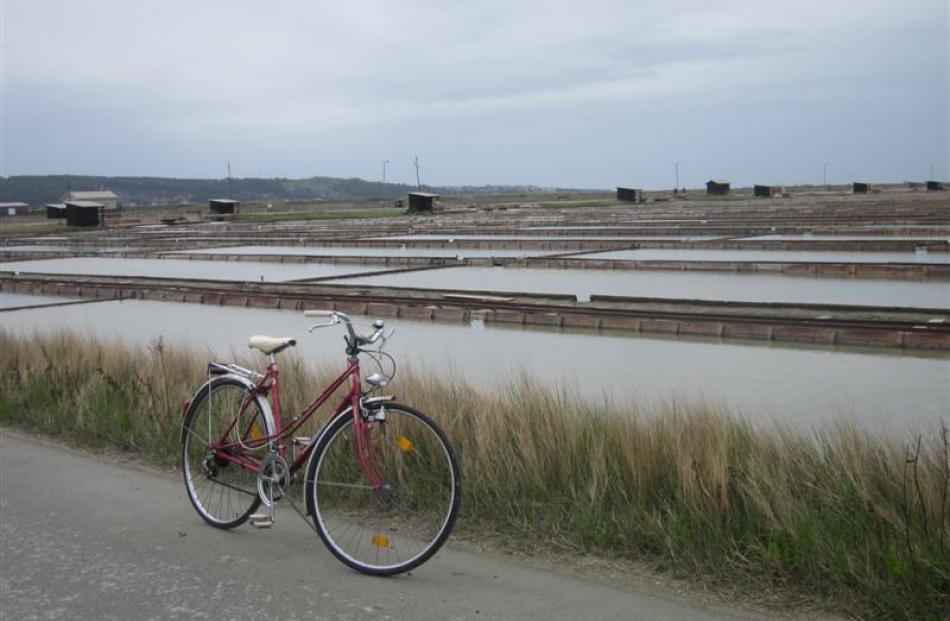
Cobbled lanes lead from the edge of the sea, past open-air produce markets, stone shops, and myriad churches, to the defensive ramparts overlooking the city. From these heights it is possible to gaze east, along the coast, toward the vast area of salt pans which now constitutes the Sečovlje Salina Nature Park.
With its miniature paddy fields of evaporating sea water and mounds of drying salt, the region was once the lifeblood of Piran, and the salt pans now exist as a working museum and home to rare and endangered plants and animals. With its neighbouring wetlands a haven for migrating birds, the region iregarded as having international environmental importance, and is a favourite destination for bird-watchers.
But history, beauty, wildlife, and holidaying potential aside, it is the Slovenians' sheer love of the outdoors that dominates the Istrian Coast. This is a region where footpaths are wider than roads, where you are more likely to be run down by a jogger than a car, and where vehicles of every description slow for a cyclist spotted half a kilometre ahead.
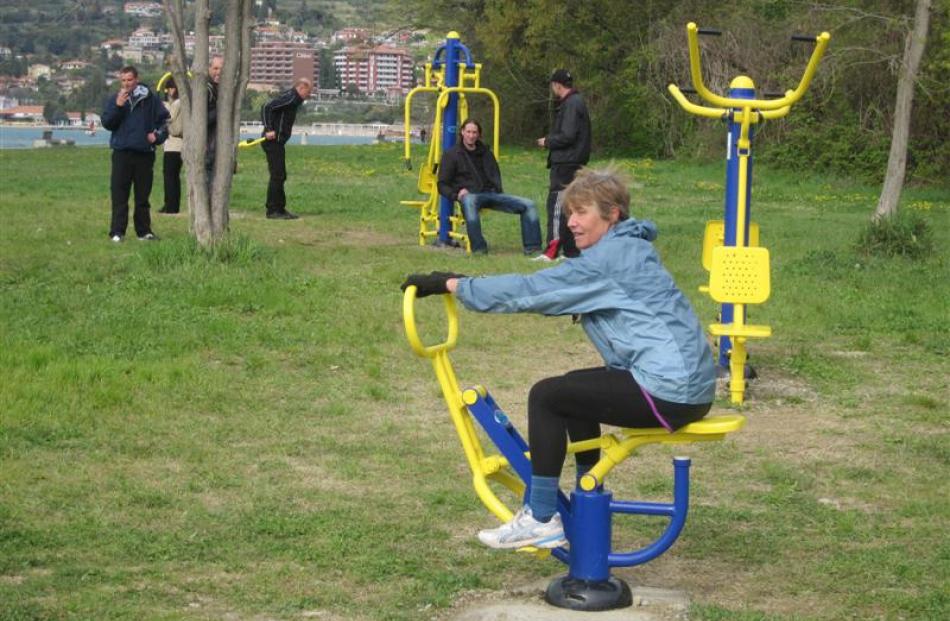
The day I arrived, on a public holiday, the coastal promenades were alive with pram-pushers, walkers, skateboarders, skaters, runners, joggers, cyclists (old and young), folk fishing from the wharf, entire families enjoying a full range of outdoor gym equipment permanently stationed in a seaside park, and even a few hardy swimmers. Beyond the waves, yachts bobbed and bounced beside life-boat rowing teams, surf-sailors, and kite-surfers, all plying the choppy seas. Every Slovenian was a trim and fit Slovenian who appeared to take it for granted that they had more right to the open spaces than anything with a motor - and the spectacle continued long after the Easter holiday period had concluded.
Later in my stay, I joined some Piran locals on a 10km run to honour the 300th birthday of their town's venerated composer, Tartini, whose statue holds pride of place in the square and whose house stands a little way off. So delighted were the organisers to have a
New Zealander register for the race that I was showered with prizes not actually earned through a race placing.
Given that it has everything to offer as a holiday destination, the Istrian Coast of Slovenia can only become busier.
Go there, in any season. In fact, go anywhere in Slovenia, as soon as you can. Just be sure to pack your Leki-poles - and perhaps your own sun umbrella.
If you go
How to get there
Fly into one of the closest internationalairports (Trieste, in Italy, or Slovenian's capital, Ljubljana, about an hour away).
Or, if first visiting somewhere such as Dubrovnik, consider a bus ride along the highly scenic coastal route from there (allow 1-2 days).
Places to stay
There are no shortages of hotels, but if you're looking for something less pricey, go for Hotel Garni or the Val Hostel. Owned by the same family, they're great value and just a stone's throw from the sea.
Email: hostel.val@siol.net.
For a longer-term stay, consider one of the many apartments available in the town.
Eating in Piran
Numerous gelato bars operate along the seafront - stop by at at least one of them (daily!). Cafe Neptun (at the entrance to the town) does a great espresso. For fresh, locally produced food, visit the open-air market in the mornings. It's situated out of sight, just behind the main square (buy your bread at the bakery opposite while you're there).
Things to do
Ask at the excellent tourist office in Tartini Square for their self-guided walk brochures, and spend the day moseying around town. Allow a half-day to visit
the salt pans and museum at the Sečovlje Salina Nature Park. Buses run regularly but you might like to consider hiring a bike and pedalling there - it's flat all the
way.