The absence of light is not necessarily the only thing that can keep one in the dark on a mine visit, former ODT reporter Marjorie Cook discovers.
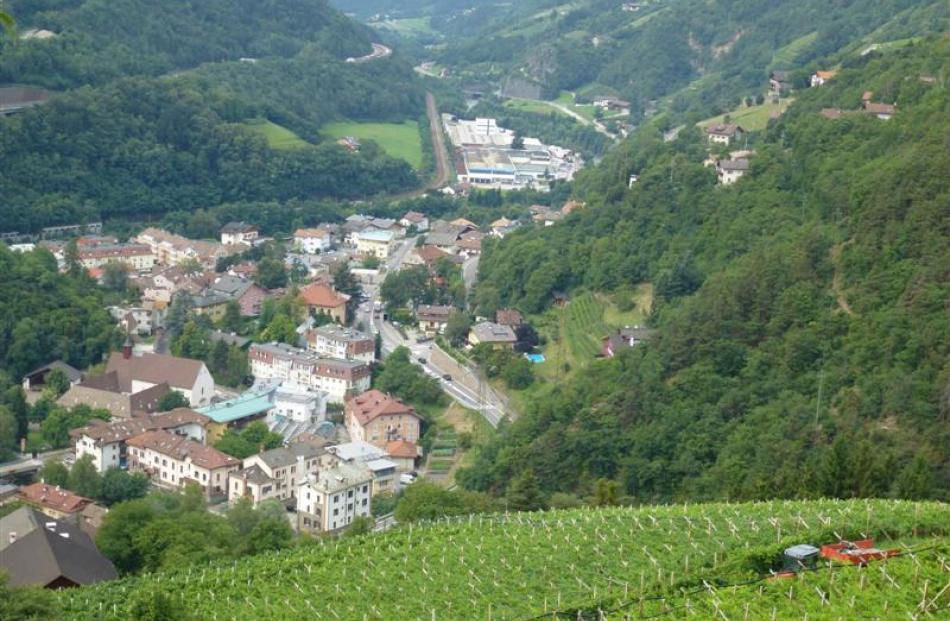
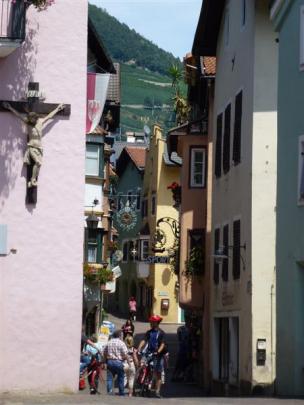
I stopped in Klausen (Chiusa in Italian) beside the Eisack (Isarco) River for four days.
I am not entirely sure one needs four days in this Italian-Austrian border town, although it is pretty. But an idea had formed in my head that I should look inside the Elisabeth Stollen (tunnel) of the Erlebnis Bergwerk at Villanders (Villandro), which is about 5km up the hill from Klausen.
I arrived on a Thursday night and when I discovered the mine was only open to the public on Tuesdays, Thursdays and Sundays, I decided to wait, happily filling in my time with walking the hills, swimming in the public pool and eating apple strudel and ice cream.
Klausen/Chiusa was once an important mining area, providing silver, lead, zinc and many other minerals for all manner of trades. The Villanders mine is now closed but operated for about eight centuries. While Tyrolean folk were carving out the insides of these mountains, Aotearoa was only just being discovered by the earliest Polynesian explorers.
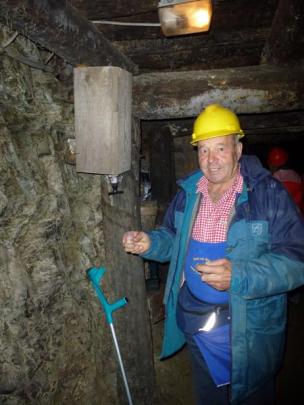
To be perfectly honest, going on a tour exclusively spoken in German was always going to be slightly frustrating but the only other option was Italian, which I also do not understand. I decided I didn't care and would immerse myself in German and pay the 8 entry fee. Herr Guide was an older man, perhaps in his 60s, and established a grandfatherly rapport with some of the children on the tour. He did not speak English.
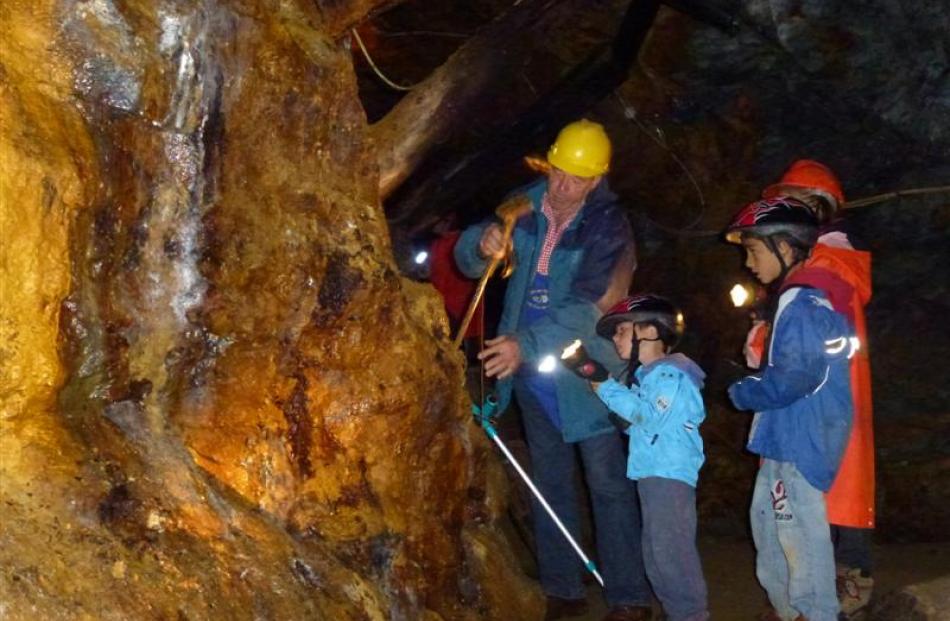
Despite whinging (probably about the cold) to their mothers, the children were distracted by his stories and became fascinated with the elements he was pointing out with his torch and walking stick. They loved it when he set some sulphur on fire and watched in awe as flaming bubbles drifted away in a small stream of chilly water.
Listening to Herr Guide's voice, I decided he was obviously a very knowledgeable chap, a good story-teller and had a sense of humour. It helped that his bunch of German tourists were giggling and making asides to each other.
Elisabeth Stollen is 1670m long and full of twists and turns. For two hours we walked with torches through narrow, freezing tunnels dripping with fresh, snow-cold water. I think we travelled for at least 1km underground but it felt like six. Elisabeth Stollen (1300masl) connects to a maze of other tunnels and shafts and I believe the entire complex totals about 16.5km. Tall men had to stoop but it was a perfect fit for me, at 163cm tall. There were some smaller side-tunnels for the children to explore but I felt gnawing worms of anxiety in my stomach as I pondered how easily I could get lost in the dark labyrinth.
I could not fall back on previous studies in geology to understand much about what I was looking at, but I could apply my imagination to the facts in front of me. I imagined Tolkien could have used this tunnel to describe his goblin-haunted Misty Mountains or the Mines of Moria. I considered how easy it would be for Gollum to become bitter and twisted as he hid from civilisation for an age in a grotty mine. I understood how such an environment would make goblins hideous by nature and deed. I wondered why Tolkien's dwarfs were such merry men and had such a poetic love for the inside of mountains. I looked at the silver and pink and white and blue and green and black minerals dripping, sliding and oozing down the chiselled rock walls and realised they were the same colour as the pigments decorating Italian cathedral walls and ceilings. I studied the gardens of fungi flowering with gossamer-like fragility and tenacious determination, slowly smothering ancient sturdy wooden beams with underground edelweiss and snowflakes.
It must have been a bitterly harsh life as an alpine miner in the Middle Ages and I pondered the nature of emperors, kings, popes and bishops, lords, landowners and merchants and why they had the need or greed for so much gold, silver and copper and other minerals.
Did they actually care about the misery that would have been impossibly unavoidable for those gathering precious materials to make cathedral pieces and weapons of war, alongside the more necessary domestic equipment? Were the miners slaves? Were they paid, and if so, how much? Was it a living wage? The German-language website, www.bergwerk.it, discusses the Erlesbnis mine. The day before I visited it, I used my German-English dictionary, the Lonely Planet German phrase book, Google Translator, and the small bits of knowledge I had gleaned from language lessons provided by friends to cobble together my own interpretation of the mine pamphlet. Through the ages, there
were conflicts between various rich landowners over the mine but I couldn't decipher enough information to learn about the miners. I am still wondering about the domestic details of working in such a hellhole. Did the workers volunteer? Were they proud to be miners? Did mothers cry as their boys left home to work under ice-cold water with hard hammers and spikes made from mine products? Did they caution their sons to dress warmly? Did the boys arrive on their first day of work bright-eyed with curiosity and how long did it take for them to be subdued? Did they want to run away and were they induced or forced to stay? What were their bosses like? Were they allowed home at night or did they stay underground, hammering away in muffled silence, for days, weeks or months on end?
Early in the tour, Herr Guide stopped at a point where I think he was saying the miners cooked meals and rested. He poured us an ice-cold dram of whisky from a wooden fitting attached to the wall. It slid down easily and began its internal warming magic. So perhaps there were small comforts in here, after all.
When we got back to the cloakroom later, Herr Guide enclosed my freezing, bloodless, lifeless fingers in his warm hands and exclaimed ''Kalt! Kalt''. I was cold. Herr Guide had acclimatised to the environment long ago but I needed a 45-minute brisk walk in blazing sun and 25degC back to the village of Villanders before I could take my wool jersey and windbreaker off. MORE research was possible.
Another 60km or so up the road towards the Brenner Pass is the town of Sterzing-Vipiteno, and about 15km up a hill from Sterzing is a mine town called Schneeberg. At about 2000m, it is one of the highest mines in Europe. The mine closed in 1985 and the Bergbaumuseum commemorates 800 years of mining activity. Entry to the museum is free but this time I declined the tour, again guided exclusively in German or Italian.
The Schneeberg mine was even larger than the Villanders mine. In the 16th century, more than 1000 miners lived in the nearby village of St Martin, knocking out rocks in 70 tunnels between 2000m and 2650m. While the Bergbaumuseum contains tools used from the 13th century up to the modern era and was filled with drawings of gnome-like people hammering at and measuring rocks, it still didn't answer - at least in English - all my questions about mining in the Middle Ages.
But there were lots of photographs from over the past 150 years, showing how more modern miners and their families lived and worked. I could see life was harsh, even in more recent times. If it was cold inside, it was also cold outside. Negotiating snow between the village and the mine was a fact of life. Before the 20th century, an extensive and difficult haulage system up and down steep mountain tracks was used, using horses and manpower.
When cable systems were introduced, men rode unsecured on high-wires, balancing on items being hauled up the hills. The miners drank beer after work, smoked long pipes, belonged to orchestras, music and sports groups, had families, were visited by priests and took part in religious festivals and ceremonies.
From what I could make out, the miners definitely wore woollen garments. And among them lived the tallest woman in the world at that time, Maria Fassnauer of Ridnaun, known in 1900 as the Tyrolean Giantess. She became a bit of a celebrity circus oddity and was feted around Europe. In all the photographs of her exploitation, she looked sad, wearing a Mona Lisa-like, not-quite smile, while her parents just looked bewildered. They certainly didn't look rich.
I left the mines feeling a tour exclusively in another language is challenging but worthwhile. It can be disappointing not to get full value for money but you could argue education is supposed to be an ongoing thing. Stuff will not always be fully laid on for you, in any case.
I am guessing that when I get around to doing my follow-up research, even if it has to wait until I get home, it will only add value to my memories and photographs. And there are other ways to comprehend. Listen to the rise and fall of voices. Watch the faces of the people around you, including children. Touch your surroundings. Breathe in through your nose. Use your imagination. Apply what you already know, question yourself and wonder about life.