Australian wilderness can be as wild as you want it, or not, at four resorts in settings that capture essential Oz: The bush of the tropical north where seasons are two: wet and dry.
The red desert of the outback, with landforms millennia old.
The southern island where wondrous animals thrive. The half-wild grasslands wrapping mountains carved from a prehistoric sea.
Wildman Wilderness Lodge Humpty Doo, NT
I surprise myself, waking at 4.30am, just as I do at home - half a world away from this classy camp that opened in April in tropical northern Australia.
My reward is beauty, but not silence. Outside the floor-to-ceiling windows of my modernistic cabin, unseen birds chuck-chuck, cackle and squeal in the predawn. Planets beam brightly over my shoulder.
Moonlight traces gum trees' shadows on the red ground and rimes the distant clouds.
This is the tranquillity that draws people to Wildman, an eco-resort west of Kakadu National Park. The 10 cabins that face a grassy airstrip are recycled, brought here by road train from a resort almost 3000km away that failed, too outback for easy access.
Wildman, on the other hand, is barely two hours by good road from Darwin. Small planes and helicopters can set down on the runway, though not today. The just-ended wet season has left it too soggy for safe landings.
That's fine with the wildlife.
The open ground is a banquet table for agile wallabies and sulphur-crested cockatoos.
Wildman is strangely shaped, a ribbon of land about 100m wide and 2km long sandwiched between Mary River wetlands and national park. The skinny, 1.6ha site has the cabins and 15 luxury safari tents at opposite ends. Birds perch on termite mounds, blue-winged kookaburras hee-haw in the paperbark forest, wallabies' big hind feet sound plop-plop-plop on the path linking the cabins to the conference centre, pool and restaurant.
It would be easy to spend the day in the air-conditioned, roomy cabin's big easy chair and watch nature's traffic. But guide Neddy Tambling is available to take guests on a walk in the floodplain fringing Wildman, lead a quad-bike excursion in parkland or on a cruise among nesting and flying birds, water lilies, wild pigs, water buffalo and a croc with an amber gaze.
Meals are generous and eaten in the open when insects don't interfere. The huge breakfast could hold you all the way to the three-course dinner, which you should hope will include barramundi, the tender, sweet favourite fish in the Top End.
Under the cabin's double roof (shade upon shade in this hot region), naps come easily and night-time dreams even more quickly. In this big-sky land, stress-free is your souvenir.
www.wildmanwildernesslodge.com.au.{C}
Longitude 131 and Ayers Rock ResortYulara, NT
Adventurers travel the world to see Earth's great landforms, among them the Grand Canyon, Everest, the Alps and this one: Ayers Rock, a chili-powder-red monolith mounding out of a flat desert in the centre of Australia.
And, pinch me, it's framed by the window of my room at this luxury lodging in the outback.
In fact, raise the sunshade in any of the 15 freestanding units, and the rock - now known by its aboriginal name, Uluru - is centre view, 10km distant. Each canvas-domed habitat is unique, dedicated to an outback pioneer and decorated with artefacts from that person or his era.
Human history gives way to natural history, however, in the tours at Uluru-Kata Tjuta National Park included for guests. In late afternoon, we're guided along Mala Walk on Uluru's northwest face and hear of Aboriginals' link to the sacred rock.
The 1.6km hike ends with canapes and Champagne as the sun ignites flame colours in the iron-rich coat the rock wears.
At sunrise, we watch dawn rouge the rounded cheeks of Kata Tjuta, formerly called the Olgas. The 36 rock domes about 32km west of Uluru were eroded from a pudding of pebbles, stones and boulders stirred into mud and sand and hardened over epochs. The wind-scoured, 2.5km walk in Walpa Gorge passes huge crumbs of this geologic batter.
Cameras get a workout at the Uluru sunset viewing before we're taken to a high point near the resort for a candlelight gourmet dinner under a blanket of stars.
Like all the delectable meals and wines at Longitude, this costs nothing extra. Neither do snacks, park fees, a shopper's shuttle into the town of Yulara, or airport transfers. Apart from options for private guiding or touring and a few remembrances for sale (some are fine art, priced accordingly), Longitude is all-inclusive.
Named for Earth's north-south grid line that passes through the national park and the resort, Longitude is easy on the land. The tent-roofed, hard-side rooms incorporate insulating materials and central Australia's boundless solar energy for climate control, and each unit is elevated to allow natural movement of the sand beneath.
The resort is sumptuous in setting and furnishings, but it was designed to be deconstructed. Its parts could be disassembled and carried away and the desert left as it was found. For the eco-minded, it's revelation of caring.
Ayers Rock Resort, owned like Longitude by the Indigenous Land Corp, offers additional lodgings, from motel-style to camping.
www.ayersrockresort.com.au {C}
Southern Ocean Lodge Kangaroo Island, South Australia
It doesn't look like safari country. The Southern Ocean, that salty moat separating Kangaroo Island and Australia's south coast from the Antarctic, is flinging frothy waves on to the beach below my elegant cocoon at Southern Ocean Lodge.
A grey curtain of chilly rain blurs the rocky promontory nearby. But this island is an ark, and more than two-by-twos are here for the spotting. Wild things could be reason enough to come, but this lodge is one, too. Nearly 300m long, and just one suite wide along most of its length, the serpentine lodge crowns a clifftop above Hanson Bay on Kangaroo's south coast. Each of the 21 suites is ocean-facing, and vast blue panoramas of sea and sky fill the view of each.
With private terraces, heated limestone underfoot, fine linens on king-size beds, mini-fridges filled with soft drinks and Champagne for the taking, music on command and sitting areas with custom 'roo-themed accessories, these digs are tenaciously top shelf.
Kelly Hill Conservation Park and the sprawling wildness of Flinders Chase National Park snuggle up to South Ocean Lodge and put animals within reach of tours planned for guests.
Island-born nature guide Brenda Hilder is keeping an eye on the road and one on the roadside scrub as we roll on a half-day excursion into Flinders Chase. She slows to a stop, and I think I see why the Cape Barren goose is one of the world's rarest geese.
Two of the pale-grey creatures are casually strolling on the two-lane highway that carries much of the island's west-end traffic. The tubby birds with lime-green beaks, pink legs and black feet cast a sassy glance our way then pad reluctantly off the asphalt.
Just beyond, two kangaroos hunched over in roadside grazing straighten to inspect us. A species unique to the island, they're smaller and more furry than their mainland cousins.
At the aptly named Remarkable Rocks, granite boulders fantastically sculpted by wind and water, I scan the bushes for a fairy wren, and the blue and black sprite I've long wanted to see pops into view.
New Zealand fur seals snoozing at rocky Admiral's Arch and a lucky sighting of the shy tammar wallaby are appetisers for the bush picnic Hilder grills for us. Clearing our plates is tempting, but it's always prudent to save room for meals at the lodge.
The island 19km off the mainland is primarily agricultural, and chef Tim Bourke taps its bounty in his new-every-day menus.
His palette includes local sheep's-milk cheese and yoghurt, crayfish, meats, fruits, shellfish, grains and honey from prized Ligurian bees.
People who live and work on this 56km by 156km isle embrace it with affection. "Here you have the bush and the coast," says lodge guide Jess Skewes. "You get the best of both worlds."www.southernoceanlodge.com.au Tours or packages by Exceptional Kangaroo Island, www.exceptionalkangarooisland.com.
Arkaba Station Flinders Ranges, South Australia
Retired national-park ranger Nick Bailey nods towards the blue-green, snaggle-toothed mountains on the horizon. "All the story of life on the planet is shown in the stones of the Flinders Ranges," he says as his four-wheel-drive vehicle carries me to Arkaba Station, a sheep ranch at the south edge of the rocky chain north of Port Augusta, an hour's flight from Adelaide.
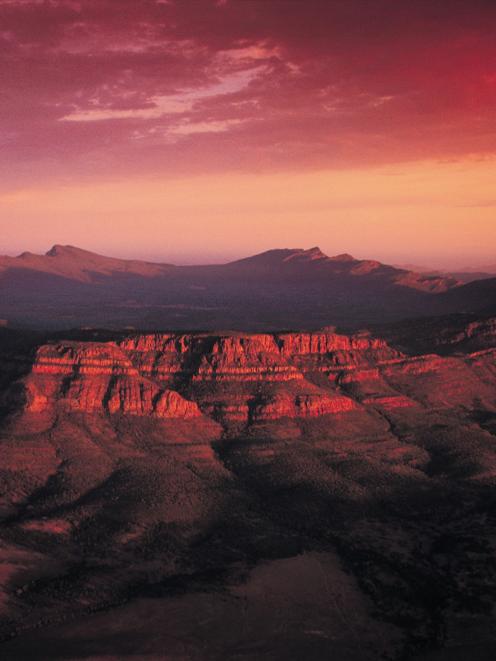
Fossils of the oldest-known life forms - ediacara, seabed dwellers Nick calls the "Mona Lisa of the planet" - were found in the Flinders in 1946, and geologists continue to study this ancient ocean bottom, now a plain of sparse grass ribbed with unfathomably old mountains and erosion-carved hills.
In this spectacular setting, Arkaba (ARE-kah-bah) is evidence of more recent history. The iron-roofed, wide-verandahed homestead built in 1851 is the heart of a 260sq km property formerly owned by the pioneer Rasheed family and now a luxury outback lodging.
Four comfortable rooms in the thick-walled house and a cottage across the lawn are open to the handful of guests for whom open spaces can't be too wide. "Some people find it eerie to be in this silence," says Dean Rasheed, who until two years ago ran 8000 sheep on Arkaba.
"I'm used to it." A communal dinner table is set with creative, savoury entrees, fresh breads and yummy desserts from the open kitchen.
In the covered conversation area outdoors, guests are free to choose among wine or water from the large refrigerator. A lounge cossets with a fireplace and library, and the small staff is caring without hovering. Activities such as hiking and mountain-biking are offered each morning and afternoon.
Dean occasionally joins Arkaba's full-time guides, driving guests along the narrow, rocky roads he and a helper cut through the station in a programme to eradicate destructive feral goats and rabbits. The 14-year effort won Arkaba three national awards for land management.
We stop at the barnlike woolshed, constructed in 1858. Beams from Oregon and corrugated-iron roofing from England weren't beyond the pocketbook during that boom time for woolgrowers.
"Smoko" (midmorning tea) gave shearers a break from the bleating of animals and click or whir of the shears.
Arkaba continues as a working sheep station, and each September, shearers harvest the merino wool.
Euros, a smaller relative of kangaroos, thrive on this land reclaimed from pests. They stand in our road, graze on scrub and give us a once-over before bounding away.
We jump from the SUV and look up when I spot a huge shadow heading towards us. A wedge-tailed eagle, Australia's largest raptor, sails overhead, close enough for us to see the tan epaulets on its chocolate-brown wings.
Birds and more birds, red gum trees wrinkled by centuries of life, high points that spread a wide vista at our feet, a hide-and-seek creek that's sometimes above ground, sometimes below - I'm enthralled. I want to look closely at everything.
"Next time you come," Dean says with understanding, "I'm going to set you up with a chair and smoko and just leave you." Yes, please.
www.arkabastation.com Rawnsley Park Station nearby at Wilpena Pound (www.rawnsleypark.com.au) also has lodgings.
Resources
Tourism Australia- www.australia.com
South Australia tourism - www.southaustralia.com
Northern Territory tourism - www.tourismnt.com.au