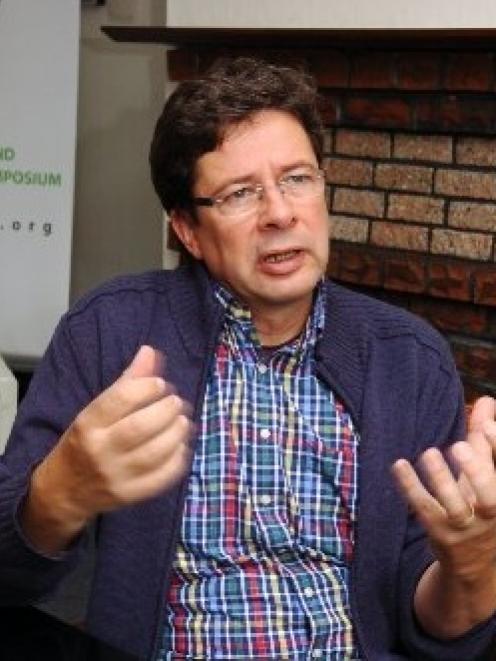
Dr Hoogewerff has been appointed chief scientist at Oritain Global, the Dunedin-based company with global links that independently and scientifically certifies the origin of food.
By looking at the properties in a food or product that were natural, they could map those properties and conclude where it was from and whether or not it was authentic.
The company was growing and there was a need for a permanent scientist, Dr Hoogewerff, who moved to Dunedin with his family three weeks ago, said.
Originally from Holland, he studied geochemistry and volcanology at the University of Utrecht in the Netherlands, where the emphasis of his work was, and still is, using inorganic elemental and isotope ratio analysis to trace materials to their origins.
He later moved into some environmental work, before applying his techniques in forensic and archaeological provenancing.
His study on 5000-year-old Otzi, the well-preserved mummy of a man found in 1991 in the Otztal Alps, near the Italian-Austrian border, was the first isotope study on the iceman.
To be involved in that project was "quite endearing", seeing the mummy "totally out of place, out of time", and he became a person, not just a mummy, Dr Hoogewerff said.
In 2000, he moved to the Institute of Food Research in Norwich, in the United Kingdom, to run its isotope ratio facility for human micro-nutrient studies.
At IFR, he set up a new research field in food authentication using the link between soil composition and food composition for determining the geographical origin of food.
Together with colleagues at IFR and beyond, he initiated the EU-funded project Trace, in which he was one of the principal investigators for geochemistry-based provenancing of food.
He accepted a senior lecturer post at the University of East Anglia in Norwich in 2006 and was director of its forensic chemistry course until this year.
He is also visiting associate professor at both the International Forensic Research Institute of Florida International University in Miami and the Forensic Science Centre at the University of Western Australia.
Dr Hoogewerff had always wanted to come to Australia or New Zealand and, when the opportunity arose at Oritain, it was the right time.
With the difficult economic situation in Europe, there were a few scientists keen to come to Australia and New Zealand.
He liked the concept of working on the practical side of the industry, not just in academic research, and it was also a lifestyle decision.
He enjoyed getting out of the office and speaking with farmers and producers, which also doubled as an opportunity to get to know the South Island.
Oritain has recently put much effort into manuka honey, working with the UMF Honey Association (UMFHA) to protect both the consumer and the $100 million New Zealand manuka honey industry.
UMFHA added to its international testing regime by developing, in partnership with Oritain, an additional test that would detect adulteration of manuka honey with any artificial ingredient.
In New Zealand, there was high-quality produce and manufacturers and producers wanted to protect those standards, Dr Hoogewerff said.
The company was also looking at milk and milk powder and working with those industries.
Milk stirred primary feelings, with people wanting to have high-quality, safe products for their children.
Dr Hoogewerff, who still does "real police work" solving cold cases, believed there were very good opportunities for Oritain.
His family had settled in well in Dunedin and he expected they would be here for 10 to 15 years and then "see what happens".
One of his dreams was to have a nut and berry farm.