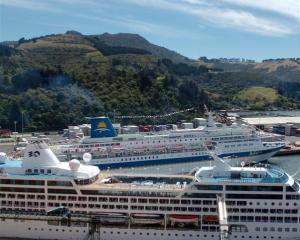
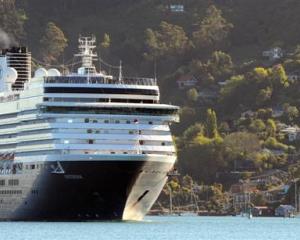
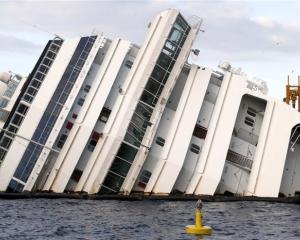
Recently, after an absence of more than eight years, the container ship Aquitania made its fourth visit since being added to Maersk's Tanjung Pelepas run.
Now flying the Liberian flag, the 26,047gt, 2226 TEU vessel was added to the Christian F, Ahrenkiel group fleet of Hamburg late in 2003.
The ship was delivered to Greek interests in April 2000, who operated it on the Bahamian register as Lionmax for two years before changing it to Corrado.
The vessel was built by the China Shipbuilding Corporation at its shipyard at Kaohsiung.
One does not hear much about this port these days, but the area around it was once the largest graveyard in the world for all types of ships.
Hardly a week passed without reports of ships sold to Taiwanese breakers for demolition at Kaohsiung.
From 1962-72, 1104 vessels ended their days there.
Among them were 34 vessels, known locally, that were owned by the major British liner companies servicing the UK-New Zealand trade.
Among the first to arrive there was the Port Chalmers of 1933.
The ship arrived there on November 15, 1965.
Two days later, demolition commenced on this survivor of two wartime convoys to Malta.
From 1973 until well into the 1980s, many more of our former visitors made their final voyages to the same graveyard.
And Dunedin was the final New Zealand port of call for three that sailed from here direct for Kaohsiung.
The first was the 1944-built steamer Pipiriki on January 18, 1971, followed by Delphic (1949) on July 30, 1971, and finally Huntingdon (1948) on July 17, 1975.
As for the name Aquitania, it is best-remembered as that of a famous Cunarder and those glorious days of steam.
It was built for the transatlantic mail route and was ordered from John Brown's Clydebank shipyard on December 8, 1910.
Keel-laying took place on June 5, 1911, the launching on April 21,1913, and after sea trials on May 10, 1914, the new liner commenced its maiden voyage from Liverpool to New York 20 days later.
This was the start of a successful and distinguished career in peacetime and on trooping duties in two world wars.
The quadruple-screw liner, powered by four steam turbines, had a speed of 24 knots.
It was designed to carry 597 first, 614 second and 2052 third-class passengers.