The biggest obstacle for Tony and Sue McDonnell was the disbelieving fertiliser company field officer.
Asked whether Ravensdown could process phosphate from his South Otago farm for use as superphosphate fertiliser, the field rep told the McDonnells there were no phosphate deposits on mainland New Zealand.
The McDonnells were visiting the Ravensdown site at the National Field Days in Hamilton in June this year, frustrated at the irony that while superphosphate had reached $500 a tonne, beneath their dairy farm sat a mineral deposit they later learnt covered 450ha and could save farmers up to $1 billion a year in imported phosphate rock.
Mr McDonnell recalled that the field officer took some convincing, even though they lived on Phosphate Rd and the original Ewing Phosphate Co Ltd building still stood on their Clarendon farm.
Finally convinced, within a minute the field officer had summoned Ravensdown chief executive Rodney Green and talks began which had led to investigations on the size and quality of the deposit on eight farms between Waihola and Milton.
Mr Green said he knew of the deposit from time working for McSkimming's Industries in Dunedin where he looked after the company's quarries.
When he took over the top job at Ravensdown, he said he asked about the merits of the Clarendon deposit but it was believed to have been exhausted.
"When Tony came in I knew exactly what he was talking about," he said.
Phosphate was discovered at Clarendon in 1902 and announced by the Otago Witness of June 11: "This discovery may quite possibly rank next in importance to the discovery of gold in this colony."
Mr Green said that early mining gave him some confidence the deposit could be viable.
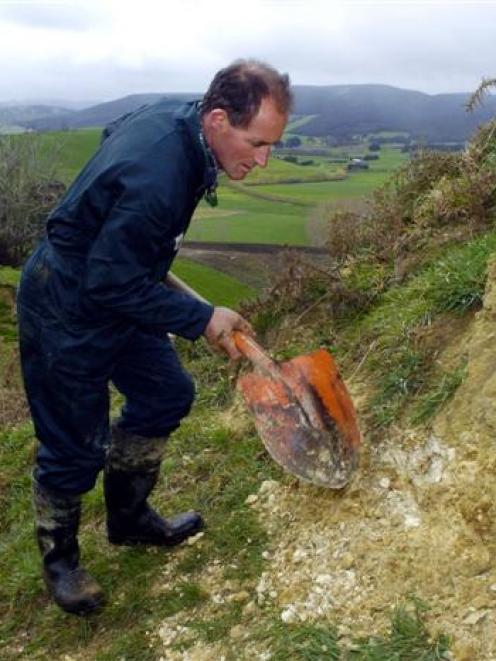
The hill behind the McDonnell dairy farm was dotted with small mines where the pioneers worked phosphate outcrops.
"It seems to me to suggest the deposit is continuous."One of the early geologists described one outcrop as "18 foot thick and several chains long".
"If that is there, what is further in?" said Mr Green.
Initial work suggests there could be 34 million tonnes, enough to make Ravensdown self-sufficient for 23 years.
As a comparison, the Macraes gold mine in East Otago has been operating for 18 years.
The reserve appears to be concentrated on the inland hill behind Clarendon, above what Mr McDonnell calls the plough line.
Since 1902 it has been thoroughly investigated, with research as recent as 1989, and Mr Green said his staff were collating that information as it assesses its potential by looking at quantity, quality and then extraction and processing costs.
Initial work involved trenching for samples, followed by a drilling programme and then an assessment of the processing required.
Overseas phosphate reserves require large processing plants to improve the purity of the phosphorous or phosphate, but Mr Green said it was too soon to speculate about what infrastructure or investment was needed here.
Easy access to road and rail provided transport options to the company's Ravensbourne plant, where it could be shipped around New Zealand and even to Western Australia where Ravensdown also operated.
The resource was worked twice, from 1902 to 1924 and 1943-55 during which about 200,000 tonnes was extracted.
But it was cheaper to buy from countries such as Nauru.
Mr Green said simple economics made it worthwhile to again look at the Clarendon deposit.
The company bought between 500,000 and 600,000 tonnes a year of phosphate which it made into the fertiliser superphosphate.
Up to a year ago, it was paying $US40 ($NZ59.60) a tonne with shipping costs of $US20 a tonne.
Demand, and countries which previously exported phosphate now shoring up their own supplies, has sent the price soaring to $US500 a tonne, while shipping costs have also increased substantially to $US300 a tonne.
Mr Green said the cost to the company had soared from about $36 million a year to $300 million.
"The numbers are just enormous."
Mr McDonnell said the cost of agriculture's most common input had forced many farmers to review their use of fertiliser, and any reduction would have a huge impact on productivity.
He said he had not considered the implication of his farm being mined, saying he was more concerned about the economic impact to New Zealand of record fertiliser prices.
Initially, he approached Ravensdown to process the phosphate for his own use, but it became obvious the deposit had larger potential and could benefit all co-operative members.
"I'm looking at it more from a nationalistic point of view. Farmers need fertiliser."
Mr McDonnell had no idea how much phosphate was on his farm, but it could be about 5% of the total area and other farms could have more substantial reserves.
He was aware it might all come to nothing, but at least the idea was being investigated.
"It might not come to much, but it gives other suppliers the message we're not totally dependent and maybe it could have the effect of stabilising international phosphate rock prices."
Mr Green said the international availability of phosphate was tightening as exporting countries increased their own supplies for food production.
"There's not a lot of suitable phosphate rock available for manufacturing superphosphate at the moment."
Exports from North Carolina in the United States had stopped, the Nauru resource was exhausted, Togo's was diminishing, China had put a large export tax on its reserve while major investment was needed to open a new resource in a remote part of Peru.
Mr Green said Russian phosphate was of low quality and in an isolated region above the Arctic circle, which left Morocco.
But its mine was 100km from port and the product transported to port by a conveyor belt.
Soaring shipping costs also put pressure on phosphate prices.
Mr Green said he was as impatient as farmers to find out if the resource was viable and the rising cost of raw material made it imperative the company acted as quickly as it could to take some pressure off farmers.
"It's important we do something and do something quickly."
> What is phosphate? <
A naturally occurring rock which is an ingredient for the most widely used agricultural fertiliser. One million tonnes of phosphate rock produces 1.7 million tonnes of superphosphate.
What does the resource mean?
It would save the Ravensdown Fertiliser Co-op up to $1 billion a year from the cost of importing phosphate.
How big is the deposit?
It covers 450ha and could yield 34 million tonnes. An estimated 190,000 tonnes was mined at Clarendon from 1902-24 and in 1943-44. The deposit was discovered in 1902, by Ralph Ewing.
Where do we get phosphate from now?
From Morocco, China and Togo.
Are there any other New Zealand deposits?
Apart from large seabed deposits 400m below sea level on the Chatham Rise, Clarendon is the only known site in New Zealand.
What happens now?
Ravensdown Fertiliser Co-op will continue to investigate the resource for another three months before deciding on its potential. If it goes ahead, resource consent would be required and a treatment plant built.