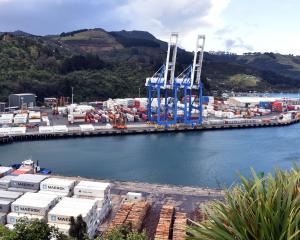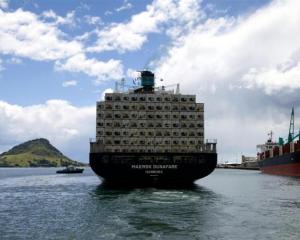
Its Next Generation Project, which sparked concerns of the effects on the coast of dumping spoil 6km out at sea, gives Port Otago a 25-year window to deepen its channel, should larger container vessels of up to 8000 TEU (20ft equivalent containers) come to Port Chalmers.
While granted consents from the Otago Regional Council (ORC), to deepen its channel between Port Chalmers and Taiaroa Head from the present 13m to 15m and remove 7.2 million cubic metres of spoil, it could be up to five years before any removal started, chief executive Geoff Plunket said.
''We have five years to start [major dredging], then 20 years to use the whole consent,'' Mr Plunket said, highlighting that commercial demand by shippers would be the main driver for any major dredging.
Earlier this month, conditions of the ORC original consents were appealed before an Environment Court judge, but most issues raised by a community group and fisheries' interest representatives were resolved before the end of the week-long hearing in Dunedin.
Mr Plunket estimated yesterday that half of the channel, through past channel maintenance programmes, was already around 14m in depth, and increasing the remainder could be done ''incrementally, under the regular maintenance programme.
''The first step would be to dredge to 14m, but there is no start date for this,'' Mr Plunket said.
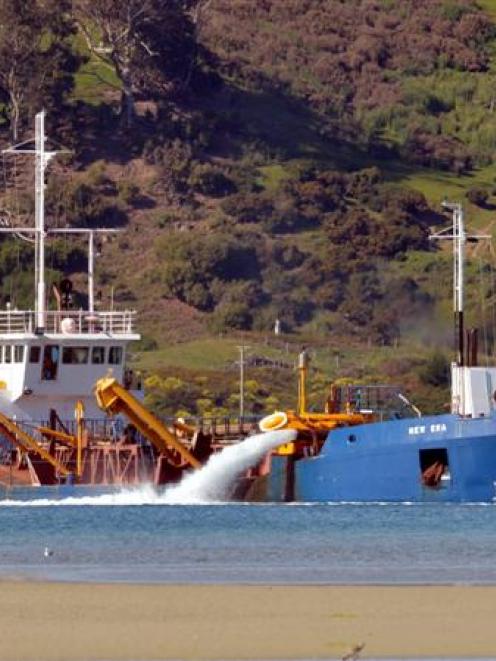
Separately, three-year resource consents for Port Otago to operate its maintenance dredging programme are being applied for through the ORC at present, with six submissions from surfing interests concerned that nearby surf breaks could be adversely affected, Mr Plunket said. He was ''hopeful of addressing those [surfers'] concerns'', but said it was likely an ORC hearing would be held next year.
He believed that after the next round of consent applications for dredging in about two years, they could all be integrated. Under the regular maintenance programme, Mr Plunket said existing coastal spoil dumps would continue to be used, at Hayward Point, Aramoana and the Spit, while the offshore designated dump spot, 6km from Taiaroa Head, would be used only for a ''big dredge'' operation, he said.
Port Otago chairman Dave Faulkner described the Environment Court outcome as a ''landmark decision'', making Port Otago the first port company in the country to have a fully-consented project to deepen its channel.
''This is substantially cheaper than any other port in the country,'' Mr Faulkner said.
Large shipping companies, caught out by an oversupply of vessels and shrinking cargo volumes during the global financial crisis, countered their massive financial losses at the time by using larger container ships and cancelled calls to smaller ports around the world.
Mr Faulkner said the global trend towards bigger ships had already started to affect New Zealand, with several of this country's largest exporters and other interest groups calling for New Zealand ports to prepare for the arrival of larger vessels.
Mr Faulkner said the court decision ranked alongside other historic events for Port Chalmers, including the first frozen meat export aboard the
Dunedin in 1882 and Port Chalmers' opening as a container terminal in 1977.
''Having the ability to increase this [channel depth] to 15m means that Port Otago's board and management could respond rapidly to changing shipping needs whenever they arose,'' Mr Faulkner said.
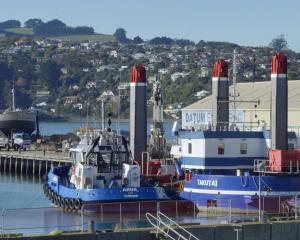
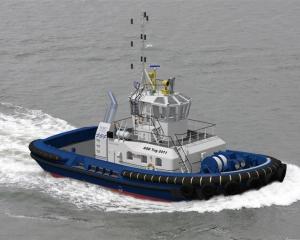
Port Otago has the added advantage of owning its own dredging fleet, so the first stage can be done at any time and, with more than 50% of the existing channel already at 14m, the cost of completing the first stage is projected to be between $5 million to $10 million. The project would benefit South Island ship users, as accommodating larger vessels would ensure that exporters and importers were not penalised by increased costs in their international supply chain, such as additional inland freight or transhipping costs, Mr Faulkner said.
ORC consents
• Resource consents allow: Deepen, widen, and maintain lower harbour channel, ship-swing area and berths at Port Chalmers to allow passage of larger ships.
• Dispose of the dredge spoil to sea.
• Extend the multi-purpose wharf, build a new fishing jetty at Port Chalmers.