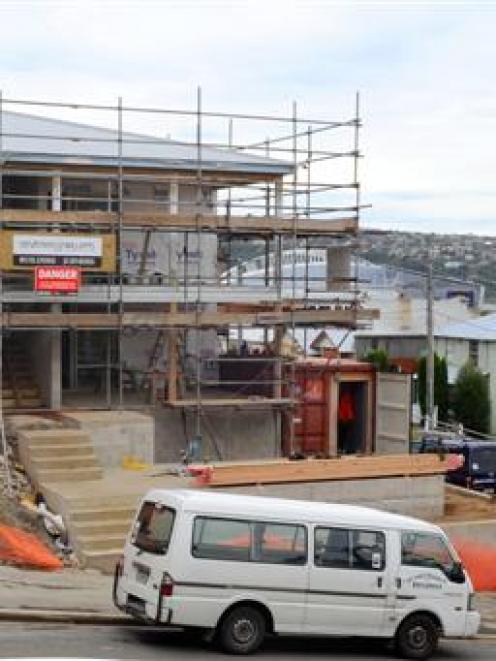
In November, new dwellings consented in Otago were up 49, or 65%, to 124 compared with November 2011, Dunedin and Queenstown both contributing equally.
The value of Otago residential consents was $42 million, well up on both the $35 million recorded in October 2011 and $27 million recorded in November 2011.
Canterbury consents were up 171, or 71%, to 413 - their highest in five years. Tasman was up 19, or 112%, to 36.
Auckland continued to lead with the highest number of new dwellings consented in November - 432 - down one from October 2011, up just two from November 2011 but up 70 from November 2010.
Overall, residential consents fell sharply in November, but that was entirely because of the volatile apartments category, Westpac economist Felix Delbruck said. Excluding apartments, consents issued for construction of new dwellings posted a solid 4.6% increase, much in line with expectations.
Non-residential building work also continued to trend higher, another big contribution coming from the Canterbury area.
''As such, our view remains firmly in place that construction will continue to boost economic growth over the coming year, largely but not totally due to post-quake building needs,'' he said.
Statistics NZ figures showed the value of non-residential building consents in November was $420 million, up $5 million compared with November 2011.
Two regions - Auckland and Canterbury - contributed 65% of the non-residential work in November with $149 million and $125 million respectively. The value of consents for non-residential building work from the next three largest regions in November were Wellington, at $40 million, and Waikato and Otago, both on $19 million.
ASB economist Christina Leung was encouraged that rebuilding work looked to be continuing in Canterbury. She estimated dwelling consents issued in Canterbury increased 9.8% in the month, on a seasonally adjusted basis - a rebound from the fall in October.
The total number of quake-related consents issued in November totalled $59 million. Of that, $25 million was for residential buildings and $33 million for non-residential work. Since September 2010, quake-related consents had totalled $749 million.
''Given this estimate only takes into account direct repairs and reconstruction on damaged sites, the true extent of rebuilding is likely to be even greater. For example, a new house built somewhere else as a result of the demolition of a damaged house would not be included as a quake-related consent.''
Less encouraging was the fall in dwelling consents issued in Auckland, Ms Leung said. There had been signs stronger housing market activity was beginning to flow through to higher house building demand earlier last year, but that recovery looked to be slowing. With the supply of new housing remaining low, the Auckland housing market was likely to remain ''very tight'' over the coming year.
The strength in the housing market presented a dilemma for the Reserve Bank, she said.
Signs of slowing momentum in the wider New Zealand economy meant the central bank would be unlikely to want to use higher interest rates to lean against the housing market.
However, the Reserve Bank had indicated it was prepared to use macro-prudential tools, such as ''loan-to-value'' ratios, with the potential for those tools to be used later this year if the disconnect grew between housing credit growth and the wider economy, Ms Leung said.