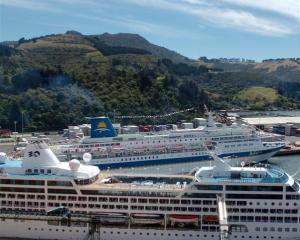
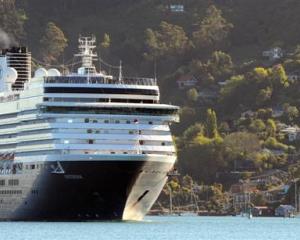
Costa, Cunard, Holland America, P&O, P&O Australia, Princess and Seabourn are brand names that represent cruise ship fleets that have been linked with calls at Dunedin and Port Chalmers.
Since 1989, all have progressively become members of the Carnival group, the largest cruise ship fleet in the world with about 100 vessels.
However, next Saturday the Carnival Cruise Line itself will make its local debut with the arrival of Carnival Spirit on the first of three scheduled visits to Port Chalmers.
Owned by the Carnival Corporation, this vessel, with its 12 decks, was designed to provide 2680 berths in 1087 cabins. The 89.520gt vessel has an overall length, including bulbous bow, of 292.50m, and has a service speed of 22 knots from twin-screw, diesel-electric machinery.
The ship was completed in April, 2001, as the first of four sister ships ordered from the Kvaerner Masa yard at Helsinki. Orginally registered at Panama, the vessel was transferred to the Maltese flag midway through last year.
Following its deployment in the Alaska cruise market last year, the ship was repositioned to Sydney. It arrived there on October 18, and is now the first unit of the Carnival Cruise Line fleet to be permanently based in Australia.
Currently, the Carnival Cruise Line fleet numbers 24 vessels up to 128,000gt built between 1991 and last year. Another vessel is on order with Fincantieri for delivery in 2016.
And, while there are many much larger cruise ships afloat today, the company was the first in the world to surpass the 100,000gt mark for a passenger vessel.
This history-making ship was the 101,353gt Carnival Destiny, delivered from Fincantieri's Monfalcone yard in October, 1996.
Although this was not the case with the earlier units of the fleet, today all the ships in the fleet have the prefix Carnival included in their names.
Another distinctive, identifying feature at the top of their red funnels, are two upwards-inclined wings.
A name that is often in the news is that of the Miami-based Carnival group's CEO, Micky Arison, who was born on June 29, 1949. He is the son of Ted Arison who died in 1999 at the age of 75.
A pioneer of the cruise ship industry, Ted Arison founded the Carnival Cruise Line in 1972, which was restyled as the Carnival Corporation in 1994.
Before new ships were ordered in the 1980s, earlier second-hand passenger liners were acquired to build up the infant fleet.
The first of these to be bought served Carnival as Mardi Gras from 1972 to 1993 and was broken up 10 years later.
As a new ship, it had already secured a place in maritime history. When it was completed in March 1961, at Newcastle by Vickers-Armstrongs, the 27,284gt vessel was the largest passenger ship to be built on the Tyne for 50 vears.
At the same time, as Empress of Canada, the ship was the last passenger liner to be built for the Canadian Pacific Line.
Caledonian Sky is a much smaller 4200gt, 114-berth, expedition-type cruise ship that made the first of three scheduled visits to Dunedin last Saturday.
Owned by Caledonian Sky Inc, of London, it sails under the flag of the Bahamas.
The ship has had a somewhat colourful career since it was completed on May 8, 1991, by the Nuovi Cantieri Apuania yard at Marina di Carrara.
It was one of four sister ships built at this yard alongside four more slightly smaller vessels built at another Italian yard in 1990-91.
All were built for Renaissance Cruises. Caledonia Sky commenced its career as Renaissance Six, and served under that name until 1998.
By then, Renaissance Cruises was starting to take delivery of eight larger, 30,277gt, French-built cruise ships with those uninspiring names R One - R Eight. But within three years the company ran into financial difficulties and the ships were sold.
Caledonian Sky has been serving under the name since late 2011. Since 1998 it has also been known as Hebridean Spirit, Megastar Capricorn, Capri, and Sun Viva 2.