


Ram breeders who have stuck with the sheep industry are the ones who are ''pretty passionate about it'', Min Bain believes.
He and his wife, Lisa, with children Lochie (13) and Danielle (10), farm at Waitahuna West, near Lawrence, and breed Romney, Dorset Down and Romdale rams.
He was among nine ram breeders at the Southfuels Farmarama in Lawrence last week, which was an increase on previous years.
Brought up at Moa Flat and part of a well-known stud-breeding family, Mr Bain shifted with his family to Dunrobin in 2000 and then to Waitahuna West in 2008, moving from a 160ha property to a steep-to-rolling 330ha property.
He enjoyed breeding rams for clients that satisfied their needs and estimated he would sell about 230 rams this year, which was about 30 more than last year.
Rams went as far afield as Banks Peninsula, as well as Winton, Central Otago and South Otago.
He started his Longridge Romney stud when he was about 14 - his parents Ken and Dawn Bain used to have the Longview Romney stud - and added a Dorset Down stud to complement the Romneys, believing it to be one of the best meat breeds.
His type of Romney had changed over the years from the more traditional type to more of a North Island hill country type.
It was his father who started breeding Romdales and they were gaining popularity, he said.
Their ram clients were farming on harder country, as flatter land was increasingly being converted to dairy. Sheep were being pushed back into the hills, so they had to be able to cope with the conditions, he said.
Waitahuna West was a great area to farm and still a traditional sheep area, whereas his home territory of West Otago was becoming ''more and more cows''.
The next generation looked set to continue the farming tradition.
Lochie, who started at John McGlashan College this year, established a Dorset Down stud three years ago.
It was frustrating sheep farmers were producing some of the best product ever but were getting ''caned'' for it, Mr Bain said.
He believed all the companies needed to ''get together and be united'' and farmers also needed to be united.
Chris and Gaynor Miller, from Roslyn Downs Partnership at Glencoe, between Gore and Winton, were encouraged to attend the Farmarama by the suggestion of one of their ram clients.
The Coopdale and Texel breeders farm in partnership with their sons: Jason, who is a director of meat company Alliance Group, and Quentin, running sheep and beef on a 600ha property they own, and a 240ha property they lease.
Mr Miller started with the Coopworth and then crossed it with Perendale about 15 years ago to give better survivability and better meat yields.
It combined the best of both breeds - the fertility, mothering ability, growth rates and wool weights of the Coopworth, with the survivability, easy care, conformation, bulk and parasite tolerance of the Perendale. They then introduced the Texel as a terminal sire to increase yield even further, he said.
Genetics have always been an interest for Mr Miller and he maintained a strong belief in the sheep industry, saying there was still much country that was most suitable for sheep.
Their sons were both given the option of dairying ''but they were committed to sheep'', Mrs Miller said.
Mr Miller still looked after the stud side and bookwork, while most of the physical work on the farm was done by his sons.
''Seniority sort of holds a bit of sway,'' he said, laughing.
If David and Christine Graham did not have faith in the sheep industry, they would not have paid $13,000 for a ram last month, they said.
The Hindon farmers bought the top-priced ram, owned by Sam and Viki Holland, from Culverden, at the Canterbury A&P Association's stud ram fairThey established Ardachy Texels in 2008, buying about 50 registered and 60 unregistered ewes from Doug and Louise Deans in Palmerston.
They had been buying rams from Mr and Mrs Deans and when they retired, Mr and Mrs Graham decided they still wanted to be able to get Texel rams.
The couple, who also have commercial sheep and cattle, said they liked the toughness and survivability of the Texel breed.
''When it dries out, they turn some pretty average feed into good meat,'' Mr Graham said.
About two-thirds of their ewes lambed on steep, tussock country and it was cold country, so their sheep needed to be tough.
Mr and Mrs Graham, who were now selling between 30 and 40 rams, were aiming to continue to improve the wool and fertility. Their new acquisition would improve their genetics, they said.
PGG Wrightson wool representative Ben Martin was back in familiar territory at the Farmarama, having grown up in Lawrence where his parents, Jock and Marie, are shearing contractors.
Mr Martin (22), who attended King's High School in Dunedin as a boarder, spent a year at polytechnic studying outdoor pursuits before working on sheep and beef farms.
He then became a trainee with PGG Wrightson and was later promoted to wool representative. His patch extended from Dunedin to Lawrence, into Middlemarch and up to Palmerston.
A keen rugby player, he was turning out for Kaikorai this year and his goal was to eventually represent Otago. Rugby fitted in well with his work as ''farmers are always interested in rugby''. He reckoned he had the ''best of both worlds'', spending time both in the office and also out on farms and meeting people.
While he was familiar with the shearing side of the wool industry - he used to spend his school summer holidays on the end of a hand-piece - the fibre itself had been a new side, but he had learnt most aspects of the industry, he said.
Mr Martin hoped to eventually head overseas to play rugby but, in the meantime, he was ''taking things as they come''.
''I'm happy doing what I'm doing at the moment.''
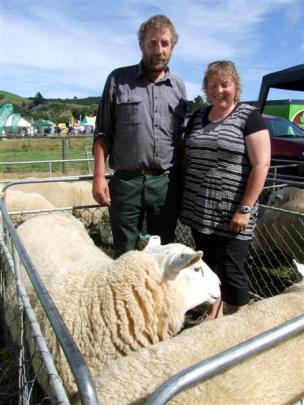
In the family ... Waitahuna West farmer Min Bain has continued a strong family interest in stud breeding. PHOTOS: SALLY RAETeam effort ... Gaynor and Chris Miller, from Glencoe, were displaying their Coopdale sheep at the Southfuels Farmarama.
Horses for courses ... Hindon Texel breeders Dave and Christine Graham find the breed is suited to their property.`Passionate' breeders hang inBy SALLY RAE Perfect balance ... PGG Wrightson wool representative Ben Martin finds a keen interest in rugby fits in well with his work.
RAM breeders who have stuck with the sheep industry are the ones who are ''pretty passionate about it'', Min Bain believes.
He and his wife, Lisa, with children Lochie (13) and Danielle (10), farm at Waitahuna West, near Lawrence, and breed Romney, Dorset Down and Romdale rams.
He was among nine ram breeders at the Southfuels Farmarama in Lawrence last week, which was an increase on previous years.
Brought up at Moa Flat and part of a well-known stud-breeding family, Mr Bain shifted with his family to Dunrobin in 2000 and then to Waitahuna West in 2008, moving from a 160ha property to a steep-to-rolling 330ha property.
He enjoyed breeding rams for clients that satisfied their needs and estimated he would sell about 230 rams this year, which was about 30 more than last year.
Rams went as far afield as Banks Peninsula, as well as Winton, Central Otago and South Otago.
He started his Longridge Romney stud when he was about 14 - his parents Ken and Dawn Bain used to have the Longview Romney stud - and added a Dorset Down stud to complement the Romneys, believing it to be one of the best meat breeds.
His type of Romney had changed over the years from the more traditional type to more of a North Island hill country type.
It was his father who started breeding Romdales and they were gaining popularity, he said.
Their ram clients were farming on harder country, as flatter land was increasingly being converted to dairy. Sheep were being pushed back into the hills, so they had to be able to cope with the conditions, he said.
Waitahuna West was a great area to farm and still a traditional sheep area, whereas his home territory of West Otago was becoming ''more and more cows''.
The next generation looked set to continue the farming tradition.
Lochie, who started at John McGlashan College this year, established a Dorset Down stud three years ago.
It was frustrating sheep farmers were producing some of the best product ever but were getting ''caned'' for it, Mr Bain said.
He believed all the companies needed to ''get together and be united'' and farmers also needed to be united.
Chris and Gaynor Miller, from Roslyn Downs Partnership at Glencoe, between Gore and Winton, were encouraged to attend the Farmarama by the suggestion of one of their ram clients.
The Coopdale and Texel breeders farm in partnership with their sons: Jason, who is a director of meat company Alliance Group, and Quentin, running sheep and beef on a 600ha property they own, and a 240ha property they lease.
Mr Miller started with the Coopworth and then crossed it with Perendale about 15 years ago to give better survivability and better meat yields.
It combined the best of both breeds - the fertility, mothering ability, growth rates and wool weights of the Coopworth, with the survivability, easy care, conformation, bulk and parasite tolerance of the Perendale. They then introduced the Texel as a terminal sire to increase yield even further, he said.
Genetics have always been an interest for Mr Miller and he maintained a strong belief in the sheep industry, saying there was still much country that was most suitable for sheep.
Their sons were both given the option of dairying ''but they were committed to sheep'', Mrs Miller said.
Mr Miller still looked after the stud side and bookwork, while most of the physical work on the farm was done by his sons.
''Seniority sort of holds a bit of sway,'' he said, laughing.
If David and Christine Graham did not have faith in the sheep industry, they would not have paid $13,000 for a ram last month, they said.
The Hindon farmers bought the top-priced ram, owned by Sam and Viki Holland, from Culverden, at the Canterbury A&P Association's stud ram fairThey established Ardachy Texels in 2008, buying about 50 registered and 60 unregistered ewes from Doug and Louise Deans in Palmerston.
They had been buying rams from Mr and Mrs Deans and when they retired, Mr and Mrs Graham decided they still wanted to be able to get Texel rams.
The couple, who also have commercial sheep and cattle, said they liked the toughness and survivability of the Texel breed.
''When it dries out, they turn some pretty average feed into good meat,'' Mr Graham said.
About two-thirds of their ewes lambed on steep, tussock country and it was cold country, so their sheep needed to be tough.
Mr and Mrs Graham, who were now selling between 30 and 40 rams, were aiming to continue to improve the wool and fertility. Their new acquisition would improve their genetics, they said.
PGG Wrightson wool representative Ben Martin was back in familiar territory at the Farmarama, having grown up in Lawrence where his parents, Jock and Marie, are shearing contractors.
Mr Martin (22), who attended King's High School in Dunedin as a boarder, spent a year at polytechnic studying outdoor pursuits before working on sheep and beef farms.
He then became a trainee with PGG Wrightson and was later promoted to wool representative. His patch extended from Dunedin to Lawrence, into Middlemarch and up to Palmerston.
A keen rugby player, he was turning out for Kaikorai this year and his goal was to eventually represent Otago. Rugby fitted in well with his work as ''farmers are always interested in rugby''. He reckoned he had the ''best of both worlds'', spending time both in the office and also out on farms and meeting people.
While he was familiar with the shearing side of the wool industry - he used to spend his school summer holidays on the end of a hand-piece - the fibre itself had been a new side, but he had learnt most aspects of the industry, he said.
Mr Martin hoped to eventually head overseas to play rugby but, in the meantime, he was ''taking things as they come''.
''I'm happy doing what I'm doing at the moment.''