

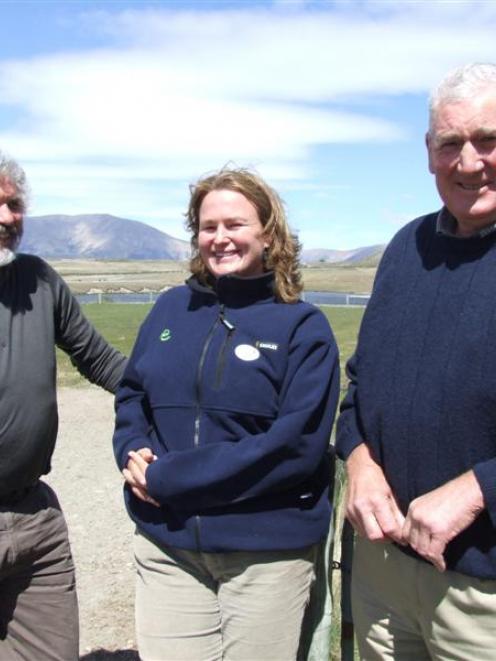
However, it was an exciting project and one that seemed "win-win" from all sides and all perspectives, he said.
Mr Ensor is part of a group driving the High Country Land Managers' Carbon Project, which was launched at Ben Avon Station, in the Ahuriri Valley, last week.
The project - the recipient of $185,000 for two years from the Ministry of Agriculture and Forestry's Sustainable Farming Fund - was a project born from concerns farmer Jim Morris had about the profitability of farming in the high country.
The project team's aim is to quantify what is happening in the carbon sequestration world with native scrublands, tussock grasslands and wetlands under different management regimes.
For Mr Ensor, a recently retired high country farmer, the project was "particularly attractive" when he heard about it.
The whole issue of carbon was a "big mystery" for the farming community at the moment and one they were finding quite frightening.
Knowledge would be a great thing.
The opportunity to be carbon neutral or to have a better understanding of carbon would be the greatest thing that could happen for farmers, he said.
To a degree, it was "stepping into the unknown" - and it had to be determined whether it was worth going any further - but he believed there would be many good spin-offs.
And it was "such a refreshing change" to have a project that was driven from the grassroots, Mr Ensor said.
Financial support has also been received from Environment Canterbury, Federated Farmers High Country, Merino Inc, Land Information New Zealand, Department of Conservation and Mr Morris, while philosophical supporters include the Forest and Bird Society, Federated Mountain Clubs, Central South Island Fish and Game, QEII National Trust and Waitaki District Council.
When it came to carbon, Mr Morris said he was trying to "make a glass half full rather than half empty", thinking how it could work for high country farmers.
In the normal course of events, the carbon tax farmers would have to pay in the future could be offset by plantings of exotic forestry.
However, in valleys like the Ahuriri, district plans precluded wholesale planting of exotic forestry.
The first part of the project was definitely the carbon - but there was a much bigger agenda in the project - all the eco-system services in the high country - the pristine waterways, biodiversity of species and landscape values, as well as carbon.
There was a long way to go, he said.
Mr Morris was thrilled such a cross-section of people was involved with the project.
"It's probably the biggest cross-section of people to take up a project in the high country, I can think of, without arguing about it. It's just fantastic," he said.
He particularly thanked ECan for its involvement and said he sadly could not commend the Otago Regional Council, which showed no interest in the project.
Considering the high country area Otago had, he found that "quite extraordinary".
Landcare Research plant ecologist Larry Burrows said Mr Morris was "pushing the limits" in all ways - political, social, environmental, economic and scientific.
Carbon was a sensible place to start, but the project had to think beyond that as well.
Sequestration of soil carbon resulting from land use change might be a starting point but it might not happen.
What was happening with soil carbon was a "big unknown".
There was very little data on high country soil carbon, no data on high country ecosystem carbon and no data that combined land use history and eco system carbon.
The plan this summer was to identify an initial set of potential sample sites on high country properties where there had been a known historical change in land use, such as retirement, destocking or managed reduction in grazing.
The older the known change the better and, while Mr Burrows had indicated a minimum site of 20ha, he would prefer more than 100ha.
From the initial list, there would be a follow-up with landowners and three or four sites selected for intensive sampling of vegetation and soil to assess carbon stocks, probably in March or April next year.
It would be good to cover a range of climates - dry, medium rainfall and wet properties.
In year two of the exercise, the data would be analysed and then it would be fed into developing a carbon land-use surface for the high country.
Mary-Ann Morris said the project specifically would rebuild the high country community which had been "knocked about" by things like the media and tenure review.
"It would be really nice now to get some positive stuff back amongst our families," she said.