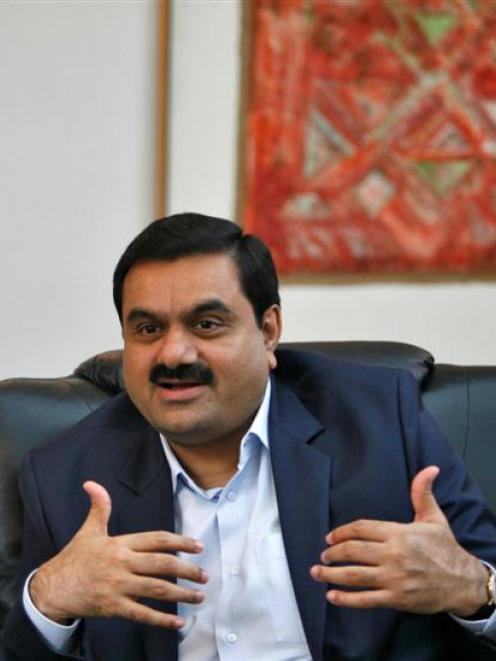
The Jindal family, ranked among the world's top 80 richest by Forbes, in May bought two minor stakes, worth a total of $A26 million, in Australian iron ore and coal mines through Jindal Steel & Power.
That followed a $US2 billion purchase by Indian self-made billionaire and college-dropout Gautam Adani of a coal mine in the state of Queensland last year.
Silverneedle Hospitality, a company backed by Nadathur S. Raghavan, an Indian philanthropist and co-founder of software company Infosys Technologies, just bought a hotel in Brisbane for A$57 million. Last year, it bought a chain of about 60 hotels in Australia and New Zealand for an undisclosed sum.
"In the last six to nine months, there has been a lot of private investment into Australia because it is seen as a safe-haven," said Paul Dowling, principal analyst at banking research firm East & Partners.
While Indian nationals have traditionally favoured Britain and North America as offshore investment destinations, private wealth bankers have noticed a growing demand for Australian real estate, particularly hotels and serviced apartments.
This comes as no surprise to Singapore-based Paul Guest, head of research and strategy at LaSalle Investment Management, as commercial property prices in Australia are very attractive.
With a forecast of about 10 percent per year, he said total returns in Australia are the highest in Asia, topping Japan's 9 percent and South Korea.
Also underpinning demand is Australia's relatively strong economic performance compared with Western peers.
Indeed, Australia is one among a select club of only eight nations that can still boast a pristine triple A rating with a stable outlook.
Dubbed the lucky country for its abundance of natural resources, white sand beaches and kind climate, it is now entering its 21st year of uninterrupted annual growth, having dodged a recession after the 2008 global financial crisis.
This year, Australia will overtake Spain as the world's 12th largest economy, despite being 52nd in terms of population.
This explains the massive increase in Australia's foreign direct investment which leapt to $A67 billion in 2012, nearly double the previous year, according to government statistics.
Still, private investment from India, a country that produces millionaires every day, would appear to lag that from others such as China.
Analysts reckon China is leading the pack though the Australian government does not keep statistics on direct investment by nationality.
For Arjuna Mahendran, head of Asian investment strategy at HSBC's private bank in Singapore, the lag is due to a general perception in India that Australian incentives are not as generous as those of other countries.
That is one reason the Australian government will next month launch a "significant investor" visa programme, with the aim of competing with New Zealand, Canada and Singapore in attracting a growing number of Asia's rich.
India is home to more than 7,000 millionaires whose fortunes amount to nearly $1 trillion, data from global wealth intelligence firm Wealth X shows.
Combined with $465 billion held by Indian nationals living outside their home country, the total is roughly equivalent to the size of Australia's entire economy.
Analysts speculate that within five years, India could have pumped as much as $30 billion into Australia.
The new Australian visas will target individuals who invest at least A$5 million in certain assets, such as infrastructure government bonds, in return for concessions on the usual migration requirements including qualifications and English skills.
Such immigration schemes tend not only to bring much-coveted long-term investment, but also contribute to economic growth and job creation.
Indian nationals seem well-placed to benefit from the programme. India has become Australia's biggest source of migrants, including a large number of IT entrepreneurs.
"Many of them are very interested in exploring the path to permanent residency," said Mark Wright, immigration leader partner at Deloitte Australia.