Cameron has said he is ready to veto the EU's seven-year budget and has attacked its "ludicrous" spending plans, in comments likely to fuel a view among many in Europe that London is drifting away from the 27-nation union.
German officials are exasperated by what they see as London's move towards Europe's margins, a feeling reinforced last week by the British parliament's vote calling for a real-terms cut in the EU's 1 trillion euro budget.
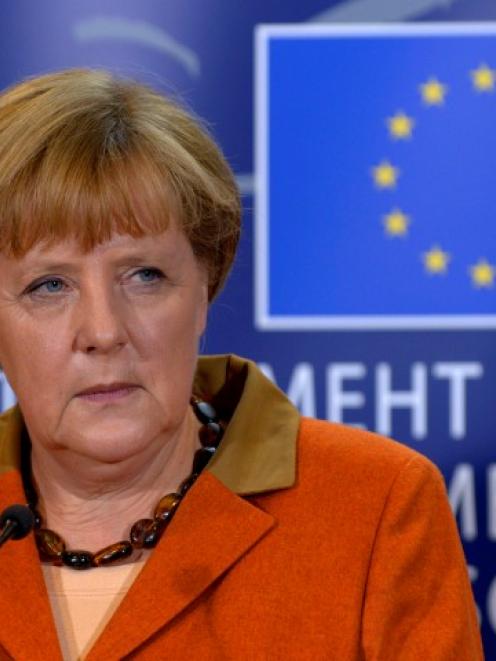
Before the talks, Merkel told the European Parliament she could not imagine a Europe without Britain, the world's sixth largest economy which relies on the EU for half its trade.
"I believe you can be very happy on an island, but being alone in this world doesn't make you any happier," Merkel said after British politician Nigel Farage, leader of the anti-European UK Independence Party, urged her to tell Cameron that Britain should leave the EU.
Cameron, who wants to stay in the bloc, will back a real-terms freeze in its budget for 2014-2020. He argues the EU must tighten its belt at a time of austerity and shrinking household budgets in many countries.
He was humiliated by the parliamentary defeat and opponents have accused him of losing control over his Conservative Party's anti-Europeans, a group that helped bring down former leaders and that wants a referendum on Britain's EU membership.
Cameron said there should be a separate budget for the EU's crisis-hit, 17-state, euro zone currency union, of which Britain is not a member.
"They are proposing a completely ludicrous 100 billion euro ($128.01 billion) increase," Cameron said. "I never had very high hopes for a November agreement because you have got 27 different people round the table with 27 different opinions."
Debate over a referendum on Britain reworking its EU role or even leaving has risen up the political agenda. A YouGov survey in October found 49 percent of those polled would vote to leave the EU if they were given a say, against 28 percent who would vote to remain in it.
'GOOD DEAL'
Before the talks with Merkel, Cameron's spokeswoman denied suggestions Britain was slowly disengaging with Europe after nearly 40 years as a member of the EU and its predecessors.
"The prime minister is very much engaging with discussions on the EU budget and wants to ensure that we get a good deal for the British taxpayer," she said.
Cameron's threat to block a budget deal could delay a funding increase for the poorest east European member states and isolate Britain from disgruntled EU nations. He has already ruffled feathers by talking of using closer euro zone integration as a chance to repatriate some powers from Brussels.
France and Denmark have also threatened to block a budget deal to press their own interests, highlighting the obstacle course facing EU leaders later this month.
The budget accounts for just over 1 percent of EU gross domestic product, compared to between 40 and 56 percent spent on national budgets. Most EU money is spent on agriculture (around 40 percent) and regional development in poorer parts of the bloc (about 35 percent), with the balance going on research, overseas development aid and 6 percent on administration.
Merkel said last week that veto threats would not help the EU's budget negotiations. Germany is the biggest net contributor to the budget while Britain, which receives an annual rebate on its payments, is the fourth largest net payer after France and Italy.