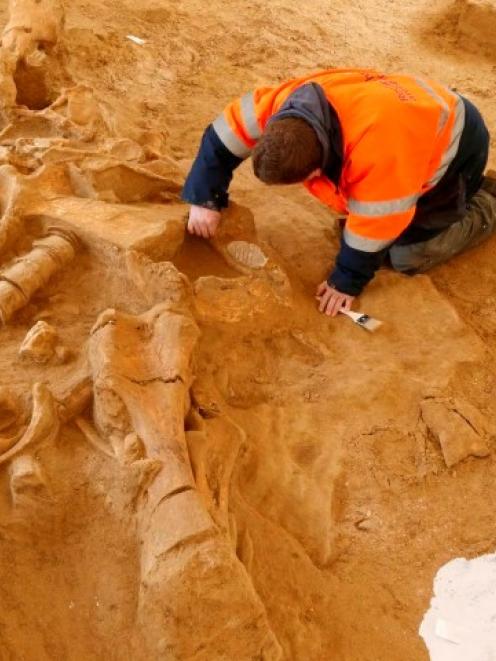
The archaeologists say that if that hypothesis is confirmed, their find would be the clearest ever evidence of interaction between mammoths and ancient cavemen in this part of Europe.
"Evidence this clear has never been found before, at least in France," said Gregory Bayle, chief archaeologist at the site.
"We're working on the theory that Neanderthal men came across the carcass and cut off bits of meat."
Archaeologists came across the giant bones by accident while they were excavating ancient Roman remains in a quarry near the town of Changis-sur-Marne, 30km east of Paris.
The mammoth, which the archaeologists have named "Helmut", is thought to be between 100,000 and 200,000 years old and is only the fourth near-complete specimen to be found in France. The first was dug up near the southeastern city of Lyon in 1859.
Scientists believe Helmut, a woolly mammoth, may have become stuck in mud or drowned.
Two tiny shards of flint found among the bones indicate that cavemen cut into the body, but make it unlikely they actually killed the creature. To come to that conclusion, the archaeologists would have expected to find a whole flint head.
Mammoth remains are commonest in the frozen climates of Siberia, where around 140 specimens have been found including some of the world's best-preserved carcasses.
The prehistoric animal disappeared from Western Europe around 10,000 years ago, most likely due to climate change and hunting.