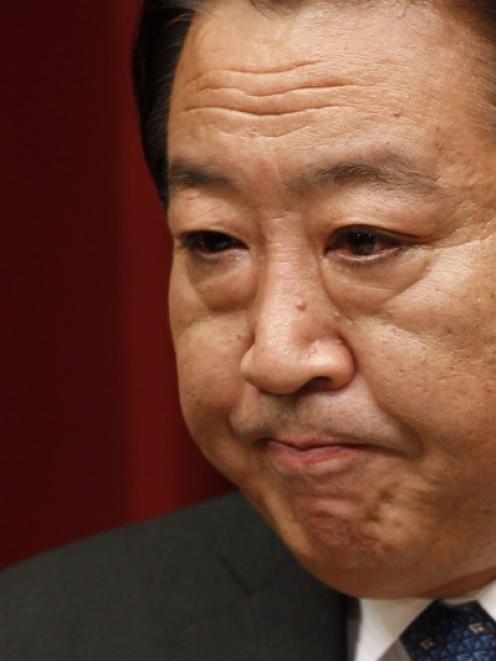
The unpopular Noda may be hoping to emulate charismatic leader Junichiro Koizumi's bold election gamble in 2005 and use a call for a major economic reform to ease the bashing his Democratic Party is expected to suffer at the hands of disappointed voters.
The maverick Koizumi's pledge to privatise the giant postal system as a symbol of vital reforms, despite opposition from lawmakers in his own party, helped him lead the then-ruling Liberal Democrats to a stunning election victory.
Now Noda, with voter support for his cabinet below 20 percent, wants to enshrine backing for the U.S.-led Trans-Pacific Partnership (TPP) trade pact in his Democratic Party of Japan's (DPJ) new campaign platform.
"We will simultaneously pursue the TPP and the free trade agreement between Japan, China and South Korea and this stance will be included in our manifesto," Noda told reporters over the weekend.
But Noda faces opposition from his ruling party MPs who fear a backlash from Japan's politically powerful farmers. Japan's farmers say a flood of cheap agricultural imports will devastate their heavily protected, small-scale operations.
The main opposition Liberal Democratic Party (LDP) opposes joining the TPP negotiations if the end result is the elimination of all tariffs. The TPP aims to tear down traditional barriers to trade.
"I think an election is close," Motohisa Furukawa, a former National Strategy Minister, told Reuters last week, adding that a December 16 vote was possible. "I don't think the situation will improve if we put it off."
DEFEAT LOOMS FOR NODA
Political analysts are not convinced Noda can steal victory at the ballot box like Koizumi, but how badly the Democrats will lose is unclear given lukewarm voter support for the LDP and the wild card of new parties such as one led by populist Osaka Mayor Toru Hashimoto.
"It wasn't that the public liked postal reform. The public liked Koizumi," said Gerry Curtis, a Columbia University political science professor.
"The problem is, the public doesn't particularly like Noda. I think what he may be after is to go down in history as the one who got the consumption tax increase and TPP."
In August, Noda persuaded the LDP and its smaller partner, the New Komeito, to back a bill to double the sales tax to 10 percent by 2015 in order to curb bulging public debt.
In return for their help in passing the bill in the opposition-controlled upper house, he promised to call a general election "soon".
Japanese business executives are pushing strongly for Tokyo to join the U.S.-led trade deal, arguing Japan will fall further behind regional rivals China and South Korea if it stays out of the pact, which so far includes the United States Australia, New Zealand, Vietnam, Malaysia, Singapore, Brunei, Chile and Peru.
Noda is Japan's sixth prime minister since 2006, when Koizumi ended a rare five-year term, and the third since the Democrats won a landslide victory in 2009, ending more than half a century of nearly non-stop LDP rule.
Since gaining office three years ago, the Democrats have fallen into policy confusion and political deadlock.
Pressure is mounting on Noda to call an election for parliament's lower house before year-end, although some in his party would prefer to delay the day of reckoning.
Lower house members' four-year terms run through August 2013 but scenting victory, the LDP and the New Komeito want Noda to keep his pledge to call a poll now.
Hoping to force his hand, they are poised to help pass key bills Noda has set as conditions for calling an election.
A law to allow the government to issue bonds to help finance the budget now looks set to pass, as does legislation to reduce vote disparities between urban and rural election districts that the Supreme Court has ruled unconstitutional.
But Noda could still decide to wait until next year to face Japanese voters, perhaps dissolving the lower chamber soon after the start of a regular session expected to begin in January.
"Noda's job is to minimise the damage to the party," said Tsuneo Watanabe, a senior fellow at the Tokyo Foundation think-tank. "If he wants to avoid a total bashing, the election should not be this year."