"We've been working in non-stop shifts," said an official with Rafael Advanced Defence Systems Ltd, which developed the system. He declined to be named for security reasons.
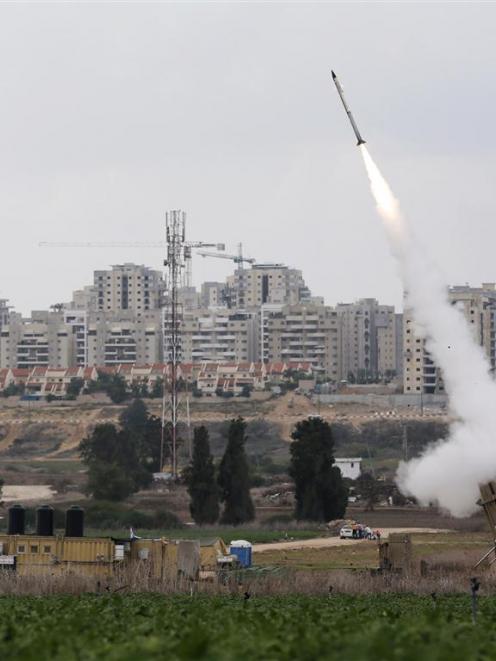
Equipped with five of the boxed-shaped batteries, the Israeli military says it has fired 360 missiles since the start of operation "Pillar of Defence" last Wednesday, which it says is aimed at halting rocket fire out of the coastal enclave.
Iron Dome's radar-guided interceptor missiles target only rockets the system calculates will land in urban areas and blow them up mid-air. A military source said it was having a 90 percent success rate.
If more Hamas rockets had got through, especially the handful fired at Tel Aviv, and caused mass casualties, devastating Israeli retaliation, perhaps including a full-scale ground assault, would have been nearly certain.
Each interception costs $30,000 to $50,000, according to former Defense Minister Amir Peretz. Israel argues that proves cost-effective in preventing lethal strikes, which could trigger a vastly more expensive war.
Sometimes two missiles are used against incoming rockets. Prior to this week's fighting Israel had stockpiled the interceptors - whose exact quantity is a state secret.
"Outstanding success rates have been achieved so far," said Avi Leshem, an official with ELTA, a smaller firm involved in the project. He said company employees were working "night and day" to ensure the batteries stay in service.
The head of Israel's air defence corps, Brigadier-General Shahar Shochat, said this week that the Iron Dome units could continue fighting "as required".
An industry source familiar with production standards for such weapons, estimated that at full output a company like Rafael would be able to produce around 10 missiles a day.
The fifth Iron Dome unit, rushed through production and posted near Tel Aviv on Saturday, features improved capabilities for tackling longer-range rockets.
Israel says it needs 13 batteries altogether for nationwide defence. Given the Gaza flare-up, the defence ministry is currently earmarking funds, including from annual U.S. grants, for about three more units.
The Rafael official said the firm now needed "months" to produce each full system, whereas it once took a few years.
"Once the basic research and development was out of the way, that speeded up manufacturing. Obviously now, with various elements of the production being especially busy, that gives the whole operation another boost," he said, adding that a sixth battery was not expected in the near future.
And with every interception, Israel learns more about the rockets being fired at it from Gaza.
"You can tell a lot from the strength of the blast" about what kind of warhead had been used, the official said. Information on the rocket's trajectory and speed are also filed away and studied afterwards.
Israel hopes to increase the range of Iron Dome's interceptions, from the current maximum of 70 km to 250 km.
Each battery costs Israel around $50 million, though the export price would likely be higher. And there is already "considerable interest" in the system overseas, ELTA said in a statement.
"But all we are thinking about is supplying Israel with its needs," the Rafael official said. "Israel comes first."