Egypt's stock market plunged on Sunday in its first day open since Mursi issued a decree late on Thursday temporarily widening his powers and shielding his decisions from judicial review, drawing accusations he was behaving like a new dictator.
More than 500 people have been injured in clashes between police and protesters worried Mursi's Muslim Brotherhood aims to dominate the post-Hosni Mubarak era after winning Egypt's first democratic parliamentary and presidential elections this year.
The country's highest judicial authority hinted at compromise to avert a further escalation, though Mursi's opponents want nothing less than the complete cancellation of a decree they see as a danger to democracy.
The Supreme Judicial Council said Mursi's decree should apply only to "sovereign matters", suggesting it did not reject the declaration outright, and called on judges and prosecutors, some of whom began a strike on Sunday, to return to work.
Mursi will meet the council on Monday, state media said.
Mursi's office repeated assurances that the measures would be temporary, and said he wanted dialogue with political groups to find "common ground" over what should go in Egypt's constitution, one of the issues at the heart of the crisis.
Hassan Nafaa, a professor of political science at Cairo University, saw an effort by the presidency and judiciary to resolve the crisis, but added their statements were "vague". "The situation is heading towards more trouble," he said.
Sunday's stock market fall of nearly 10 percent - halted only by automatic curbs - was the worst since the uprising that toppled Mubarak in February, 2011.
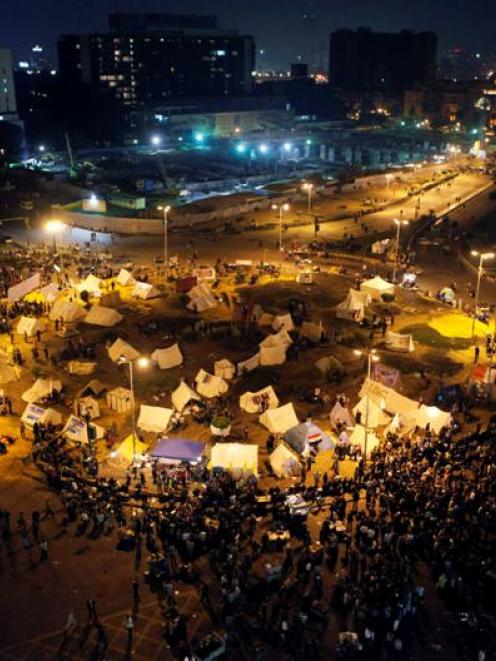
Images of protesters clashing with riot police and tear gas wafting through Cairo's Tahrir Square were an unsettling reminder of that uprising. Activists were camped in the square for a third day, blocking traffic with makeshift barricades. Nearby, riot police and protesters clashed intermittently.
Mursi's supporters and opponents plan big demonstrations on Tuesday that could be a trigger for more street violence.
"We are back to square one, politically, socially," said Mohamed Radwan of Pharos Securities, an Egyptian brokerage firm.
Mursi's decree marks an effort to consolidate his influence after he successfully sidelined Mubarak-era generals in August. It reflects his suspicions of a judiciary little reformed since the Mubarak era.
Issued just a day after Mursi received glowing tributes from Washington for his work brokering a deal to end eight days of violence between Israel and Hamas, the decree drew warnings from the West to uphold democracy. Washington has leverage because of billions of dollars it sends in annual military aid.
"The United States should be saying this is unacceptable," former presidential nominee John McCain, leading Republican on the Senate Armed Services Committee, said on Fox News.
"We thank Mr. Mursi for his efforts in brokering the ceasefire with Hamas.... But this is not what the United States of America's taxpayers expect. Our dollars will be directly related to progress toward democracy."
The Mursi administration has defended his decree as an effort to speed up reforms that will complete Egypt's democratic transformation. Yet leftists, liberals, socialists and others say it has exposed the autocratic impulses of a man once jailed by Mubarak.
"There is no room for dialogue when a dictator imposes the most oppressive, abhorrent measures and then says 'let us split the difference'," prominent opposition leader Mohamed ElBaradei said on Saturday.
WARNINGS FROM WEST
Investors had grown more confident in recent months that a legitimately elected government would help Egypt put its economic and political problems behind it. The stock market's main index had risen 35 percent since Mursi's victory. It closed on Sunday at its lowest level since July 31.
Political turmoil also raised the cost of government borrowing at a treasury bill auction on Sunday.
"Investors know that Mursi's decisions will not be accepted and that there will be clashes on the street," said Osama Mourad of Arab Financial Brokerage.
Just last week, investor confidence was helped by a preliminary agreement with the International Monetary Fund over a $4.8 billion loan needed to shore up state finances.
Mursi's decree removes judicial review of decisions he takes until a new parliament is elected, expected early next year.
It also shields the Islamist-dominated assembly writing Egypt's new constitution from a raft of legal challenges that have threatened it with dissolution, and offers the same protection to the Islamist-controlled upper house of parliament.
"I am really afraid that the two camps are paving the way for violence," said Nafaa. "Mursi has misjudged this, very much so. But forcing him again to relinquish what he has done will appear a defeat."
Many of Mursi's political opponents share the view that Egypt's judiciary needs reform, though they disagree with his methods. Mursi's new powers allowed him to sack the prosecutor general, a holdover from the Mubarak era who is unpopular among reformists of all stripes.