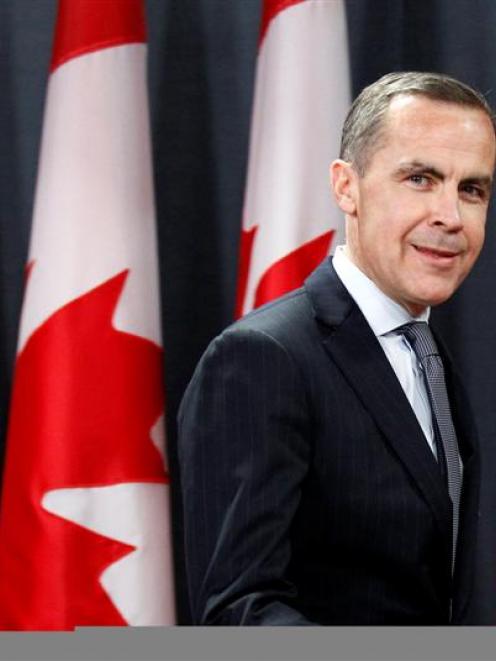
A former Goldman Sachs investment banker who as central bank head guided the Canadian economy through the global economic crisis, Carney will succeed Mervyn King who retires next July.
"He is quite simply the best, most experienced and most qualified person in the world to be the next Governor of the Bank of England," finance minister George Osborne told parliament in announcing the appointment.
During the crisis, Carney helped to make Canada's recession one of the shallowest of the world's richest nations. No Canadian bank needed government help, and the country recovered all the jobs it lost in the downturn relatively rapidly.
By contrast, Britain had to bail out some of its biggest banks and the economy is struggling to achieve growth four years after the crisis broke.
Carney also heads the Financial Stability Board (FSB), a Basel-based body that sets global banking rules.
"This will be a very important transitional phase for both the institution itself, the Bank of England, but above all for the British economy," Carney told a news conference in Ottawa.
From next year the BoE will take charge of British financial regulation, almost doubling its size. This boosted the case for a governor with strong management skills and financial market experience, rather than someone in King's academic mould.
Carney said he would help the British economy as it tries to reduce its reliance on financial services.
"I can play a constructive role ... in relaunching this institution with its new responsibilities, contributing to price stability, to financial stability and to ensuring that the rebalancing of the UK economy - which is underway - ... is seen through over the course of the next five years."
Carney's past as a Goldman Sachs investment banker has been a double-edged sword, as he fought to prove his loyalties lie with ordinary citizens, not his high-flying banker ex-colleagues. He clashed memorably last year with JPMorgan Chase & Co Chief Executive Jamie Dimon in Washington as the banker argued against new regulations for the financial sector.
Until now, Carney had strongly played down the possibility of heading the British central bank. "(It's a) surprise, huge surprise," said Peter Dixon, an economist with Commerzbank. "That was the one guy I didn't have in the running."
The athletic-looking Carney will now become Britain's most powerful unelected public figure, responsible for setting interest rates and looking after the banking sector.
Britain's government had been widely expected to pick Deputy Governor Paul Tucker as the new chief, ignoring calls for a more radical option to shake up the central bank.
"Mr Carney is unique amongst the potential candidates in combining long experience of central banking, huge international credibility in economics, deep expertise in financial regulation and a first hand experience of private sector financial institutions," Osborne said.
Pressure on Carney will be high and financiers in the City of London would expect him to act quickly to jolt Britain's $2.5 trillion economy out of stagnation, prevent bubbles and keep the financial sector safe.
Carney is not a British national, although Osborne said he would apply for UK citizenship. He studied at Oxford University.
Carney will serve at the Bank of Canada until May, and then starts at the Bank of England in July. He will serve a five-year term, rather than the eight-year term that had been expected for the next BoE governor.
"Perhaps one factor in Carney's favour is the Canadian banks were very highly regulated before the credit crisis and accordingly the Canadian banking system is in good shape," said Philip Shaw of Investec.
"One thing we would expect is the new governor sets about delegating responsibility very quickly, given the enormity of the tasks that the Bank of England is taking on."
Other figures earlier named as possible successors had included Financial Services Authority chairman Adair Turner, John Vickers, author of a government report on bank reform, and Terence Burns, a former top finance ministry civil servant.