President Mohamed Mursi had been due to address the nation, but a presidential source said the Islamist leader, criticised by his opponents for his silence in the last few days, might speak on Friday instead. He did not explain the possible delay.
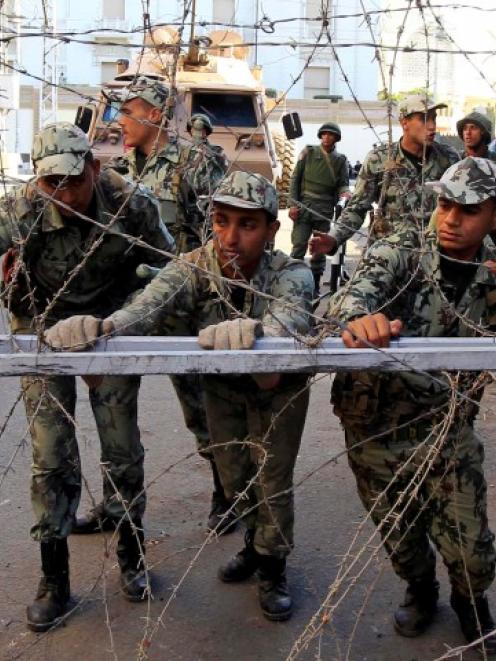
Hundreds of Mursi supporters who had camped out near the palace overnight withdrew before a mid-afternoon deadline set by the Republican Guard, an elite unit whose duties include protecting the palace. Scores of opposition protesters remained, but were kept away by a barbed wire barricade guarded by tanks.
The military played a big role in removing President Hosni Mubarak during last year's popular revolt, taking over to manage a transitional period, but had stayed out of the latest crisis.
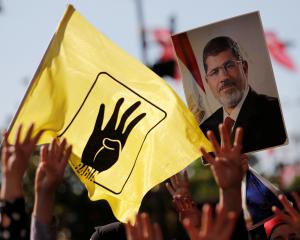
Mursi's Islamist partisans fought opposition protesters well into the early hours during duelling demonstrations over the president's Nov. 22 decree to expand his powers to help him push through a mostly Islamist-drafted constitution.
Officials said seven people were killed and 350 wounded in the violence, for which each side blamed the other. Six of the dead were Mursi supporters, the Muslim Brotherhood said.
Prosecutors investigating the unrest said Brotherhood members had detained 49 wounded protesters and were refusing to release them to the authorities, the state news agency said.
The Brotherhood's spokesman Mahmoud Ghozlan denied this, saying all "thugs" detained by members of the Islamist group had been handed over to the police or the Republican Guard.
The street clashes reflected a deep political divide in the most populous Arab nation, where contrasting visions of Islamists and their liberal rivals have complicated a struggle to embed democracy after Mubarak's 30 years of one-man rule.
MILITARY'S ROLE
The United States, worried about the stability of an Arab partner which has a peace deal with Israel and which receives $1.3 billion a year in U.S. military aid, has urged dialogue.
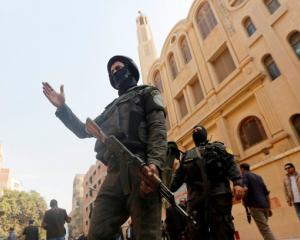
The commander of the Republican Guard said deployment of tanks and troop carriers around the presidential palace was intended to separate the adversaries, not to repress them.
"The armed forces, and at the forefront of them the Republican Guard, will not be used as a tool to oppress the demonstrators," General Mohamed Zaki told the state news agency.
Hussein Abdel Ghani, spokesman of the opposition National Salvation Front, told Reuters more protests were planned, but not necessarily at the palace. "Our youth are leading us today and we decided to agree to whatever they want to do," he said.
Outside Cairo, supporters and opponents of Mursi clashed in his home town of Zagazig in the Nile Delta, state TV reported.
Egypt plunged into renewed turmoil after Mursi issued his Nov. 22 decree and an Islamist-dominated assembly hastily approved a new constitution to go to a referendum on Dec. 15.
Since then six of the president's advisers have resigned. Essam al-Amir, the director of state television quit on Thursday, as did a Christian official working at the presidency.
The Supreme Guide of the Brotherhood, to which Mursi belonged before he was narrowly elected president in June, appealed for unity. Divisions among Egyptians "only serve the nation's enemies", Mohamed Badie said in a statement.
BLOODY CLASHES
Rival factions used rocks, petrol bombs and guns in the clashes around the presidential palace.
"We came here to support President Mursi and his decisions. He is the elected president of Egypt," said demonstrator Emad Abou Salem, 40. "He has legitimacy and nobody else does."
Opposition protester Ehab Nasser el-Din, 21, his head bandaged after being hit by a rock the day before, decried the Muslim Brotherhood's "grip on the country", which he said would only tighten if the new constitution is passed.
Mursi's opponents accuse him of seeking to create a new "dictatorship". The president says his actions were necessary to prevent courts still full of judges appointed by Mubarak from derailing a constitution vital for Egypt's political transition.
U.N. Human Rights Commissioner Navi Pillay urged the Egyptian authorities to protect peaceful protesters and prosecute anyone inciting violence, including politicians.
"The current government came to power on the back of similar protests and so should be particularly sensitive to the need to protect protesters' rights to freedom of expression and peaceful assembly," Pillay said in Geneva.
Mursi has shown no sign of buckling under pressure from protesters, confident that the Islamists, who have dominated both elections since Mubarak was overthrown, can win the referendum and the parliamentary election to follow.
Mahmoud Hussein, the Brotherhood's secretary-general, said holding the plebiscite was the only way out of the crisis, dismissing the opposition as "remnants of the (Mubarak) regime, thugs and people working for foreign agendas".
As well as relying on his Brotherhood power base, Mursi may also tap into a popular yearning for stability and economic revival after almost two years of political turmoil.
Egypt's pound hit an eight-year low on Thursday, after previously firming on hopes that a $4.8 billion IMF loan would stabilise the economy. The stock market fell 4.6 percent.
Foreign exchange reserves fell by nearly $450 million to $15 billion in November, indicating that the Central Bank was still spending heavily to bolster the pound. The reserves stood at about $36 billion before the anti-Mubarak uprising.