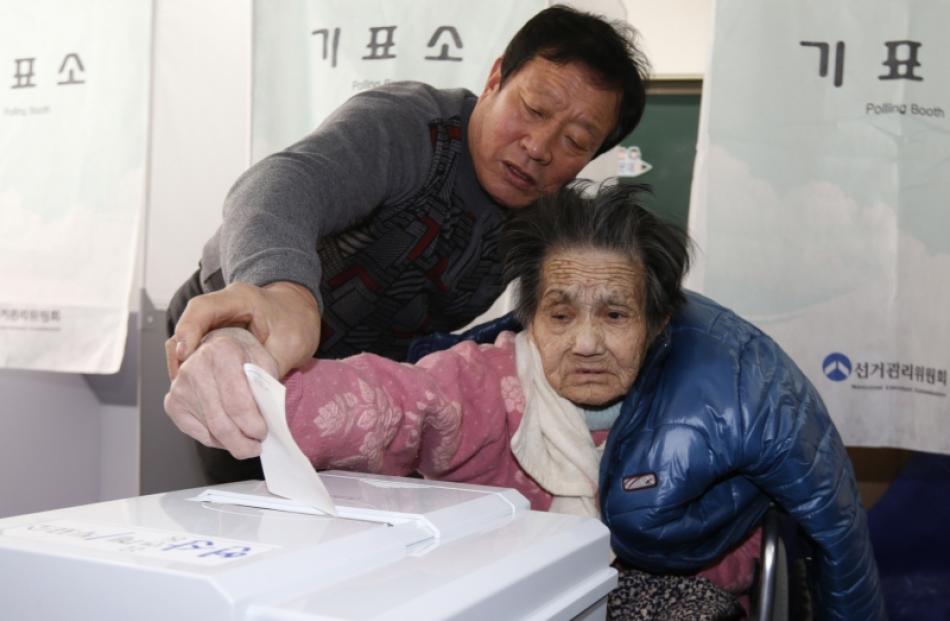
South Koreans voted in freezing winter temperatures for a new president in a battle between the daughter of their former military ruler and a man her father jailed for political activism.
The next president of Asia's fourth largest economy will have to deal with a hostile North Korea, under young and untested new leader Kim Jong-un, and a slowing domestic economy.
Conservative candidate Park Geun-hye had a narrow lead in polls published last week, the last allowed under election rules. If she wins, she would be the first woman leader of the country, which is still largely run by men in dark suits.
"I trust her. She will save our country," said Park Hye-sook, 67, who voted in the same polling station as her namesake and was out with a friend doing her morning exercises when she heard that Park Geun-hye was about to arrive.
"Her father ... rescued the country," the housewife and grandmother said.
The 60-year-old daughter of Park Chung-hee has pledged dialogue with impoverished North Korea, whose rocket launch last week reinforced fears it is developing a long-range missile. She has promised a tough line on the isolated North's nuclear and missile programmes.
Park, wearing a red muffler, was cheered by crowds chanting her name as she entered the polling station and urged voters to "open a new era".
Her left-of-centre challenger, Moon Jae-in, is a former human rights lawyer who has promised unconditional aid for North Korea and to reintroduce an engagement policy that ushered in closer ties between the Cold War rivals.
Those ties started unravelling with the shooting by North Korea of a tourist from the South in 2008, and deteriorated with the sinking of a South Korean warship in 2010, which the North denies, and the shelling of a South Korean island the same year.
Moon cast his ballot in the southern city of Busan and said voters left disenchanted by five years of conservative rule under Lee Myung-bak, who is constitutionally limited to a single term, had the chance to "change the world with their vote".
Gangnam style promise
More than 40 million people are eligible to vote and political analysts have said turnout has to be in the high 70 percent range for Moon to win. Moon has promised to perform global pop sensation Psy's Gangnam Style "horse dance" if turnout is 77 percent.
The polls opened at 6am (local time) and close at 6pm, when the three network television stations will announce the result of a jointly conducted exit poll.
Five hours into voting, 10.7 million South Koreans amounting to 26.4 percent of the electorate, had braved freezing temperatures to cast their ballots, a higher turnout than five years ago, according to the state election commission.
The cold weather - minus 10degC in the capital Seoul early in the day and forecast to remain below freezing throughout the day - was likely to have an impact on turnout, which had been expected to be high.
Many analysts forecast a tight race between the two front-runners, who were separated by as little as 0.5 percentage point in some polls, with Moon making late gains on Park.
While Park's bid to become president has stirred debate and divisions about her father's rule, and the prospect of a nuclear-armed North Korea also hangs over the country, the main issue in the election has been the economy.
While outwardly successful and home to some of the world's biggest companies, such as Samsung Electronics and Hyundai Motor, South Korean society has become steadily more unequal.
The hundreds of thousands of graduates that its universities churn out each year complain they have trouble finding decent jobs and, while South Korea is now the 29th richest country in the world in terms of gross domestic product per capita, income differentials have widened sharply.
Park has proposed more social welfare under what she terms "economic democratisation" but has given few specifics. Her party says it will not spend more money to boost the economy.
Park, who has never married nor had children, has advocated a broader welfare policy than when she ran five years ago, when she failed to win the conservative presidential nomination, and has proposed paying for it by cutting wasteful spending.
Moon, by contrast, has proposed an $US18 billion jobs package, boosting maternity pay and taxing the super-rich. He has also pledged to repeal a controversial free trade agreement with the United States.
While North Korea was the main issue for just 4.7 percent of voters, according to a poll by broadcaster SBS taken last week, the 18-year rule of Park's father still divides Koreans and will be on the minds of many voters.
The elder Park took power in a 1961 coup and helped push South Korea from poverty to developed nation status, but at the cost of repressing human rights and democracy.
His wife was shot by a North Korean-backed assassin who was gunning for him in 1974 and his then young daughter took on the role of South Korea's first lady until Park's own killing in 1979 by his security chief after a drunken night out.
Park has at times sought to appeal to the spirit that her father embodied. On Tuesday she evoked his economic call to arms of "Let's Live well" in a bid to rally her party faithful.
But at other times she has stumbled over apologies to victims of her father's rule and sought to appeal to her mother's softer image.
Moon, jailed in 1975 when he was a student activist, has attacked Park "for living the life of a princess". His only political experience was as an aide to former President Roh Moo-hyun, who was his law partner.