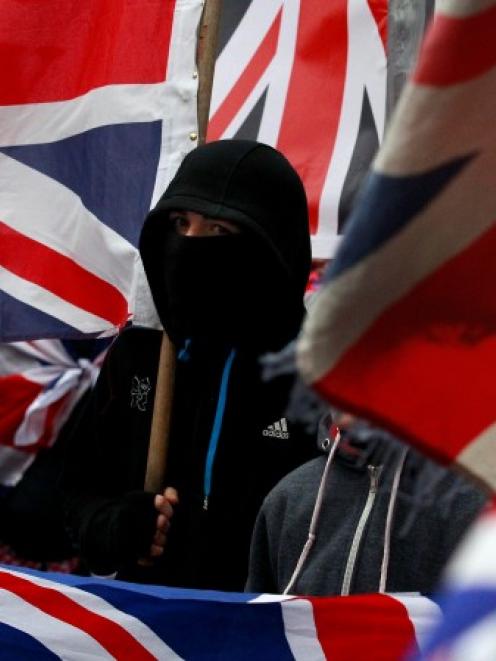
The violence, which stems from Loyalist protests over the removal of the British flag over Belfast City Hall, is among the worst in the province since a 1998 peace accord ended three decades of sectarian conflict.
Shots were fired at police on Saturday (local time) during a third successive day of street battles in which rioters attacked officers with petrol bombs, bricks and other missiles.
Police said on Sunday that 70 people had been arrested, including a 38-year-old man on Saturday on suspicion of attempted murder over the shooting.
Police had said that members of pro-British militant groups helped orchestrate and took part in the first wave of violence in early December. The Police Federation for Northern Ireland (PFNI) said the recent attacks showed this was now clearly the case.
"What it quite clearly demonstrates is the fact that paramilitaries have hijacked this flags protest issue and they have now turned their guns on the police," federation chairman Terry Spence told BBC radio.
"It is very clear that there are leading members of the UVF (Ulster Volunteer Force), who are exploiting this and are organising and orchestrating this violence against police officers who are out there trying to uphold the law and prevent anarchy on our streets."
Both the UVF and Northern Ireland's other main loyalist militant group the Ulster Freedom Fighters ceased hostilities in 2007 and decommissioned their stocks of weapons following the signing of the peace deal.
At least 3600 people were killed in the 30 years of violence as Catholic nationalists seeking union with Ireland fought British security forces and mainly Protestant loyalists determined to remain part of the United Kingdom.
In scenes that recalled that earlier strife, pro-British loyalists began rioting in early December after a vote by mostly nationalist pro-Irish councillors to end the century-old tradition of flying Britain's Union flag from the city hall.
"NO STOMACH FOR THIS"
Analysts said that although the violence was worrying, the small numbers of protestors indicated they might unable to develop any strength.
"Clearly the violence is a step up in terms of what's happened more recently but they're simply not getting people out on the street," said Peter Shirlow, a professor at Queen's University who has spoken with 0protestors in recent days.
"Protestants are annoyed about the flag but they're even more annoyed about the violence. There's no stomach for this, that mass mobilisation is just not there any more."
The police federation's Spence said however it was the most challenging time for police in a decade.
Militant nationalists, responsible for the killings of three police officers and two soldiers since an increase in tensions from 2009, have also not reacted violently to the flag protests, limiting any threat to the 15 years of peace.
The British-controlled province's first minister, Peter Robinson, said on Friday that rioters were playing into the hands of nationalist groups who would seek to exploit every opportunity "to further their terror aims".
The moderate nationalist Social Democratic and Labour Party (SDLP) party said on Sunday that shots were fired using a ball-bearing gun at the house of one its councillors in Belfast, shattering windows.