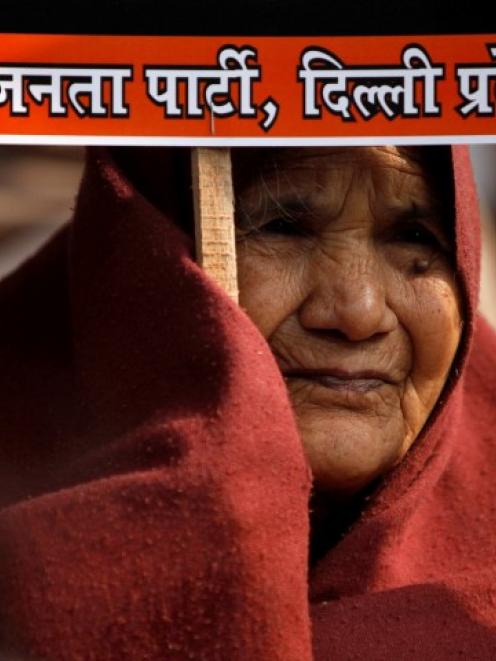
The 23-year-old physiotherapy student died on December 28 in a Singapore hospital, two weeks after a gang rape on a moving bus in New Delhi that ignited protests across India and neighbouring countries and government promises of tougher punishments.
"We want the world to know her real name," the woman's father told Britain's Sunday People newspaper.
"My daughter didn't do anything wrong, she died while protecting herself," he added. "I am proud of her. Revealing her name will give courage to other women who have survived these attacks. They will find strength from my daughter."
The father's interview sparked widespread interest on social networking sites. Her name was the top trending topic among Indian Twitter users with many, including journalists and Bollywood actors, praising his decision to reveal her name.
Mainstream Indian media did not identify her, however, and she was still being referred to as "Amanat", an Urdu word meaning "treasure", by some TV channels.
A spokesman for Delhi Police declined to comment when asked if the authorities would take action against social networks or publications carrying the student's name.
There have been growing calls in India to name the victim. Politician Shashi Tharoor last week questioned the merit of keeping her anonymous, and suggested naming new anti-rape law after her, a proposal her father supported.
Indian law generally prohibits the identification of victims of sex crimes. The law is intended to protect victims' privacy and keep them from the media glare in a country where the social stigma associated with rape can be devastating.
The father later told Reuters he had no objections to the media using his daughter's name, but did not elaborate.
ACCUSED DUE IN COURT
Five men have been charged with gang rape and murder and will appear in a New Delhi court on Monday to hear the charges.
Rajiv Mohan, a prosecutor in the case, said Singapore's Mount Elizabeth Hospital gave the cause of death as "septicaemia from multi-organ failure due to multiple organ injuries".
Mohan said the prosecution had matched DNA from her blood to blood found on the accused's clothes, and on hers, which one of the men had allegedly tried to burn to destroy evidence.
"The blood stain appearing on the burnt cloth has been tallied with the blood sample of the victim," Mohan told reporters on Saturday.
The British paper named the father and his daughter, saying that the father had given permission, but added that it would not publish a photo of her at the family's request. Reuters has opted not to identify the victim.
Mohan told Reuters the police and prosecution still had no intention of revealing her identity. The spokesman for Delhi police could not immediately be reached for comment.
"Even if family members have given their permission to disclose the victim's identity for a greater cause, we can't disclose her identity," Mohan said, citing section 228a of the Indian penal code.
Legal experts consulted by Reuters said a situation could arise where Indian media, wary of legal cases, chose not to name her while foreign publications do.
Citing the same law, Delhi police have started legal proceedings against TV network Zee News after it ran an interview with a friend of the victim who was with her during the attack.
He accused the police of responding slowly and failing to cover the victim and himself after they were thrown from the bus without clothes and bleeding.
"The police is not taking any chances and wants to be in a controlling situation, scaring everybody off by filing (legal complaints)" said senior Supreme Court advocate Sanjay Hegde, who predicted such complaints were unlikely to lead to prosecution.
PUBLIC PRESSURE
Despite huge public pressure to move quickly, it might take several weeks to formally begin the trial against the five men, public prosecutor Mohan said. He said the case could be concluded within four to five months.
A juvenile also accused of the assault will be tried separately. Mohan said police had recovered items stolen from the victim and her friend during the attack.
The protests and fierce public debate that followed the Dec. 16 rape have revealed fissures between conservatives who blame a wave of sex crimes on a loss of traditional values and a growing middle class used to women playing a larger role in public life.
The head of a Hindu nationalist organisation linked to the main opposition force, the Bharatiya Janata Party, on Friday stoked debate by saying sex crimes and gang rapes mainly happened in urban India - a position not supported by facts.
"You go to villages and forests of the country and there will be no such incidents of gang rape or sex crimes. They are prevalent in some urban belts," said Mohan Bhagwat, the head of the Rashtriya Swayamsevak Sangh.
While per capita rape statistics are lower than in many nations, one case is reported in India every 20 minutes.
A global poll of experts last year by TrustLaw, a legal news service run by Thomson Reuters Foundation, showed India to be the worst place among G20 countries to be a woman.
Activists say most sex crimes in India go unreported, and official data show that almost all go unpunished. Reported rape cases rose nearly 17 percent between 2007 and 2011.