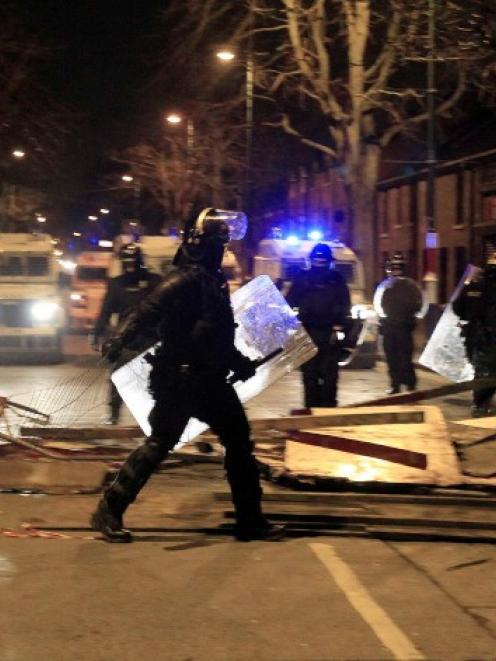
A crowd of about 100, mostly teenagers, attacked officers on Tuesday in the east of the city but police did not have to resort to water cannon and plastic baton rounds to stop the violence as was the case on Monday.
Riots began last month after a vote by mostly nationalist pro-Irish councillors to end the century-old tradition of flying the British flag from Belfast City Hall every day unleashed the most sustained period of violence in the city for years.
Businesses have been disrupted and Belfast's reputation tarnished by some of the worst scenes seen since a 1998 peace deal ended 30 years of conflict in the province.
"We are already aware of investors who have lost interest in Northern Ireland because of these disruptions," a Confederation of British Industry statement said on Tuesday. The riots had had a detrimental impact on local business and tourism, it said.
Tuesday's trouble began when hooded rioters, their faces covered by scarves, hurled missiles at police riot jeeps following a protest under heavy police guard.
Some sported British flags and one group carried a banner saying "No Surrender", a mantra of loyalists during the province's darkest period, commonly known as the "Troubles".
Most of the protests have involved between 200 and 300 rioters and police say they contained the attacks, arresting 106 people, 81 of whom have been charged with an array of offences.
However, Northern Ireland's police chief Matt Baggott warned on Monday that prolonged unrest would eat into officers' ability to deal with what he called the very severe threat posed by mostly Catholic anti-British dissidents.
Militant Irish nationalists, responsible for the killings of three police officers and two soldiers since an increase in tensions from 2009, have so far not reacted violently to the flag protests, limiting any threat to the 15-year peace.
Baggott also urged politicians to act to halt the uproar, and unionist politicians - who share power in the province with their former nationalist foes - have said they will meet on Thursday to seek to address their communities' issues.
Most people on the streets of Belfast were unwilling to see the British-controlled province return to the bloody times that cost some 3,600 lives over three decades.
"I'm technically a loyalist because I'm Protestant and value my British values and, to be honest, I don't think the flag should be removed. But, violence and throwing petrol bombs at the police doesn't do anything constructive," said east Belfast resident Marianne McDonald.
"There will always be that element here who think violence is the way to get your point across but it's not like that any more," she said.
The Union flag, which will now fly over Belfast City Hall on 17 specified days a year, will be raised for the first time since the rioting began on Wednesday to mark the birthday of Prince William's wife Kate, the Duchess of Cambridge.