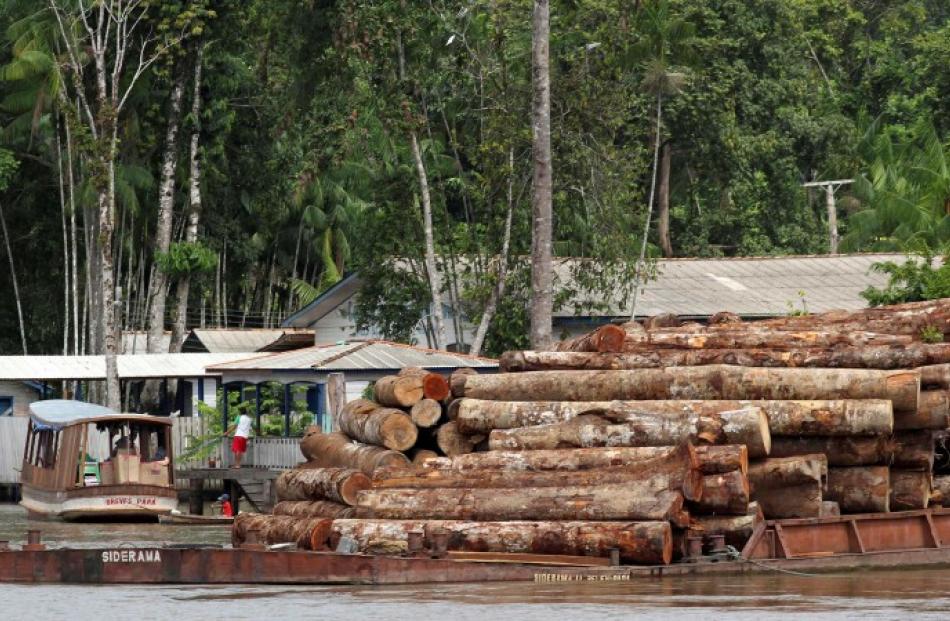
After years of gains against destruction of the Amazon rainforest, Brazil appears to be suffering from an increase in deforestation as farmers, loggers, miners and builders move into previously untouched woodland, according to data compiled by the government and independent researchers.
Imazon, a Brazilian research institute that tracks deforestation through satellite imagery, said in a recent report that destruction in the world's largest rainforest climbed for the fourth consecutive month in December.
In the last five months of 2012, Imazon detected clearings of 497 square miles (1,288 square km) of woodland - a Los Angeles-size total that is more than twice as big as the combined areas detected in the last five months of 2011.
Preliminary data from Brazil's space agency, which produces its own monthly estimates, also suggests an increase in deforestation between August and October, the last month for which its figures have been released.
Researchers and government officials say more data is needed to confirm that a full-fledged reversal is under way after what had been a sustained reduction in deforestation in recent years. Among other variables, clouds from the ongoing rainy season hinder definitive imagery. Additional data could also clarify whether new gaps in the rainforest canopy are the result of deliberate clearcutting and fires or of natural thinning.
If the increase continues, it would confirm fears raised by scientists and ecologists that changes to Brazil's environmental policies, growing inroads by developers and government-backed infrastructure projects are eroding gains in the fight to protect a region that has about 12 percent of the planet's fresh water, is an abundant source of oxygen and is home to an untold number of plant and animal species.
"The context is ripe for the destruction to intensify," said Paulo Moutinho, executive director of the Amazon Environmental Research Institute, a well-known not-for-profit group. "It's clear that the levels could easily continue to grow."
Government officials urge caution, noting the long-term trend in progress against deforestation. "It's too early to sound an alarm," said Francisco Oliveira, the director of policies against deforestation at Brazil's environment ministry. "A fuller picture will emerge once the clouds are gone."
CHALLENGING SCIENCE
Many factors drive deforestation.
Loggers and miners have long exploited hardwoods and ores in a jungle the size of Western Europe. As Brazil became an agricultural powerhouse in recent decades, soybean growers, cattle ranchers and others increasingly farmed cleared woodland.
Then there is the ongoing push to tap the Amazon region's rivers with hydroelectric dams - a process critics say lures people to areas that would otherwise remain untouched.
Tracking deforestation is a challenging science that relies on a mix of satellite data and on-the-ground reconnaissance.
Brazil's government and scientists at Imazon, a privately funded institute in the Amazon city of Belem, get preliminary evidence through satellite imagery. More conclusive data takes longer to compile and relies on slower higher-resolution visuals and on-site surveys by scientists and environmental inspectors.
The government releases an annual tally through July, when the region is driest and aerial views are the most clear.
Data showed that deforestation, through July 2012, had fallen to record lows for four consecutive years, largely because of stricter environmental enforcement.
A spike in 2007, when a surge in commodity prices sparked a rush for cropland, was curtailed after the government introduced steeper fines and blocked credit for offenders.
In response, loggers turned to smaller, more focused felling in efforts to evade satellite scans.
Now, scientists and environmental activists warn that violators are emboldened by regulatory changes, high global prices for agricultural exports and a scramble by settlers to get in on the economic activity around hydroelectric dams and other big infrastructure and industrial projects.
"You are going to see an increase in deforestation very soon," Marina Silva, a former environment minister and longtime Amazon activist, warned in a Reuters interview last year.
She and other critics have lambasted the government of President Dilma Rousseff, whose drive to revive Brazil's once-booming economy has wrought changes that environmentalists fear unleash destruction. Rousseff, for her part, has said the policies are both necessary and environmentally sustainable.
Among other regulatory changes, Brazil in late 2011 gave local officials more authority over the enforcement of environmental laws and in the process closed many of the federal outposts where forestry agents, especially in the vast and remote rainforest, represented the only obstacle to offenders.
Last year, Brazil revamped its "forestry code," longstanding rules for the types of woodland that must be preserved around developments. While the new code theoretically remains strict in the conservation it mandates, critics argue that enforcement will be difficult because of the handover to local officials.
Oliveira, the environment ministry official, said the federal government can still respond swiftly. Instead of relying on fixed bases, he explained, new units of environmental agents were created in recent months that can be deployed when needed -- making them "more agile" as violators clear smaller patches.
"Our methods and strategies are evolving," he said.
Still, scientists fear some of the damage could be happening before the government's very eyes. Government-backed dams, roads and mines are speeding a reversal, they argue, because they grant passage to previously isolated swaths of the Amazon.
"You have all these factors coming together making it much easier to gain access to the forest," said Paulo Barreto, an Imazon researcher. The recent numbers have spiked so quickly, he added, "it will be difficult for the annual figures to fall."