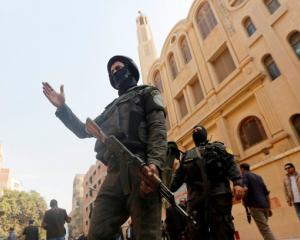
Armoured vehicles and military police fanned through the streets of Port Said, where gunshots rang out and protesters burned tyres in anger that people from their city had been blamed for stadium deaths last year.
The rioting in Port Said, one of the most deadly spasms of violence since Hosni Mubarak's ouster two years ago, followed a day of anti-Mursi demonstrations on Friday, when nine people were killed. The toll over the past two days stands at 39.
The flare-ups make it even tougher for Mursi, who drew fire last year for expanding his powers and pushing through an Islamist-tinged constitution, to fix the creaking economy and to cool tempers enough to ensure a smooth parliamentary election.
That vote is expected in the next few months and is meant to cement a democratic transition that has been blighted from the outset by political rows and street clashes.
The National Defence Council, led by Mursi and which includes the defence minister who commands the army, called for "a broad national dialogue that would be attended by independent national characters" to discuss political differences and ensure a "fair and transparent" parliamentary poll.
The statement was made on state television by Information Minister Salah Abdel Maqsoud, who is also on the council.
The National Salvation Front of liberal-minded groups and other opponents cautiously welcomed the call but demanded any such dialogue have a clear agenda and guarantees that any deal would be implemented, spokesman Khaled Dawoud told Reuters.
The Front spurned previous calls for dialogue, saying Mursi ignored voices beyond his Islamist allies. The Front earlier on Saturday threatened an election boycott and to call for more protests on Friday if demands were not met.
Its demands included picking a national unity government to restore order and holding an early presidential poll.
THREATS OF VIOLENCE
The political statements followed clashes in Port Said that erupted after a judge issued a verdict sentencing 21 men to die for involvement in the deaths of 74 people after a local football match on February 1, 2012, many of them fans of the visiting team.
Visiting fans had threatened violence if the court had not meted out the death penalty. They cheered outside their Cairo club when the verdict was announced. But in Port Said, residents were furious that people from their city were held responsible.
Protesters ran wildly through the streets of Mediterranean port, lighting tyres in the street and storming two police stations, witnesses said. Gunshots were reported near the prison where most of the defendants were being held.
A director for Port Said hospitals told state television that 30 people had been killed, many as a result of gunshot wounds. He also said the more than 300 had been wounded.
Inside the court, families of victims danced, applauded and some broke down in tears of joy when they heard Judge Sobhy Abdel Maguid declare that the 21 men would be "referred to the Mufti", a phrase used to denote execution, as all death sentences must be reviewed by Egypt's top religious authority.
There were 73 defendants on trial. Only a handful appeared in court in Cairo. Those not sentenced on Saturday would face a verdict on March 9, the judge said.
At the Port Said football stadium a year ago, many spectators were crushed and witnesses saw some thrown off balconies after the match between Cairo's Al Ahly and local team al-Masri. Al Ahly fans accused the police of being complicit in the deaths.
The fans, who call themselves "Ultras Ahlawy", said Saturday's ruling started the process of retribution, and hoped the rest would face the same fate when verdicts are issued on March 9.
Among those killed on Saturday was a former player for al-Masri and a football player in another Port Said team, the website of the state broadcaster reported.
TEARGAS RAINS DOWN
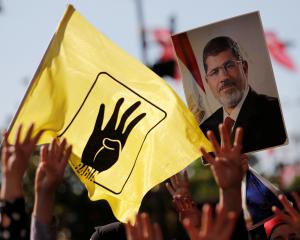
On Friday, protesters angry at Mursi's rule had taken to the streets for the second anniversary of the uprising that erupted on Jan. 25, 2011 and which brought Mubarak down 18 days later.
Police fired teargas and protesters hurled stones and petrol bombs. Nine people were killed, mainly in the port city of Suez, and hundreds more were injured across the nation.
On Saturday, some protesters again clashed with police. In the capital, youths pelted police lines with rocks near Tahrir Square. In Suez, police fired teargas where protesters angry at Friday's deaths hurled petrol bombs and stormed a police post.
"We want to change the president and the government. We are tired of this regime. Nothing has changed," said Mahmoud Suleiman, 22, in Cairo's Tahrir Square, the cauldron of the 2011 anti-Mubarak revolt and near where youths again stoned police.
Port Said, Ismailia and Suez, which have witnessed some of the worst violence in the past two days, lie on the Suez Canal but a canal official said there was no disruption to shipping through the waterway vital to international trade.
Mursi's opponents say he has failed to deliver on economic pledges or to be a president representing the full political and communal diversity of Egyptians, as he promised.
"Egypt will not regain its balance except by a political solution that is transparent and credible, by a government of national salvation to restore order and heal the economy and with a constitution for all Egyptians," prominent opposition politician Mohamed ElBaradei wrote on his Twitter account.
Mursi's supporters say the opposition does not respect the democracy that has given Egypt its first freely elected leader.
The Muslim Brotherhood, which propelled Mursi to office, said in a statement that "corrupt people" and media who were biased against the president had stirred up fury on the streets.
The political schism between Islamists and secular Egyptians and frequent bouts of violence have hurt Mursi's efforts to revive an economy in crisis as investors and tourists have stayed away, taking a heavy toll on Egypt's currency.
Mustapha Kamal Al-Sayyid, a professor of political science at Cairo University, said the latest violence reflected the frustration of many liberal-minded Egyptians and others.
"The state of polarisation between Islamists and others is most likely to continue and will have a very negative impact on the state's politics, security and economy," he said.