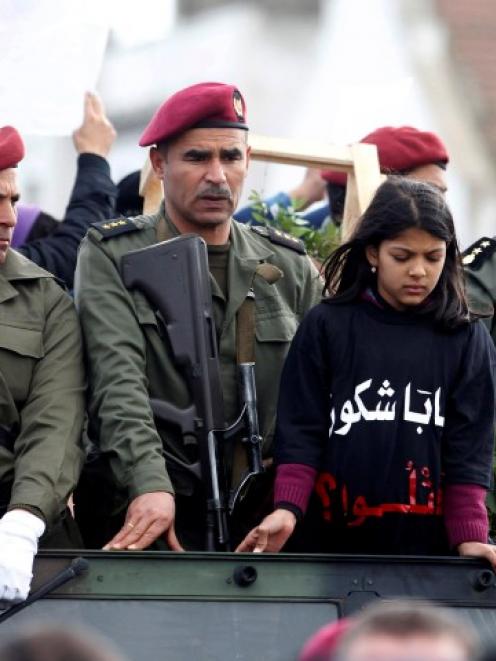
Teargas and smoke from burning cars at times wafted over the Tunis cemetery where Belaid was buried in the country's biggest funeral since independence leader Habib Bourguiba died in 2000.
Braving chilly rain, at least 50,000 people gathered to honour Belaid in his home district of Jebel al-Jaloud in the capital, chanting anti-Islamist and anti-government slogans.
Belaid's assassination has shocked a country which had hitherto experienced a relatively peaceful political transition since an uprising that inspired others around the Arab world.
It has heightened tensions between dominant Islamists and their secular opponents against a backdrop of frustration at the lack of social and economic progress since President Zine al-Abidine Ben Ali was forced to flee the country in January 2011.
"The people want a new revolution," shouted mourners in Tunis, who also sang the national anthem.
Violence erupted near the cemetery as police fired teargas at demonstrators who threw stones and set cars ablaze. Police also used teargas against protesters near the Interior Ministry, a frequent flashpoint for clashes in the Tunisian capital.
Police arrested 150 people during the disturbances in Tunis, Interior Ministry spokesman Lotfi Hidouri said.
Crowds surged around an open army truck carrying Belaid's coffin, draped in a red and white Tunisian flag, from a cultural centre in Jebel al-Jaloud towards the leafy Jallaz cemetery, as a security forces helicopter flew overhead.
"Belaid, rest in peace, we will continue the struggle," crowds chanted, holding portraits of the politician killed near his home on Wednesday by a gunman who fled on a motorcycle.
Some demonstrators denounced Rachid Ghannouchi, leader of the ruling Islamist Ennahda party. "Ghannouchi, assassin, criminal," they chanted. "Tunisia is free, terrorism out."
CLASHES IN GAFSA
Police fired teargas to disperse anti-government protesters throwing stones and petrol bombs in the southern mining town of Gafsa, a stronghold of support for Belaid, witnesses said.
Crowds there had chanted "The people want the fall of the regime", a slogan first used against Ben Ali.
In Sidi Bouzid, the southern town where the revolt against the ousted strongman began, about 10,000 marched to mourn Belaid and shout slogans against Ennahda and the government.
Banks, factories and some shops were closed in Tunis and other cities in response to a strike called by unions in protest at Belaid's killing, but buses were running normally.
Tunis Air cancelled all its flights because of the strike, a spokesman for the national airline said, adding that normal service would resume on Saturday.
After Belaid's assassination, Prime Minister Hamdi Jebali, an Islamist, said he would dissolve the government and form a cabinet of technocrats to rule until elections could be held.
But his own Ennahda party and its secular coalition partners complained they had not been consulted, casting doubt over the status of the government and compounding political uncertainty.
On Friday Jebali reiterated his plan for a cabinet of technocrats, saying this would not need the approval of the National Constituent Assembly because he was not dissolving his government, but would replace all of its members.
"This government is ready," he told reporters, without disclosing the names of his new ministers.
"HOPE EXISTS"
No one has claimed responsibility for the killing of Belaid, a lawyer and secular opposition figure.
His family have blamed Ennahda but the party has denied any hand in the shooting. Crowds have attacked several Ennahda party offices in Tunis and other cities in the past two days.
"Hope still exists in Tunisia," Fatma Saidan, a noted Tunisian actor, told Reuters at Belaid's funeral. "We will continue to struggle against extremism and political violence."
She called for national unity, saying: "We are ready to accept Islamists, but they don't accept us."
While Belaid had only a modest political following, his criticism of Ennahda policies spoke for many Tunisians who fear religious radicals are bent on snuffing out freedoms won in the first of the revolts that rippled through the Arab world.
Secular groups have accused the Islamist-led government of a lax response to attacks by ultra-orthodox Salafi Islamists on cinemas, theatres and bars in recent months.
The economic effect of political uncertainty and street unrest could be serious in a country which has yet to draft a new constitution and which relies heavily on the tourist trade.
Mohamed Ali Toumi, president of the Tunisian Federation of Travel Agencies, described the week's events as a catastrophe that would have a negative impact on tourism, but he told the national news agency TAP no cancellations had been reported yet.
France, which had already announced the closure of its schools in Tunis on Friday and Saturday, urged its nationals to stay clear of potential flashpoints in the capital.
The cost of insuring Tunisian government bonds against default rose to its highest level in more than four years this week and ratings agency Fitch said it could further downgrade Tunisia if political instability continues or worsens.