The pro-independence Scottish National Party (SNP) that runs Scotland's devolved government plans to hold a referendum on emotionally charged subject next year, and has played down the impact of a "Yes" vote on Scotland's international status.
But the 57-page legal opinion - drafted for the British government by two independent experts on international law - said the implications could be far-reaching, likening the situation to the 1991 collapse of the Soviet Union when Russia was declared the USSR's legal successor but the 14 other Soviet states had to forge their international relations anew.
The overwhelming weight of international precedent suggested Scotland would be legally deemed a "new state", it said - a scenario that would force it to re-apply to join international bodies such as the EU, the United Nations and NATO.
The government's intervention came as a panel of experts, including two Nobel prize-winning economists, issued a report saying the SNP's plan to keep the British pound in the event of independence was a sound strategy, suggesting it would also be wise to keep the Bank of England as the central bank.
The SNP argues that North Sea oil revenues combined with Scotland's fishing, farming and whisky industries would be enough to keep an independent Scotland solvent. But critics say the oil is running out, that Scotland would lose disproportionately generous British government subsidies, and that it would struggle to raise enough tax to pay its bills.
The British government's unusual decision to publish the legal opinion reflects its concern that Scots may vote for independence, triggering the break-up of a United Kingdom comprising England, Scotland, Wales and Northern Ireland.
CAMERON LEGACY
European Commission President Jose Manuel Barroso also believes Scotland would be "a new state". When asked about it, he has repeatedly said that any new state that breaks away from an existing EU state would have to re-apply to join the bloc.
Spain's government is facing a similar challenge with Catalonia, where at least one poll has shown that more than half of Catalonian voters would choose independence if given the chance.
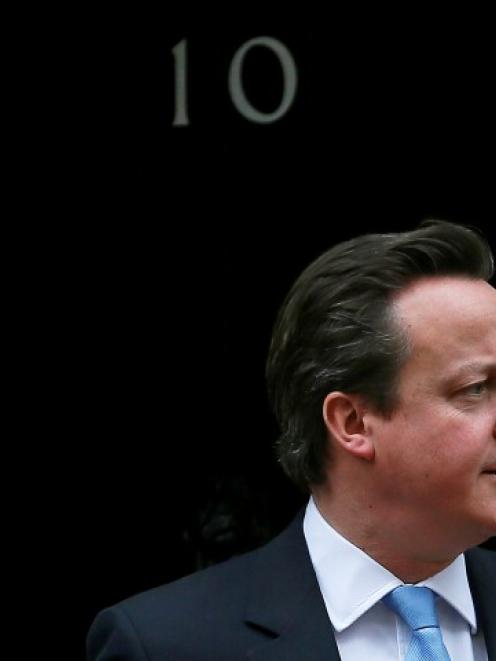
Prime Minister David Cameron intervened in the British debate on Sunday, conceding that Scotland had what it takes to be an independent nation, while arguing it enjoyed "the best of both worlds" as part of the UK. [ID: nL5N0B92I6]
"Put simply: Britain works. Britain works well. Why break it?" he wrote in an article published in Scottish newspapers.
Cameron's political future and historic legacy are on the line. He has pledged to contest the next British election in 2015 and his own Conservative party would never forgive him if he presided over the break-up of the UK.
London's main parties are campaigning jointly against independence, knowing that Alex Salmond's SNP is a highly motivated political machine that will spare no effort to win a vote on its flagship policy.
Tapping into an emotive cocktail of historical rivalry and a perception that the British parliament in London does not nurture Scotland's national interests, the "Yes Scotland" campaign wants independence to be a reality by 2016.
Scottish secession could create serious problems for the remainder of the United Kingdom.
Britain's Trident nuclear submarine fleet is based in Scotland, revenues from Scottish North Sea oil remain important to its coffers, and analysts say Britain would find it harder to maintain its voice in international bodies such as the U.N. Security Council as well as in European Union decision-making.
"ARROGANT"
The SNP published a document this month suggesting the transition arrangements could be made relatively swiftly, and that Independence Day for Scotland could come in March 2016, a timetable opponents dismissed as unrealistic.
Nicola Sturgeon, the SNP's deputy leader, told BBC radio on Monday that different legal experts gave different views on the international status of an independent Scotland.
"These are matters that will be settled not by law but by negotiation and agreement," she said. "If the UK government is really saying that they would, in the event of a yes vote, go out of their way to make life difficult for Scotland, not only is that very arrogant but it would also put them in a position of arguing against their own interest."
Opinion polls suggest support for independence has stalled, with around one third or less of voters backing it and just under half opposing it. But Cameron and politicians from other parties remain nervous.
One of the central planks of Cameron's argument is that Scotland already enjoys a high degree of autonomy through its own parliament, and he has hinted that it would be able to repatriate even more powers if it rejected full independence.
"This must not be a leap in the dark, but a decision made in the light of day," he told Scots.