While the churchgoers prayed, the revelers outside drank beer, beat drums and flirted in a days-long party known for such debauchery that local officials hand out free condoms.
True, the city isn't always as crazy as it is during the annual revelry Of Carnival.
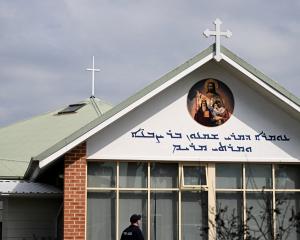
Also true, though, is that the near-empty church, one of the few quiet spots in Rio this week, tends to a shrinking flock of Catholic faithful. Brazil has the world's biggest Catholic population but the Church is steadily losing its influence, here and across much of Latin America.
"There's nothing wrong with having fun," says Henrique Pereira, a 35-year-old businessman leaving the church after a prayer. "But I wish people valued faith and the Church as much."
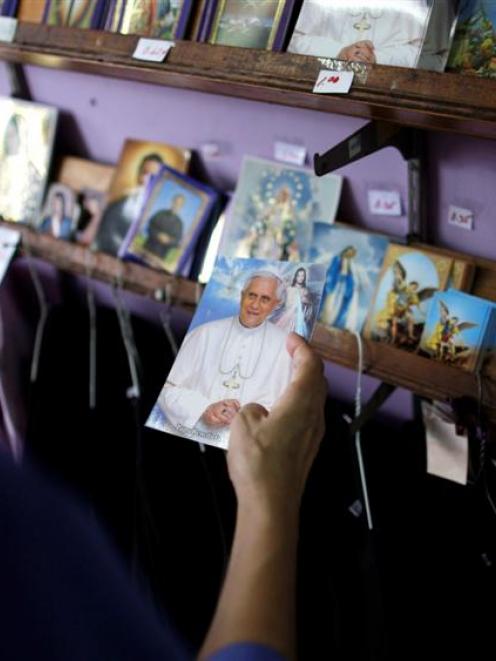
This is the landscape awaiting the successor to Pope Benedict, who said on Monday he would step down.
If his goal is to retain Catholic churchgoers or even attract new faithful in a region undergoing profound cultural, social and economic change, a new pontiff must find ways to wed doctrine with contemporary Latin American lifestyles.
While the region is still home to more Catholics than any other, boasting 42 percent of the 1.2 billion faithful, the numbers have dwindled in recent decades.
As Latin America grows more prosperous, more urban and more educated, people are less pliant to a religion that once held a firm grip on believers in locales as diverse as the pampas of Argentina and the parched pueblos of northern Mexico.
"Latin America is becoming more like the rest of the Western world and in that sense less homogenous when it comes to faith," said Fernando Altemeyer, a theology professor at the Catholic University of Sao Paulo. "There are changes in society here that make it hard for any one faith or belief to dominate."
The transformation, of course, is happening elsewhere too, as growth in big, emerging economies empowers millions once segregated by poverty, geography, and social strictures. Cell phones and the Internet are also bringing the world to once isolated corners.
Latin America has long been a Catholic stronghold and there is growing talk that the next pope could be from the region, a nod to its importance inside the Church.
The Church's internal theological differences have often played out in Latin America. Indeed, as a cardinal, Pope Benedict quashed a rebellion among those in the Latin American Church who supported so-called liberation theology, a left-leaning movement focused on helping the poor.
Along with other tensions, the rift was later compounded by the recent growth of Evangelical denominations.
For many across Latin America, evangelical churches are attractive because they preach success and prosperity in this life, as opposed to the sacrifice and struggle that Catholics are taught to endure. Many churchgoers also say they prefer Evangelical pastors, who shed the robes and ritual of Catholic mass for casual attire and free-form sermons.
Aware of that challenge, some of the Catholic leadership in Latin America has long pushed the church to modernise.
"I dream of a pope free from the titles of nobility, of crowns, of palaces," Eduardo de la Serna, an Argentine priest, wrote in Página 12, a Buenos Aires daily. "I dream of a pope who presents himself as everyone's brother."
Pope Benedict, to be sure, acknowledged the pressure by describing a Church that today exists to "propose" beliefs, not to "impose" them. And some of the cardinals who will be electing his successor, including several from Latin America, hail from some of Catholicism's more progressive ranks.
Still, change in the Church is slow.
For every guitar-strumming priest seeking to make mass more fun - Brazil's Father Marcelo Rossi fills stadiums and recently penned a bestselling book - many others criticize efforts to make the Church more palatable.
"We should live more consistently with faith," warned Joaquin Diez Esteban, a prominent Peruvian priest, in an interview. "Faith shouldn't be a feeling, like it so often is in Latin America ... more popular religiosity than deep conviction."
The debate over modernization is common in Brazil, Latin America's biggest country and an ethnic melting pot with some of the world's more tolerant views on sex, race and religion.
There are 120 million Catholics in Brazil - about 65 percent of the population, compared with over 90 percent in 1970. But much of the affiliation, theologians warn, is due to family and cultural ties - not active participation in the church.
"Belief in the Church is different now than it was when it was one of the few functioning institutions anywhere," said Altemeyer, the professor in Sao Paulo.
Those at Nossa Senhora da Paz on Monday said they welcome the chance for change.
After pausing to pray before a stone crucifix, Ana Beatriz Couto de Andrade, a 35-year-old software consultant, said a new pope should make the church more inclusive.
"Many people want something to believe in, but they feel like the church is not accessible," she said.
By choosing Benedict, a church enforcer whose theological strengths surpassed his ability to connect with followers, some said the Vatican may have marginalized parishioners who already felt out of step with the Church.
"You need someone charismatic," said Mercio Franco Maturano, a 51-year-old lawyer. "This pope didn't inspire."
Even longtime parishioners said they see room in the Church for changes that would embrace those that currently feel excluded.
"It doesn't matter who you love, what you look like or who you sleep with," said Ary David de Almeida, an 83-year-old retiree. "The Church should realise that the world is changing and learn to make adjustments for that."