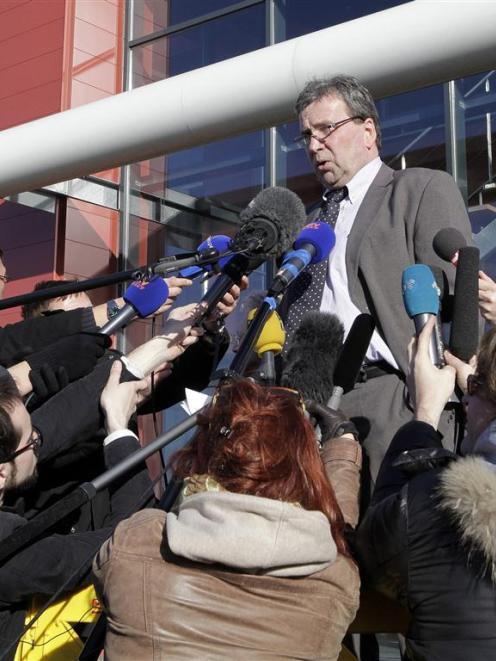
In France, wholesalers and officials traded grievances, while more products were removed from sale in Britain, Germany, Austria and Norway; police raided factories in several countries and Dutch prosecutors accused one meat supplier there of fraud.
No one is reported to have fallen ill from eating horse in the month since it was first identified in Irish beefburgers, but evidence of widespread mis-labelling and revelations of a complex market in which produce crisscrosses the EU trading bloc have damaged Europeans' confidence in the food on their plate.
Governments have come under pressure to act and to explain lapses in quality control, while supermarkets, fast-food chains and ready-meal manufacturers are battling to save reputations, some fighting for their very survival amid a welter of lurid headlines playing on a popular queasiness about eating horses.
A French meat company with a famous name accused by the government in Paris of knowingly passing off horsemeat as beef hit back angrily on Friday, accusing ministers of jumping to a hasty conclusion, as its workers feared for their livelihoods.
"This verdict arrived at by the ministers ... has condemned 300 families to death," said the Spanghero company's marketing director Christophe Giry, referring to its 300 employees.
"We're being used as scapegoats for politicians and everybody," he added. "They needed to find a head."
"The government has been too hasty," said company boss Barthelemy Aguerre, a day after ministers said it could not have failed to realise cheap meat from Romania was horse not beef.
"I think we will prove our innocence," he added.
Consumer Affairs Minister Benoit Hamon said: "At the very least there was a lot of negligence ... Millions of consumers have been duped, so we had to act quickly."
At Spanghero's factory - a red and white corrugated-iron-clad building in Castelnaudary, a town famed for its cuisine near the southern city of Toulouse - workers were throwing carcasses, sausages and burgers into a dumper truck on Friday.
The Spanghero family, a dynasty of French rugby players who founded the firm but sold it in 2009, bemoaned the loss of their good name: "We have been plunged into dishonour," said Laurent Spanghero, whose brother once captained the national rugby team.
The Romanian government and abattoirs that routinely slaughter horses have said their exports were properly labelled.
Dutch prosecutors launched a criminal investigation into an as yet unnamed company believed to have been falsely labelling beef mixed with horsemeat after searching a plant in the south.
They said it was "suspected of forgery, fraud and money laundering" and added: "It is believed the company processed horse carcasses from Ireland and mixed them with beef."
In a separate development, a Dutch businessman who was convicted last year of selling falsely labelled horsemeat, denied suggestions of involvement in the latest scandal.
After a senior Romanian food safety official identified Jan Fasen's company Draap Trading as a buyer of horse meat from Romania, a lawyer for Fasen, who is based in Breda in the southern Netherlands said in a statement he denied all allegations, including of being a key figure in a fraud network.
He noted that Fasen was appealing against last year's conviction, which court documents show involved the sale of beef mixed with horse to two French companies.
Governments have highlighted that horsemeat poses little or no health risk - though some carcasses have been found tainted with a painkiller given to racehorses but banned for human consumption - and have said retailers are ultimately responsible for ensuring the products they sell are what they claim to be.
One supermarket chain, Kaiser's Tengelmann in Germany, said it plans to sue Comigel, a French supplier of frozen beef lasagne and other ready meals, for selling it horsemeat: "We feel cheated and deceived," Tengelmann boss Raimund Luig said.
"We will definitely file for damages."
German discount supermarket chain Lidl said it had taken beef tortelloni off its shelves after Austrian health authorities said they found horsemeat in one sample made by Liechtenstein-based Hilcona. The latter blamed its supplier.
Compass Group, the world's biggest caterer, and Whitbread, Britain's biggest hotel group, added to the list of firms withdrawing beef products found to contain horse.
Also in Britain, leading chain Tesco, one of the earliest casualties of horse-tainted beefburgers, highlighted a different approach to defending its reputation, telling customers they would be able to track the implementation of systems it is putting in place to ensure the origins of its food are clear.
British supermarket bosses signed an open letter to consumers telling them they "share their anger and outrage" at finding food safety "compromised by fraudulent activity or even, as alleged, an international criminal conspiracy".
That move came after Prime Minister David Cameron, himself under pressure from voters, appeared to chide the retailers.
Britain's Food Standards Agency, set up in 2001 after the "mad cow disease" scandal saw British beef banned by European neighbours, said on Friday that of 2,501 tests for horse DNA in samples of beef products from shops, 29 had shown traces above 1 percent.
Authorities in the northwestern English county of Lancashire said they were recalling pies from 47 local school kitchens after they provisionally tested positive for traces of horse DNA. "This does not appear to be a food safety issue, but I've no doubt parents will agree we need to take a very firm line with suppliers," County Councillor Susie Charles said in a statement.
EU governments approved an EU-wide programme of DNA tests on beef products to assess the scale of a food scandal involving mislabelled horsemeat, the bloc's executive said on Friday.
The initial one-month testing plan will also check horsemeat for potentially harmful drug residues, after six horses slaughtered in Britain tested positive for the anti-inflammatory phenylbutazone, which is illegal in meat for human consumption.
The British government and the European Union have called for a high-level meeting to investigate the scandal, and it will be on the agenda of a Feb. 25 EU farm ministers' meeting.