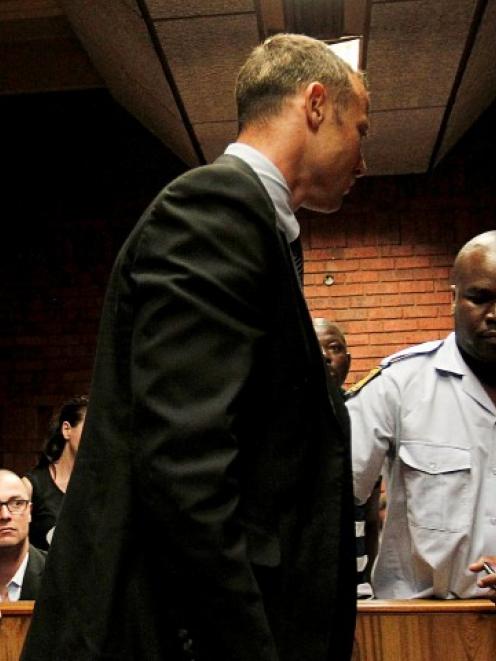
Initial reports of the shooting in the early hours of Thursday suggested Pistorius (26) a double amputee who became one of the biggest names in world athletics, may have mistaken law graduate and model Reeva Steenkamp for an intruder.
A statement released by his family dismissed the charge of murder laid on Friday in "the strongest terms". His bail hearing resumes in a Pretoria magistrate's court on Tuesday.
Within hours of the shooting, police confirmed that Steenkamp had been killed by more than one gunshot, that Pistorius was the only suspect, that neighbours had heard earlier disturbances, that there were no signs of a break-in and that a 9mm pistol had been recovered from the two-storey home.
Since then, police have released no more details.
The same cannot be said of the South African media, part of a global publicity machine that built up Pistorius into the ultimate sporting tale of triumph over adversity - a man who rose to the pinnacle of world athletics, racing at the Olympics despite having no lower legs.
Some of the most widely reported local media allegations are that Steenkamp was in the bathroom when she was shot, was hit by four rounds - in the head, hand, hip and chest - and that shots were fired through the bathroom door.
In addition, leading Sunday newspaper City Press said investigators had found a blood-stained cricket bat in Pistorius' bedroom. The paper said police had not yet worked out whose blood it was, but said Steenkamp's head was "crushed".
The newspaper also alleged that Steenkamp, who will be buried on Tuesday, had slept in the same bed as Pistorius that night - Valentine's Day eve - and that her iPad was on the bedroom floor along with an overnight bag.
The ENCA television channel said CCTV footage from the gated community showed Steenkamp arriving at the complex shortly after 6pm on the previous evening.
Police have declined to comment on any of the reports, saying official details will only emerge in court.
However, the allegations - if true - undermine the legal argument of self-defence, as well as the suggestion that Pistorius was taken by surprise by a would-be stranger in his house in the middle of the night.
"If what the media says is in fact the truth, I cannot see that any defence based on self-defence can, by any stretch of the imagination, succeed," said Eddie Classen, a partner at BDK Attorneys, one of South Africa's biggest criminal defence firms.
"ROID RAGE"?
Under the white-minority rule that ended in 1994, South Africa had relatively lax curbs on the use of lethal force, not only in self-defence but also in making arrests. Put bluntly, if the only way to stop a fleeing robber was to shoot him, you could.
However, the laws were tightened up after the end of apartheid when the "right to life" became enshrined in the new constitution of Nelson Mandela's "Rainbow Nation", making it permissible to use lethal force only when your life is directly threatened.
Furthermore, when the immediate threat is gone - a shot intruder, say, goes down with a bullet in the leg - the self-defence argument ends.
"The law says that you have to stop the moment that you have repelled an attack, so normally one shot will suffice," said Steven Tuson, a professor of criminal law at Johannesburg's Wits University.
If Pistorius's lawyers choose to avoid the self-defence avenue, another option may be to argue temporary insanity based on chemical stimulants, a defence irreverently referred to in sports-mad South Africa as "roid rage", short for 'steroid'.
This is why Pistorius was taken for blood tests immediately after the shooting, Tuson said, "to exclude that defence". Classen also said the "roid rage" defence could only succeed in "extraordinary circumstances".
One other possible avenue is for Pistorius to argue "putative self-defence" - that he thought he was being attacked even if he wasn't. Even then, Classen said the content of the media reports, if true, curtailed his chances of success.
"The facts of the matter - and I caution again because I am only reading them from the media - suggest something totally different," he said.