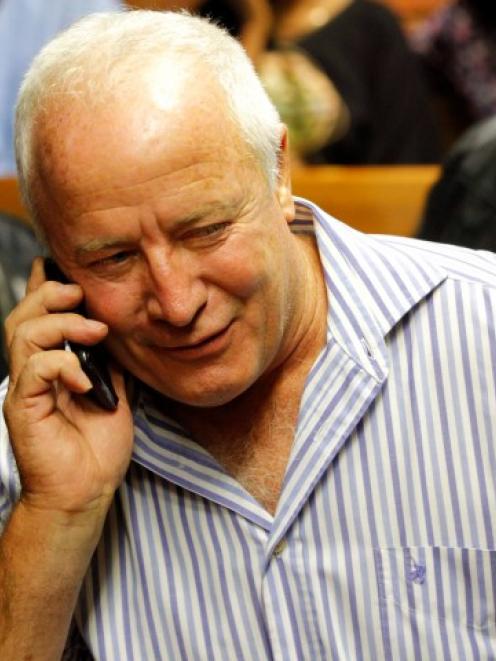
The decision by Magistrate Desmond Nair drew cheers from the Paralympics star's family and supporters. Pistorius himself was unmoved, in marked contrast to the week-long hearing, when he repeatedly broke down in tears.
Nair set bail at 1 million rand ($US113,000) and postponed the case until June 4. Pistorius would be released only when the court received 100,000 rand in cash, he added.
Less than an hour later, a silver Land Rover left the court compound, Pistorius visible through the tinted windows sitting in the back seat in the dark suit and tie he wore in court.
The car then sped off through the streets of the capital, pursued by members of the media on motorcycles, before it entered his uncle Arnold's home in the plush Pretoria suburb of Waterkloof.
At least five private security guards stood outside the concrete walls, keeping reporters at bay.
Under the terms of his bail, Pistorius, 26, was also ordered to hand over firearms and his two South African passports, avoid his home and all witnesses, report to a police station twice a week and abstain from drinking alcohol.
The decision followed a week of dramatic testimony about how the athlete shot dead model and law graduate Reeva Steenkamp at his luxury home near Pretoria in the early hours of Feb. 14.
Prosecutors said Pistorius committed premeditated murder when he fired four shots into a locked toilet door, hitting his girlfriend cowering on the other side. Steenkamp, 29, suffered gunshot wounds to her head, hip and arm.
Pistorius said the killing was a tragic mistake, saying he had mistaken Steenkamp for an intruder - a possibility in crime-ridden South Africa - and opened fire in a blind panic.
However, in delivering his nearly two-hour bail ruling, Nair said there were a number of "improbabilities" in Pistorius's version of events, read out to the court in an affidavit by his lawyer, Barry Roux.
"I have difficulty in appreciating why the accused would not seek to ascertain who exactly was in the toilet," Nair said. "I also have difficulty in appreciating why the deceased would not have screamed back from the toilet."
By local standards, the bail conditions are onerous but it remains to be seen if they appease opposition to the decision from groups campaigning against the violence against women that is endemic in South Africa.
"We are saddened because women are being killed in this country," said Jacqui Mofokeng, a spokeswoman for the ruling African National Congress' Women's League, whose members stood outside the court this week with banners saying "Rot in jail".
TOO FAMOUS TO RUN
However, Nair said he made his decision in the "interests of justice" and argued that the prosecution, who suffered a setback when the lead investigator withered under cross-examination by Roux, failed to show Pistorius was either a flight risk or a threat to the public.
Roux stressed the Olympic and Paralympics runner's global fame made it impossible for him to evade justice by skipping bail and leaving the country.
"He can never go anywhere unnoticed," Roux told the court.
Pistorius, whose lower legs were amputated in infancy forcing him to race on carbon fibre "blades", faces life in prison if convicted of premeditated murder.
Prosecutors had portrayed him as a cold-blooded killer and said they were confident that their case, which will have to rely heavily on forensics and witnesses who said they heard shouting before the shots, would stand up to scrutiny at trial.
"We are going to make sure that we get enough evidence to get through this case during trial time," a spokesman for the National Prosecuting Authority told reporters.
In court, lead prosecutor Gerrie Nel was scornful of Pistorius's inability to contain his emotions. "I shoot and I think my career is over and I cry. I come to court and I cry because I feel sorry for myself," Nel said.
"DEEPLY IN LOVE"
In his affidavit, Pistorius said he was "deeply in love" with Steenkamp, leading Roux to stress his client had no motive for the killing.
Pistorius contends he reached for a 9-mm pistol under his bed because he felt particularly vulnerable without his prosthetic limbs.
According to police, witnesses heard shouting, gunshots and screams from the athlete's home, which sits in the heart of a gated community surrounded by 3-m- (yard-) high stone walls topped with an electric fence.
In a magazine interview a week before her death, published on Friday, Steenkamp spoke about her three-month relationship with the runner, who won global fame last year when he reached the semi-final of the 400 metres in the London Olympics despite having no lower legs.
"I absolutely adore Oscar. I respect and admire him so much," she told celebrity gossip magazine Heat. "I don't want anything to come in the way of his career."
Police pulled their lead detective off the case on Thursday after it was revealed he himself faces attempted murder charges for shooting at a minibus. He has been replaced by South Africa's top detective.
Pistorius's arrest stunned the millions around the world who saw him as an inspiring example of triumph over adversity.
But the impact was greatest in South Africa, where he was seen as a rare hero for both blacks and whites, transcending the racial divides that persist 19 years after the end of apartheid.