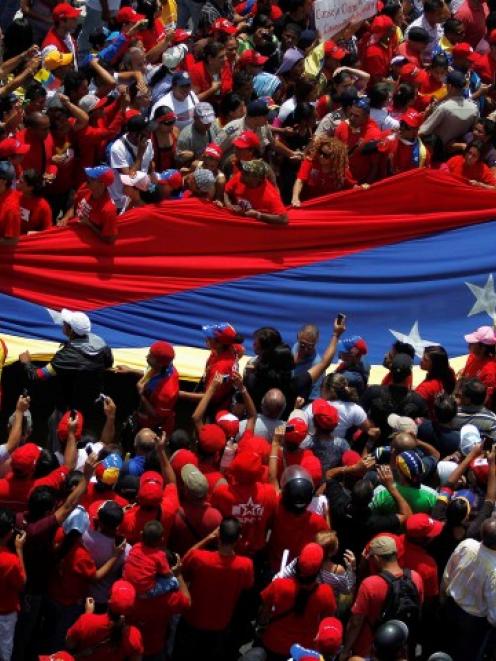
Tens of thousands of "Chavistas" marched behind a hearse carrying the remains of the flamboyant and outspoken president, draped in Venezuela's blue, red and yellow national flag.
Loudspeakers played a recording of the charismatic socialist singing songs. Some supporters held heart-shaped placards that said: "I love Chavez!" Others cheered from rooftops, waving red T-shirts.
Ending one of Latin America's most remarkable populist rules, Chavez died on Tuesday (local time) at age 58 after a two-year battle with cancer that was first detected in his pelvis.
His body will be taken to a military academy on Wednesday to lie in state for three days before a state funeral.
The future of Chavez's leftist policies, which won him the adoration of poor Venezuelans but infuriated opponents who denounced him as a dictator, now rests on the shoulders of Vice President Nicolas Maduro, the man he tapped to succeed him.
"We ask our people to channel this pain into peace," Maduro said.
Maduro, a 50-year-old former bus driver and union leader, will probably face Henrique Capriles, governor of Miranda state, in an election now due within weeks in the OPEC nation with the world's largest oil reserves.
The stakes are huge for the region, given the crucial economic aid and cheap fuel the Chavez government supplied to allies across Latin America and the Caribbean.
Venezuelan debt prices fell on Wednesday as investors opted to lock in gains chalked up in anticipation of Chavez's death, citing short-term political uncertainty.
Authorities said the vote would be called within 30 days, as stipulated by the constitution, but did not specify the date.
One recent opinion poll gave Maduro a strong lead over Capriles, in part because he has received Chavez's blessing as his heir apparent, and he is likely to benefit from the surge of emotion following the president's death.
The tall, mustachioed Maduro has long been a close ally of Chavez. He immediately pledged to continue his legacy and is unlikely to make major policy changes soon.
Maduro will now focus on marshalling support from Chavez' diverse coalition, which includes leftist ideologues, business leaders and radical armed groups called "colectivos."
Some have suggested he might try to ease tensions with Western investors and the U.S. government. Yet hours before Chavez's death, Maduro alleged that "imperialist" enemies had infected the president with cancer and he expelled two U.S. diplomats accused of conspiring with domestic opponents.
'DON'T BE ANXIOUS'
A victory by Capriles, 40, a centrist politician who calls Brazil his model for Venezuela, would bring big changes and be welcomed by business groups, although he would probably move cautiously to lower the risk of political instability.
"This is not the time to stress what separates us," Capriles said in a condolence message, calling for unity and respect for the loss that many felt after Chavez's death.
"There are thousands, maybe millions, of Venezuelans asking themselves what will happen, who even feel fear ... Don't be scared. Don't be anxious. Between us all, we're going to guarantee the peace this beloved country deserves."
Military commanders pledged loyalty to Maduro, who will be Venezuela's caretaker leader until the election.
Soldiers fired 21-gun salutes in barracks across Venezuela at 8 a.m. to honor Chavez.
It was not immediately clear where Chavez would be buried.
He had ordered a striking new mausoleum built in downtown Caracas for the remains of independence hero Simon Bolivar, his inspiration, and it is due to be finished soon.
"To the pantheon!" shouted Chavez supporters during Wednesday's parade, which was led by Maduro walking just in front of the cortege.
Much of Caracas was quiet overnight, with streets deserted, especially in wealthier districts. Many shops locked their doors in fear of looting as news of Chavez's death spread. There were long lines outside gasoline stations.
Hundreds of emotional "Chavista" loyalists stayed outside the military hospital where he spent his last two weeks. A female TV reporter from neighboring Colombia was beaten up, and gunshots were fired in the air.
"Chavez lives, the fight continues!" supporters shouted.
A stony-faced Bolivian President Evo Morales flew in on Wednesday to join the mourning. The presidents of Argentina and Uruguay also arrived before dawn, state media said.
"I have no words for such pain. We don't know whether to shout or cry," said 39-year-old government worker Kimberly Garcia, her eyes swollen from tears.
State oil company PDVSA said its installations were functioning normally, and the Central Bank president said Venezuela's economy was unaffected.
Condolences flooded in from around the world - ranging from the Vatican and the United Nations to allies like Iran or Cuba.
OBAMA REACHES OUT
U.S. President Barack Obama was less effusive about a man who put his country at loggerheads with Washington, saying his administration was interested in "developing a constructive relationship with the Venezuelan government."
Opponents at home hoped for a fresh start.
"Chavez was very dominant and used the powers of state in a very discretional way, as though this was his own estate," Juan Vendrell, a 58-year-old engineer, said in a wealthy neighborhood of Caracas. "I would like a change and for institutions and democracy to be restored."
Chavez led Venezuela for 14 years and had easily won a new six-year term in an election in October, defeating Capriles.
His folksy charisma, anti-U.S. diatribes and oil-financed projects to improve life for residents of long-neglected slums created an unusually powerful bond with many poor Venezuelans.
That intense emotional connection underpinned his rule, but critics saw his autocratic style, gleeful nationalizations and often harsh treatment of rivals as hallmarks of a dictator whose policies squandered a historic bonanza of oil revenues.
The nationalizations and strict currency controls under Chavez frightened off investors. Even some of his followers complained that he focused too much on ideological issues at the expense of day-to-day problems such as power cuts, high inflation, food shortages and violent crime.
The government declared seven days of mourning.
Chavez's health weakened severely just after his re-election on Oct. 7, possibly due to his decision to campaign for a third term instead of stepping aside to focus on his recovery.
"His legacy will be the transformation of Venezuelan political culture, putting social inequality and poverty alleviation at the top of the political agenda," said Diego Moya-Ocampos, a Venezuela analyst.
"However, that came at the cost of greater authoritarianism in government and challenges to democracy as he sought to consolidate his leadership."