"I don't have any reason to believe that anybody in the agency did anything illegal," he said.
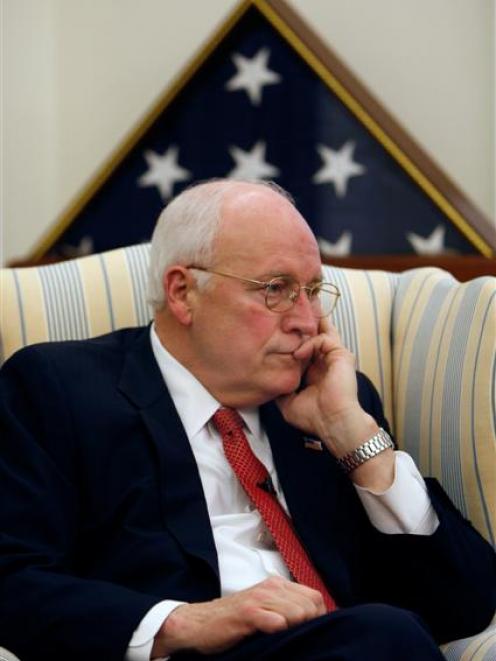
In an interview with The Associated Press, Cheney also said that Bush has no need to apologise for not foreseeing the economic crisis.
"I don't think he needs to apologise. I think what he needed to do is take bold, aggressive action and he has," Cheney said. "I don't think anybody saw it coming."
During a wide-ranging interview in his West Wing office, Cheney also said Iran remains at the top of the list of foreign policy challenges that President-elect Barack Obama will face.
He said an "irresponsible withdrawal" from Iraq now would be ill-advised.
And he said he's convinced that North Korea helped Syria build a reactor - a site that Israel suspected of being a nuclear installation and bombed in 2007.
After Obama takes the oath of office on January 20, the 67-year-old Cheney plans to spend time with his wife, Lynne, their two daughters and six grandchildren. They probably will split their time between houses in Virginia and their hometown of Casper, Wyoming.
Cheney said he also may write a book.
An avid fisherman, Cheney said the first place he wants to fish is the South Fork of the Snake River on the Wyoming-Idaho border.
Cheney is leaving the White House after a government career spanning four decades, including stints as defence secretary, President Gerald R Ford's chief of staff and a longtime congressman from Wyoming.
The vice president often laughs off talk that he played his role as second-in-command to Bush like a wizard, controlling the levers of the presidency from behind the scenes. Still, Cheney will go down in history as one of the most influential vice presidents in US history.
During the interview, he strongly defended the administration's terrorist-fighting policies.
Cheney said the administration rightly used programs to intercept communications of suspected terrorists and used tough methods to interrogate high-value detainees.
He also said he did not have any qualms about the reliability of intelligence obtained through waterboarding - an interrogation technique simulating drowning used on three top al Qaeda operatives in 2002 and 2003.
"It's been used with great discrimination by people who know what they're doing and has produced a lot of valuable information and intelligence," he said.
Obama has criticised interrogation practices he says amount to torture and has promised to close the US detention centre at Guantanamo Bay, Cuba.
Cheney acknowledges that there is still a lot of work to be done in Iraq, but he said much progress has been made.
"I hear a lot of people, among our critics, who keep saying 'Iraq's a mess, pull out.' Well, that's not true. It's not a mess," Cheney said.
"We have made major progress. We have come close to achieving a significant proportion of our objectives, and an irresponsible withdrawal now is exactly the wrong medicine."
Asked if he was concerned that removing US troops would cause the nation to backslide into the violence of a few years ago, Cheney said it all depends on what the US does under the next administration.
Obama has said he wants all combat troops out of Iraq by the spring of 2010, leaving a residual force of trainers, air controllers, advisers and logistics soldiers until the end of the mission.
Cheney said that Obama's decision to keep Robert Gates on as defence secretary makes "some of us cautiously optimistic that the new administration is going to be more reasoned and responsible in terms of how they proceed, and not take action that would undermine the basic fundamental system that we put in place."
On Iran, a nation he said was one of the prime sponsors of terror in the world, Cheney said more sanctions will likely be needed to get the Iranians to stop enriching uranium. Uranium enriched to a low level is used to produce nuclear fuel, but further enrichment makes it suitable for use in nuclear weapons.
"One of the things I worry about most is that linkage between a government that supports terror and terrorists on the one hand, and on the other hand is developing a number of deadlier of weapons," he said. "And I think that's a combination that is a scary prospect, and ought to be."
North Korea also will be a trouble spot that Obama will have to watch and address, he said.
North Korea continues to be a problem partly because it hasn't kept its commitment to provide a complete declaration of its nuclear activities.
In addition, Cheney said: "It looks like they have a continuing, ongoing programme to produce highly enriched uranium" and "they helped the Syrians build a nuclear reactor."
In April 2008, seven months after the facility was destroyed, the White House said that North Korea's secret work on the reactor with Syria was "a dangerous and potentially destabilising development for the world."
The White House said the destroyed facility was not intended for "peaceful purposes."
But besides the comments in April, top Bush administration officials have said little publicly on the issue, which is still being investigated by the UN nuclear watchdog agency.