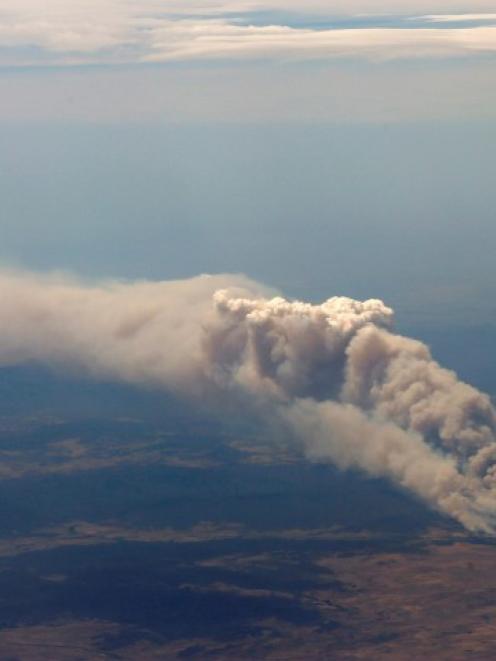
Battling a day that saw the worst fire danger in history across much of New South Wales, Victoria and Tasmania, crews kept catastrophe from major towns and cities, despite outbreaks that last evening were still threatening homes.
But the danger is far from past, with high temperatures predicted to roast coastal NSW and Sydney until an expected southerly change early this morning, and a return to scorching temperatures again by the weekend.
As darkness fell, the potential for explosive firestorms remained. Many areas will remain under threat for days, possibly weeks, with little or no rain in sight, extremely low humidity and massive stores of tinder in grasslands and bush.
Late yesterday towns and homes were under threat from renewed outbreaks on Tasmania's Tasman Peninsula, where more than 100 properties were devastated last weekend, and near Wagga Wagga, Cooma and Tarcutta in NSW.
More than 130 fires were burning in NSW - 40 uncontained - and about 40 continued to ravage Tasmania.
NSW Rural Fire Services spokesman Fred Nicholls said members were nearing exhaustion.
"We are starting to run short on extras, we have had four days of this now," he said. "When you do this day after day, it wears the guys out."
Yesterday's temperatures, peaking from a two-week heatwave pumped in by superheated air in the interior, forced authorities to declare catastrophic risk along NSW's South Coast, with 90 per cent of the state under severe risk. Much of northern Victoria was also at severe risk.
The Bureau of Meteorology increased the colour range of its scale, increasing the maximum to 54°C and adding a new purple code above the previous black maximum.
By early afternoon the mercury had soared to 40°C in Sydney and areas of the South Coast, with even higher peaks inland.
In Alice Springs and the remote South Australian town of Oodnadatta temperatures have remained well above 40°C for the past week. Oodnadatta was expected to reach 47°C yesterday.
In NSW winds gusting to 80km/h drove dangerous fronts through bush and grasslands towards communities. Sydney late yesterday had escaped the worst.
A fire at the Lucas Heights nuclear reactor in southern Sydney was contained by early afternoon. But in the Shoalhaven region south of Sydney a fire broke containment lines and was heading towards the holiday area of Sussex Inlet, and flames were threatening properties near Bega, on the Far South Coast. At least 20 homes were under threat at Brogo, in the Bega Valley.
Another dangerous front threatened properties close to Cooma, at the foot of the alpine country southwest of Canberra, another was burning near Wagga Wagga, and a major blaze was nearing Tarcutta, on the Hume Highway about 450km southwest of Sydney.
Authorities also upgraded the alert level for NSW's Riverina region from severe to catastrophic.
In Tasmania potential disaster again flared on the Tasman Peninsula, where hundreds of people had earlier been evacuated by boat to Hobart and where others who remained were relying on food supplies trucked or boated in.
Residents of Eaglehawk Neck and nearby communities were advised to flee as fires again flared up around the town, Bream Creek and Kellevie.
Fire crews contained a major outbreak at Flowery Gully, near Beaconsfield in the state's north.
Fires continued to burn in Victoria and several licked at the fringes of Canberra. But late yesterday a southerly front had cooled temperatures in Victoria and southern NSW, with light showers falling at about 4pm in Canberra.