The determination of a former committee that as an act of policy it would not grant any conditional licenses was clearly not binding upon the committee which was elected in March last. The fact that a majority of the former committee failed to secure re-election may possibly be taken as an indication that the electors did not endorse their policy.
Indeed, there is a strong presumption that the success of three "moderate" candidates was due to the expectation that they would be prepared to grant conditional licenses in the district or, at all events, that they would bring an open mind to the consideration of applications for such licenses. In the circumstances the decision of the committee in favour of the applications that were dealt with last week should not excite surprise.
Whether it is sound judgement that admits of the licensing of booths for the sale of liquor at popular gatherings is, however, distinctly questionable. It is, in fact, rather absurd to suppose that the visitors to the show and the races would have to endure any serious hardship if, during the four and a-half hours for which the booths will be open on each day, they were deprived of the opportunity of obtaining alcoholic refreshment.
The people who attend other sports meetings, the races at Wingatui among them, where no liquor is publicly offered for sale, seem to enjoy themselves reasonably well, and it is not an altogether extravagant assumption that nobody who is interested either in the show or in the trotting races would be deterred from attending the one or the other if there were no licensed booth on the ground.
• The American four-masted schooner M. Turner arrived at Auckland shortly before 7 o'clock on Monday evening from Portland (North America) with a cargo of over 1,800,000ft of Oregon pine. She occupied 78 days on the passage, and on November 10, while sailing before a moderate north-west breeze, a large waterspout was seen.
The huge column passed within a cable's length of the ship, and looked as if at any moment it would envelop the ship, and should such have been the case she would have been badly damaged. The captain ordered sail to be shortened and got a shot gun ready with the intention of firing at the waterspout so as to burst it, but at the moment it collapsed and fell into the sea in a huge cataract. - ODT, 27.11.1912.
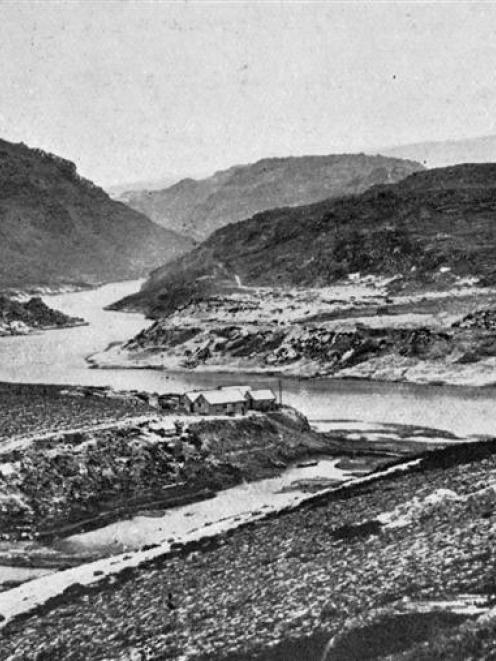
• COPIES OF PICTURE AVAILABLE FROM ODT FRONT OFFICE, LOWER STUART ST, OR WWW.OTAGOIMAGES.CO.NZ