The latest round of waiting list cuts, reported from the Otago District Health Board, is an attempt to give certainty to those assessed as having the most urgent need of elective surgery.
In other words, the hurdles have again been raised because the board cannot provide sufficient numbers of staff to meet waiting list demands and Ministry of Health requirements.
No-one, least of all the providers of health services, can be satisfied with this situation, and after nearly a decade in which government spending on public health services has doubled (and so, too, have wage and salary costs), the system continues to fail to meet even moderate expectations.
The accusation is often levelled at boards that they are overloaded with administrators, and it was of some moment when the Otago board's chairman, Richard Thomson, felt moved a few days ago to mount a defence.
Mr Thomson made a good, if narrow, case arguing health board guidelines say a ratio of 75% clinical to 25% non-clinical staff is an efficient mix, and that is about the ratio at Dunedin Hospital.
The broader picture is somewhat more disturbing.
The Clark Government's decision in 1999 to restructure the public health system for population-based funding led to the creation of no fewer than 21 district health boards, each with their own expensive system of directors, structure and attendant camp followers from accounts systems to "communications departments", together with the cohort of centrally located ministry officials needed to supervise functions and subject everything to regulatory scrutiny.
Given that every board has up to 11 directors, each of whom is paid a minimum of $16,000 a year, this means a nominal 200-plus people, all assumed to have the skills needed to manage their part of a $12 billion business, are overseeing the provision of public health services to just 4 million, a third of whom also have private medical insurance.
Do we need 21 health boards and 200-plus directors for 4 million people? Has anyone asked that question recently? We know that competencies at some health boards have proved inadequate and that, as a general rule, hospital expenditures (adjusted for inflation) have increased far in excess of measured outputs.
Some of this imbalance must be due to such a far-flung administrative structure absorbing a hefty quotient of that doubled health funding.
It is certain that 21 health boards are bound to result in wasteful duplication, a point picked up in the National Party's 2007 health policy discussion paper: "It is inefficient and inhibiting to have 21 DHBs that duplicate planning, monitoring and funding functions.
The funding arms of DHBs should co-operate as shared-service networks across their regions . . ."
Of course, the Otago and Southland boards are attempting a "shared funder" arrangement, and there are tentative steps in other areas in such matters as the purchase of medical "hardware".
But National's discussion paper does not talk about reducing the number of boards; it seeks efficiencies elsewhere and greater devolution to primary health care.
The party's health policy has yet to be announced so it may yet look to see if greater efficiencies can be found in hospital governance.
Recently published comment by a Wellington economist suggests as few as four regional health boards could actually look after the health needs of the whole population.
Four replacing 21 might be too much at one bite, but there may be good gains to be made to free up funds for more staff and surgical services by reducing, for example, the six South Island boards to two.
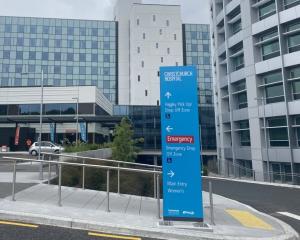
South Canterbury, Otago and Southland could be run as one district, with the mid and upper half of the South Island, and the West Coast, as the other centred on Christchurch.
A public health system which of necessity has to impose the rationing of its services must at least attempt to be as efficient as its private competitors which are restrained, in effect, only by the depth of their users' pockets.
The relationship between health spending and productivity needs to be very carefully examined, because the long-term forecasts for health spending in the public sector are gloomy indeed: one study predicts the spending needed to cope with the needs of an ageing population will be double the rate of growth in the economy, even allowing for inflation.
None of this will be any comfort to the 300 people on the waiting list for elective surgery who found themselves this month to be no longer on that list.
After all, they did not put themselves on the list in the first place, and presumably their place there was medically justifiable according to the system.
Removing them from the list does not necessarily make them any less in need.