One shark says to the other, "Don't eat the hard bits on their backs - they make you fart."
The humour ticks many boxes.
It is delightfully backwards, with the sharks as connoisseurs and top predators instead of us, a minority group [the scuba fraternity] are victims, there is a touch of potty humour, and we are able to briefly laugh at our deep-seated fears - of sharks in particular, and being out of our depth in foreign environments in general.
Our fear of sharks subsumes many deeper fears - the unknown of ocean depths, bloody dismemberment, other larger carnivores, racks of razor-sharp teeth, loss of family and friends, and sudden horrible death.
These fears surfaced surprisingly at a recent council meeting, where the annual DCC spending of $38,000 on shark nets was questioned.
Some senior councillors in particular remembered the shocking St Clair shark attacks from the 1960s and were strongly opposed to any suggestion the shark net spending be stopped.
Cr Collins argued passionately, saying the shark bell at St Clair was not there for nothing, and Cr Brown said he had personally known of two local victims of shark attacks and there was no way he would ever vote against the spending on shark nets.
The sincerity and intense emotion of these pleas was obvious, and it carried the day for probably another year of provably useless shark net spending. Facts seem not to matter much in this council decision, as facts appear to have little to do with many council decisions.
Emotion tends to rule the roost generally, at least partly because factual information is scarce or skewed, but also because voter emotion plays a large part in which candidates get elected to council in the first place.
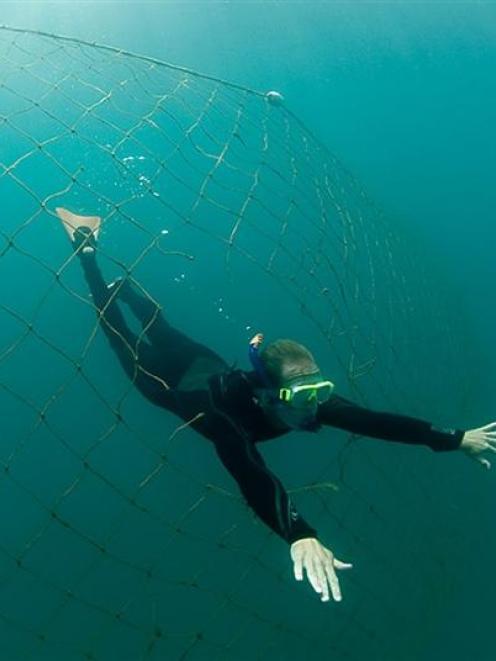
Not many people seem to realise our shark nets do not form a barrier to keep sharks away from the beach. There are just four of them buoyed in a broken line offshore covering less than 5% of the direct passage from open sea to shore.
St Clair-St Kilda beach is 3.5km long and averages 20m deep; the four nets total 800m long and 5m deep.
Cr Collins has argued there has not been a shark fatality in Dunedin since the nets were put in 35 years ago.
However, the DCC is the only local authority in New Zealand to maintain shark nets, and there has not been a shark fatality anywhere in the country for 35 years.
University of Otago marine science department Associate Prof Mike Barker said the nets "do nothing except provide swimmers with an illusion of safety". (ODT 1/1/2011). The nets only catch smallish shark species unlikely to cause human casualties, and these sharks get caught swimming away from the beach as often as swimming towards it.
Ocean Zoo director Craig Thorburn, of Auckland, said none of the sharks caught in Dunedin's nets over the past 35 years could be considered a danger to people. DCC staff have no record of a great white ever being caught in the nets.
Our $38,000 per annum shark nets make swimmers about as safe as using string for a seat belt.
There may be some psychological security in having nets, but this is certainly a false sense of security and may even have the unintended effect of making swimmers and surfers less careful about sea-sport safety.
The struggling, then rotting, carcasses of sharks and other sea creatures tangled in the nets may well have the effect of attracting sharks rather than repelling them.
Prof Barker says, "With or without the nets in place, a swimmer or surfer could be attacked tomorrow, [but] the chances of being killed in your car while driving to the beach, or drowning, or being struck by lightning are all higher."
Does this mean the DCC will be installing lightning rods overhead in the Octagon soon if someone there gets struck by lightning? Quite possibly.
As I see it, there is one fundamental fear not recognised about the shark net saga. It is the universal councillor fear of being booted out at the next election.
How will councillors feel if they vote out the shark nets, and then someone at St Clair gets attacked by a shark? Councillors may know the nets are totally useless, but does the public? This is a perceived political risk.
Despite all the factual evidence, and the irrational idea that a few little nets across a long beach can do anything but snag a white pointer's lunch, $38,000 of ratepayers' hard-earned dollars is wasted every year.
Plus interest of course, since the cupboard is bare, it will all be borrowed over decades; and the 20 years of extra loan interest will just be added to the already enormous export of Dunedin dollars by the DCC.
Cr Brown and others in our community will seemingly long bear the emotional scars of knowing the friends and family of those horrific Dunedin shark fatalities which clustered inexplicably over 35 years ago.
The need to be seen to be doing something, even if we know it is patently useless, is a reaction to life's difficulties. Hopefully, with greater public awareness and better water safety education generally, we can stop this waste of net costs and debating time on council, and sink this silliness once and for all.
Whatever the fears, and whether Jaws is real or not, our shark nets are a wanton waste and we should vote them out now.
- Lee Vandervis is a Dunedin city councillor.