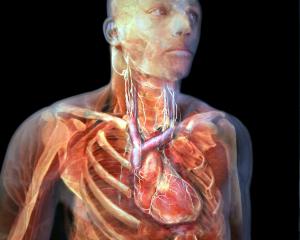
Ian Harris reflects on the mystery of both our individual significance and insignificance.
IF you were ever able to stand on another planet and reflect on your life from that perspective, you could hardly escape two quite contradictory conclusions. One would be a sobering realisation of your total insignificance in the universe. The other, how amazing it is that you are here at all - and therefore how unimaginably significant you are.
That's because each of us is the highly improbable result of 3.5 billion years of evolving life on Earth, and 200,000 years of the existence of homo sapiens.
Behind you lie aeons of the human struggle to survive - by hunting and gathering, migration and settlement, the endless flow of people across continents.
Our ancestors survived hunger, danger, disease, and disaster to bear offspring. Who they mated with through thousands of generations depended on who was around at the time, the social structure they were part of, and whom they encountered in forays into the surrounding regions to hunt, barter or wage war.
Latterly, many crossed oceans to settle in places such as faraway New Zealand, and married others who had done the same. That's how most of us come to be here today. Chance, chance and chance.
But that's not the half of it. In the normal pattern your mother, who was born with her whole life's quota of 300 to 400 ova already present in her body, released one egg each month from her early teens till menopause, probably in her 40s.
It took only one spermatozoon from your father to fertilise one of those eggs - but he was capable of releasing 100 million or more spermatozoa in every millilitre of fluid. Of that total at least 75 million would still have been alive, with 25 million vigorous enough to have a good chance of fertilising the egg.
The process has been likened to "a marathon run in a maze filled with mucus followed by an obstacle course" (the extra spurt required to penetrate the ovum wall). Be that as it may, any one of the spare 24,999,999 sperm could have produced someone who was not you.
One spermatozoon did make the breakthrough, however, and you are here because of it. In all likelihood, there would have been similar sperm tsunamis in previous months that led nowhere. Mood, stress, timing, drugs, diet could all have made a difference. Chance - and mystery, the mystery that is you.
So it is not inevitable that you exist. It is rather one of those everyday miracles built into the working of the natural world.
You owe your being to a biological flick in time. It could so easily have turned out otherwise.
Still there is more. As a child growing up, you owe your language, diet, schooling, religious attitudes and social opportunities to the happenstance of family, geography, culture and the era you were born. Change any one of those, and you would not be the person you are today.
Chance again, and mystery.
Now place those personal particularities within the grander sweep of space and time. Then you might register that for 13.7 billion years after the Big Bang you were not, and for 4.6 billion years of Earth's existence you were not, and for 3.5 billion years of life on Earth you were not, and for 2.5 million years of hominid development you were not, and for 200,000 years during which homo sapiens emerged you were not.
But today, for the briefest flicker of time in the story of the universe, you are.
As a secular Christian, I find genuine mystery in all this, along with awe, wonder, and awareness of the responsibility that comes with the gift of life and consciousness. A person suffering from an incurable disease might wonder: Why me?
Anyone who calculates the odds of existing at all might ask the same question: Why me?
Here is mystery anchored in the midst of ordinary life. It assumes no supernatural reality, yet reflecting on it opens a window on to the vastness, the unity and the interconnectedness of all that has been, is, and will be.
Many people, religious and irreligious alike, have experiences of heightened awareness and sensitivity they might describe as mystery.
Such moments bring a sense of enhanced being, a welling-up of peace, trust, hope, gratitude, love, and affirmation of life.
Yet this quickening of the imagination occurs within the framework of our very secular human minds and bodies.
These have always been the crucible of mystery, and always will be.
Next time: What about fate and destiny?