A secular Christian faith interprets Jesus as a man whose life makes total sense within this world of space and time, writes Ian Harris.
There's a view of God that holds that if something happens, it must be because God wills it. Another, that God knows what will happen, but it's over to us to make our own decisions - we're not robots. Another, that this sort of God-talk is redundant in the 21st century, because it hinges on supernatural speculation that for many westerners has outlived its usefulness.
This withering away of a sense of the supernatural brings loss as well as gain: loss of certainty beyond this life, loss of a strand of a religious heritage that has been central to western identity and culture, and along with that, loss of an unassailable moral authority through which the churches, at their best, saved society from some of its worst excesses.
But for those Christians who embrace the new world shaped by advances in knowledge and modern biblical exploration, there is also great gain. An example is the way new perspectives are opening up on mystery and transcendence. These have always been central to religious experience - and still are, but in a quite different way.
Some would argue that a supernatural reality is essential to both. That is understandable, given the pre-modern world-view within which the Christian tradition was fashioned. The secular world-view that now prevails in the western world, however, demands a radically new approach.
For dispensing with the supernatural does not rule out mystery. Now, though, it is not so much the mystery of the ultimately unknowable, but of human life itself.
Awe and wonder may be a better way of expressing that, if only because those who focus on mystery sometimes brandish it as if it were a supernatural trump card.
''Ah yes,'' they say when logical argument runs out, ''but beyond all that is elusive/ineffable/ungraspable/indescribable/inexpressible/intangible (take your pick) mystery.''
Mystery then becomes the unchallengeable hidey-hole in which the God of the gaps can repose for ever (the God of the gaps being the explanation for everything that cannot yet be explained by science or other knowledge).
So where does religion sit in relation to mystery today? Here, Christianity re-thought from a secular perspective has much to offer, stemming from the dual vantage point that it is both the most secular of the world's great faiths, and it is within the Christian West that secular culture has taken root.
There are good reasons for that, beginning with the church's most innovative doctrine: the other-worldly God of old became human flesh and blood in Jesus of Nazareth. God was ''earthed''. The human (and not just the human Jesus) became the locus of the divine. This insight is so astounding that it is only slowly being rediscovered, after lying dormant for 2000 years.
Sir Lloyd Geering points out that this revolutionary perspective proved too much for the early church, which took the opposite tack: instead of teasing out the implications of making God human, it poured its creativity into making Jesus divine.
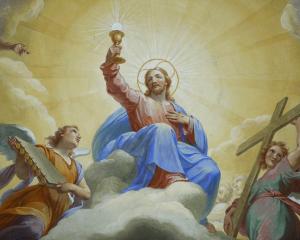
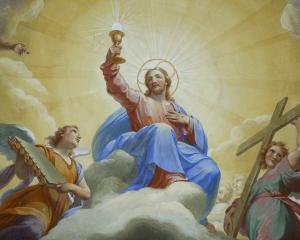
Drawing on the cosmology of the times, it imagined Jesus as having been sent by God from a heaven that was as real as Earth, to be born in Palestine; and after his death and resurrection it returned him bodily there. In heaven, say the church's 4th-century creeds, he reigns over creation as a full and equal partner with God the Father and the Holy Spirit, three aspects of the one Godhead.
It was inevitable that mystery gathered around Jesus in that heavenly world, and for hundreds of years theologians wove their interpretations around that understanding of God in his heaven with Christ at his right hand, and humans sweating it out on Earth.
A secular Christian faith, by contrast, grows naturally out of that doctrine of the Incarnation or enfleshment of God in human form. It does not locate a supernatural God in a faraway heaven, nor insist that Jesus is ''divine'' in the traditional sense. Instead, it interprets Jesus as a man whose life makes total sense within this world of space and time.
That affirmation of humanity as the locus of the divine does not mean abandoning any notion of mystery and transcendence. It simply reinterprets them so that they belong naturally within our secular experience of the amazing miracle of life.
Transcendence climbs across (that is what ''transcendent'' means) the confines of our everyday existence to give a glimpse - and an experience - of a quality of life that excites, transforms, enlarges, satisfies and renews. The divine becomes incarnate.
That is mystery. And that mystery is what Christmas is all about.
Ian Harris is a journalist and commentator.