High up on a tussock face a volunteer, Jack, is cutting Douglas fir and larch wildings.
''How did all these wilding trees get up here?'''
'It's the wind,'' Sid replies. Jack looks around him.
''But the nearest conifer trees are at least 4km down the road''.
''And that,'' says Sid, ''is the challenge of wilding trees.''
''Wilding'' is the term used for unintended regeneration of conifer species that seed and spread. Most people appreciate trees. I certainly do. A stately pine, a magnificent Douglas fir, the autumn colour of a larch tree; each one is a wonderful example of the wider conifer species.
Unfortunately, particularly downwind, these same conifers can release vast quantities of seeds which germinate and quickly grow, smothering our alpine lands.
There are helpful ways of understanding wilding control.
Planting the right trees in the right places is one way forward. Conifers, whether in forest blocks, smaller planted areas, or specimen trees, enhance our landscapes, offer shelter and can offer commercial value.
The choice of site and species is important. It is time now to think about Douglas fir, larch, Scots or Corsican pine trees and windbreaks on an exposed sites that are within a few kilometres of high country or on land that is not heavily stocked.
The pioneers and settlers planted conifers without realising how they would spread. Unfortunately, poorly sited conifer woodlots, windbreaks, have spread and will continue to take over vast tracts of high country unless they are halted.
In a perfect world, wilding conifers would not need to be felled, cut or sprayed but prevailing wind and strong wind events scatter the seed for kilometres. Pinus contorta has spread from the faces of Mid Dome in Southland. Young contorta tree weeds are now showing up in the alpine lands near Waikaia. The Mid Dome Trust is investing hundreds of thousands of dollars in an attempt to eradicate these tree weeds.
Near vulnerable alpine lands, some landowners are replacing their conifer shelter belts with non-seeding trees such eucalypts, thuya, poplars, abies - a Spanish fir - and Sequoia.
Understanding the potential seed spread from the various conifer species is helpful.
Pinus radiata, the large-limbed pine trees whose cones we love for lighting the fire, produce heavy seed which is only released on hot days and falls close to the parent tree.
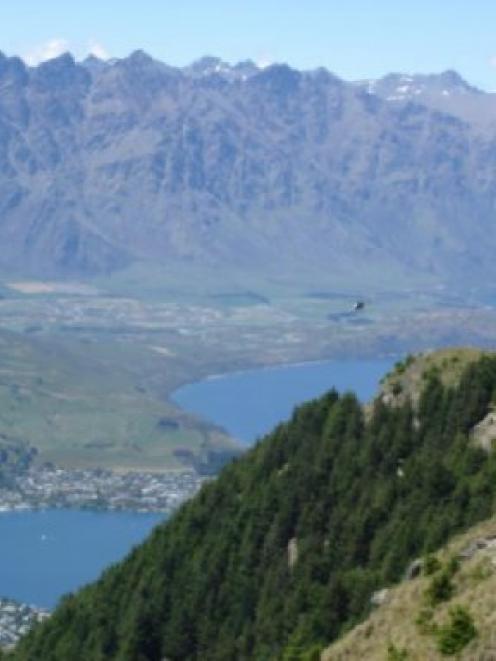
Douglas fir cones hang on the end of branch tips. They can be laden with cones which open in the autumn and release large quantities of light seed. This seed can be blown anywhere from metres to kilometres, depending on the wind event. In the Wakatipu area Douglas fir seeds are blowing up from lower land and establishing high on the craggy bluffs of the Remarkables.
Larch, green in spring and gold in autumn, makes delightful specimen trees in gardens, in parks and away from alpine lands. Larch seed is also light. Windblown, it germinates, grows rapidly and produces seeding cones.
Contorta pine seeds profusely and can be windblown (''distances of up to 40km are possible in very strong winds'', Ledgard NJ, 2001), although most seeds drop and germinate within shorter distances. The time between seed germination and the new tree coning and spreading varies with each species.
The time factor between seed germination and a conifer coning affects the wilding threat. Radiata pine takes about 15 years to cone and is a low threat, whereas Douglas fir not only seeds and germinates profusely but it can also, with good conditions start coning in under 10 years.
Douglas fir is a major problem in the Wakatipu area. Contorta pines begin producing seeding cones within six years and must be removed by landowners under the ORC pest management legislation. Eradicating and controlling wildings before they take over much of Otago's high country requires understanding the dynamics of the species and their potential invasion.
A few old pines will spread very slowly and are very low risk. Removing high-risk seeding trees as soon as possible is a top priority. Leave profuse seeding Douglas firs on or near vulnerable land and the cost of containment escalates out of control. Cutting and spraying conifers is costly and not always popular.
Leave the trees now and they will spread rapidly up to 1100m and over into the next valleys. Nationwide management strategies on wildings adopt the mantra of ''a stitch in time saves nine''. An area of wildings might cost $100,000 this year to control; if left for five years $500,0000 will be required.
Rational, though not always popular, decisions can be made if weed tree control is understood. If left or ignored, the cost of leaving coning wildings will become too great. A contract gang of six men costs $1800 per day plus helicopter transport. On heavily infested rough high country, the area cleared each day is small. At more than $2000 per hour, spraying dense wilding areas by helicopter is more cost effective and regrowth is minimal.
No method is cheap. Trusts, councils and landowners will not continue to pour finance into going over the same alpine lands controlling these weeds while seed from wilding blocks, such as at Roaring Meg, blows down Kawarau Gorge and up on to the skyline.
Rational, well-communicated decisions will be to remove seeding conifers where possible, to plant and appreciate good specimen trees that enhance our landscapes. Thoughtfully chosen ''right trees in the right places'' offers the way forward.
Peter Willsman is chairman of the Wakatipu Wilding Conifer Control Group.