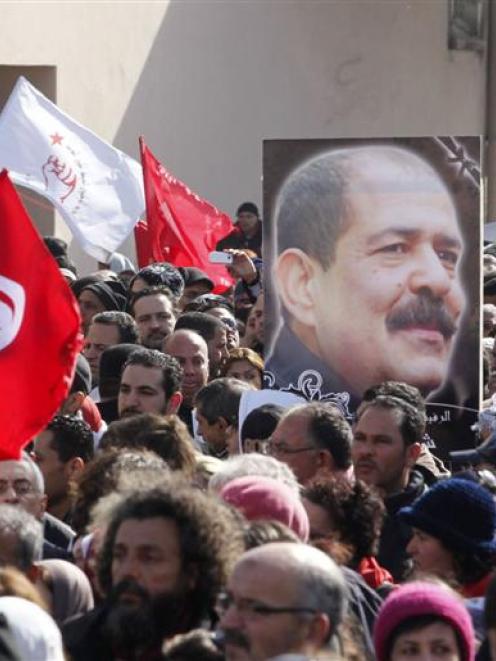
The Tunisian human rights lawyer and political leader was assassinated outside his home as he left for work last Wednesday, and the country immediately erupted in violent anti-Government demonstrations. His wife, Basma, said she would file murder charges against the ruling Ennahda party and its leader, and the mobs in the street chanted the mantra of the Arab revolutions, ''The people want the fall of the regime''.
But the regime in question is the democratically elected government of a country that has already had its revolution. Tunisia was the birthplace of the ''Arab Spring''. It held its first free election on October 2011, to elect an assembly to write the new constitution. The winner, as in a number of other Arab countries, was a moderate Islamic party.
The Ennahda-led transitional Government has made some mistakes, as you would expect of inexperienced politicians, but it has shown no desire to subvert democracy. Indeed, the Islamic party formed a coalition with two secular centre-left parties after the election, and in the weeks before Mr Belaid's murder it was deep in talks to broaden the coalition and bring other secular parties in.
Those other parties have now walked out of the talks, demanding the cancellation of the results of the 2011 election. That certainly does not serve Ennahda's interests, and the violent protests in the streets are even more of a problem, since they might trigger a military intervention to ''restore order'' (the Tunisian army is strongly pro-secularist). In terms of motive, Ennahda has none. So who would actually benefit from killing Chokri Belaid?
One suspect is the Salafists, religious extremists who despise the Ennahda party but absolutely hate militant secularists like Mr Belaid. Many in the secular camp criticise Ennahda's founder and leader, Rachid Ghannouchi, for failing to ''crack down'' when Salafist fanatics attack peaceful political gatherings, and he must bear some blame here.
But that's still a long way from plotting a murder. Mr Ghannouchi, like the leaders of other moderate Islamic parties across the Arab world, is reluctant to treat the Salafists as enemies (even though they are), because they both compete for the votes of pious Muslims. But he also argues, quite reasonably, that mass arrests and torture of Salafists in the style of the old regime is immoral and counterproductive. Just track down the ones who have committed specific crimes.
Did the Salafists commit this particular crime? Possibly. Killing a militant secularist would be emotionally satisfying to them. But they are not actually the leading suspect in Chokri Belaid's murder.
The prime suspect is the old ruling elite, people who served the former dictator and have been deprived of power and opportunities for graft since the revolution. They can only regain their privileges if democracy fails, so violence in the streets, extreme political polarisation, the discrediting of an elected government and a military takeover are precisely what they need.
The Constitutional Democratic Rally, the party whose members loyally served the dictator and were lavishly rewarded by him, was banned after the revolution, and some of its senior members are in jail or in exile. But there are still plenty of others around, and it would be astonishing if they were not plotting a comeback. The only viable route to that goal is to stimulate a civil war between the secular democrats and the Islamic democrats.
If this is where the logic takes us, why are some of the secular parties taking to the streets? In some cases, no doubt, grief and rage have led them astray. In other cases, however, there is probably the cynical calculation that this is the most effective way to hurt the Islamic party, even if it had nothing to do with the murder.
Ennahda's response has been less than coherent. Prime Minister Hamadi Jebali, shocked by the news of the murder, offered to replace the government with a cabinet of technocrats and call early elections, but the party's founder and leader, Rachid Ghannouchi, said that the Government should stay in place and track down the murderers.
Mr Jebali is sticking to his guns, and the outcome is far from clear. The whole thing is a mess, and Tunisians are justifiably concerned that their revolution has lost its way. But there is quite a good chance that they will be able to get the process of building a law-abiding democracy back on track without a major disaster, and it's certainly far too soon to say that their revolution was a mistake.
- Gwynne Dyer is an independent London journalist.