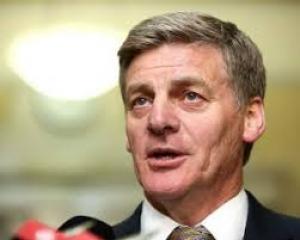
Bill English has set the Budget date nice and early - as John Key did the election date in 2011 and is likely to do in 2014. Now, are Mr English and Mr Key - and Steven Joyce, who is to make a science speech on Thursday - up to the fiscal science challenge?
That science challenge - not to be confused with the prime minister's science challenge for scientists themselves - is to match richer small-countries' commitment. Governments here for two decades, including Mr Key's, have not committed to science the public resources better-performing small countries do. Contrast the European Union's increase in its science budget this month while cutting its overall budget.
Mr Joyce, who as boss of his new super-ministry is the minister in charge of science and other innovation, would protest that in the 2012 Budget the Government did lift investment in science and innovation and project a continuing lift over the next four years.
But even at the end of that trajectory - and note that Mr Key is talking up innovation as the key to enrichment - Mr Joyce would be investing below 0.6% of GDP, that is, below the OECD average and far below that of smart, rich, small countries with which Mr Key's chief science adviser, Sir Peter Gluckman, has been building a relationship. That investment underpins the success of Nordic countries, billed by The Economist this month as ''the next supermodel''.
Sir Peter brought together Denmark, Finland, Ireland, Israel and Singapore in Auckland in November in a discussion which linked science and innovation with economic analysis by David Skilling, once of the Treasury and now in Singapore, who argues that small countries, being flexible, can, if they act strategically, navigate global ups and downs better than big countries with lumbering political systems.
Sir Peter, like the legendary Sir Paul Callaghan a notable innovator in his own right, is now teasing out with those countries a programme of joint projects.
There is a parallel with United Nations ambassador Jim McLay's pitch for a Security Council seat in 2015-16: that small countries have different priorities from big muscly ones, not least in needing good global governance. Mr McLay argues that small New Zealand contributes disproportionately to peace-building and other co-operative activities, has an independent foreign policy which gives it good credentials as a broker and conciliator and thus can be an accurate and energetic representative for small countries.
Another way of putting the McLay line is that New Zealand is a small, smart country. That is what Sir Peter wants us to want to be - more than our fiscal commitment shows.
Mr Joyce would protest, with reason, that his Callaghan Innovation Crown entity, with a tight focus on working with businesses to solve technical challenges and help them innovate, will do that by making more effective use of some of our scientists.
Actually, Industrial Research Ltd, out of which the new institute was created, was increasingly doing what the institute is to do. Callaghan Innovation looks less an innovation and more a managerial reshuffle.
There is also a risk, which will need careful management, that too tight a focus on technical assistance to firms will distract scientists from doing the science that generates unexpected commercial innovations, as Sir Paul's science did - and that scientists decamp to another country (one of Sir Peter's other five?) to do that work.
The more scientists who do that - after an expensive education at taxpayers' expense here - the less will they be able to meet another Gluckman ambition.
Mr Joyce's speech on Thursday is to a two-day conference of science communicators, which will focus on natural disasters science's role in warning the public and public agencies of risks and explaining events. Sir Peter's on the same day is to the Institute of Public Administration on ''communicating and using evidence in policy formation''.
Sir Peter will develop a theme that has been a hallmark of his chief science adviser's role: that good policy requires good advice, which requires the best use of the best evidence - and that science has a big role to play.
Most policy reflects politicians' instincts, prejudices, values or pragmatism and the inevitable trade-offs politics and electoral success require. It is informed by advice from public servants who do usually trawl through evidence, including scientific evidence, but often, Sir Peter says, the science is misunderstood, misused or misapplied. Politicians, interest groups and the media also often cherry pick or otherwise employ science to support a case or, as in climate change, declare the science ''confused'' as an excuse for inaction.
A report is due soon on a survey which found wide variations in government agencies' use or misuse of scientific evidence. Sir Peter says protocols are needed, including peer review of expert advice.
That is quite a science challenge for Mr Key and Mr Joyce - perhaps as big as their and Mr English's fiscal one.
- Colin James is a leading social and political commentator.