
PHOTO
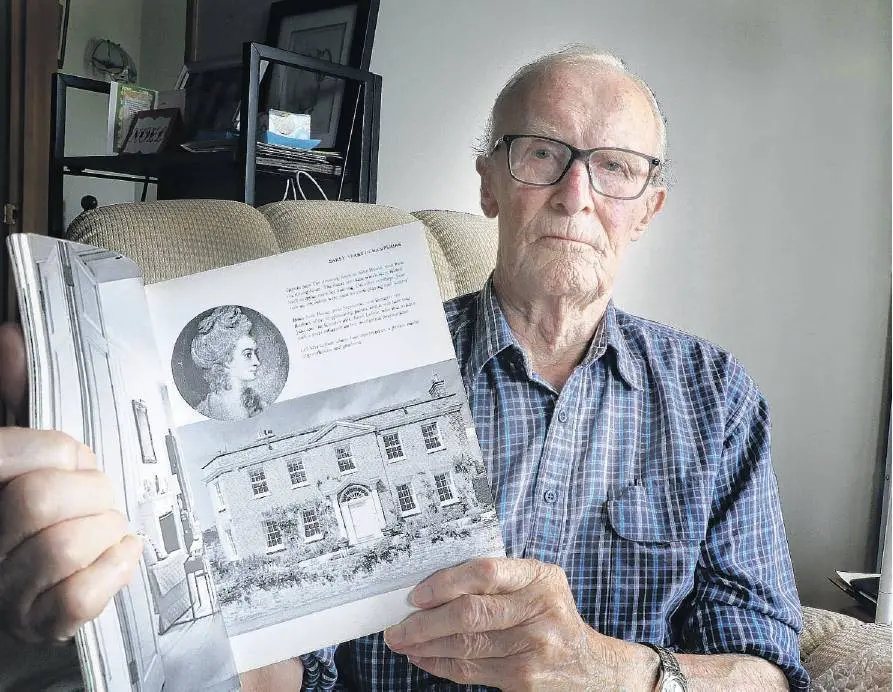
John Stopford is not letting age slow him down. Even though the Amberley Rest Home resident turned 100 on Saturday.
He still drives and is still active in the Amberley Lions Club, the Amberley RSA and Amberley Community Care.
For a man born into a service-oriented family, he ranks helping others highly amid his many other life achievements.
John was born in London in 1926 to Frederick Victor Stopford (a career Royal Navy Lieutenant who later became a Rear-Admiral) and his wife Mary (Molly).
Frederick Stopford’s father was Rear-Admiral Walter George Stopford RN, the fourth son of James Thomas Stopford, 4th Earl of Courtown.
At just one, John and his mother, Molly, embarked on a series of sea voyages on Banana Boats to travel halfway around the world to meet up with his father, who had been appointed to the Royal Navy’s Far East Station in China.
In 1933, he embarked on another adventure when his family moved to Berlin.
His father was an assistant military attaché at the British Embassy, reporting on the rise of the Nazi military machine.
‘‘I was only seven then, so all the politics didn’t mean much to me. I was more interested in visiting Berlin’s Tiergarten Park and the Zoo, which were fabulous.
‘‘I do recall all the flags and the pageantry of the Nazi marches in the streets, and my father often mentioning the rise in militarisation and persecution of Jews there. In fact, he was so worried about our safety, my mum, brothers and I were sent back to England in 1934.’’
Back in England, the family moved into Ashe House in Hampshire, where John occupied the same room that Jane Austin used as her writing room to pen the classic novel Pride and Prejudice.
‘‘From there I went to boarding school, which was another great adventure as I learnt many life skills which I still use today.”
He loved to keep fit, born from gymnastics sessions for the whole school on the playing fields during summer, and a passion for football.
As war loomed in 1939, John moved to the Stowe Public School, where he later joined the Home Guard at age 15.
John was proud to don a uniform and be like his father, grandfather and great uncle, who had been a Major General in the British Army.
‘‘It’s what our family did – we serve, and when I reached 17, I joined the Royal Navy.’’
Initially sent to one of the Butland's Holiday Camps requisitioned for the war as a recruit depot, he went on to train as a special combined operations boat commander, until his commissioning course was cancelled and he was sent back to recruit school as an ordinary seaman.
‘‘The lords in the admiralty did me a favour. They decreed there were too many officers, so they sent us all back to rejoin our recruit course, but later at D-Day, many of the small combined ops boats were destroyed and their crews killed, so I survived.”
He says a family friend helped him transfer from the Navy to the Army, where he joined a reconnaissance armoured car unit late in 1944.
‘‘I loved the training, and I was commissioned as a second Lieutenant with the 7th Royal Tank Regiment.’’
In 1946, his regiment went to India to help in the country’s partition.
‘‘It wasn’t a nice time to be there with all the death and destruction.’’
Back in the United Kingdom in 1947, he worked on projects which included using jet take-off assistance packs normally used by planes in the RAF, to see if they could get suck tanks out of the mud.
‘‘It was a lot of scary fun with everyone getting very wet and muddy.’’
Because John held a conflict-only commission, he was demobilised from the army later and travelled to Canada to see his relations on his mother’s side.
‘‘I looked around and did lots of odd jobs until one day in Vancouver in 1953, I saw a sign for army recruiting.
‘‘I went in and asked if they would be interested in me because of my knowledge of the Centurion Tanks.
‘‘The Canadian Army was soon to receive them as its new main battle tank. ‘‘I had worked on them in the British Army.’’
He quickly found himself recommissioned and working with an armoured unit in Calgary.
Ten years later, his unit, the Fort Garry Horse, was all packed and ready to leave for their tour of duty with NATO forces in Germany, when on the eve of their departure in October 1962, the Cuban Missile Crisis happened.
‘‘We were all packed up, and families set to travel when it all kicked off, so we were held back for a month while it played out.
‘‘I loved training in Europe with NATO. I have so many fond memories of training with all the different armies based there in Germany.’’
Retiring from the Lord Stratcona’s Horse, one of the top Canadian Army Armoured units as a captain in the early 1970s, John and his late wife Barbara and their family of three children emigrated to Amberley in New Zealand.
‘‘We came in 1971 to look around, loved it and settled near friends in Amberley.’’
John worked initially at a charcoal business before joining the Hurunui County Council in 1976.
Ten years later, he and a friend started Amberley Community Care, driving aged people to medical appointments in Christchurch.
He is still involved today.
John is known for his community work with many organisations and has received much praise over the years for his work with Lions and others.
On Monday, March 9, John and his family had a small private gathering to celebrate his birthday.
‘‘I was on the phone with my younger brother in England the other day, and he wished me well. It’s good to know I still have family alive today.’’